

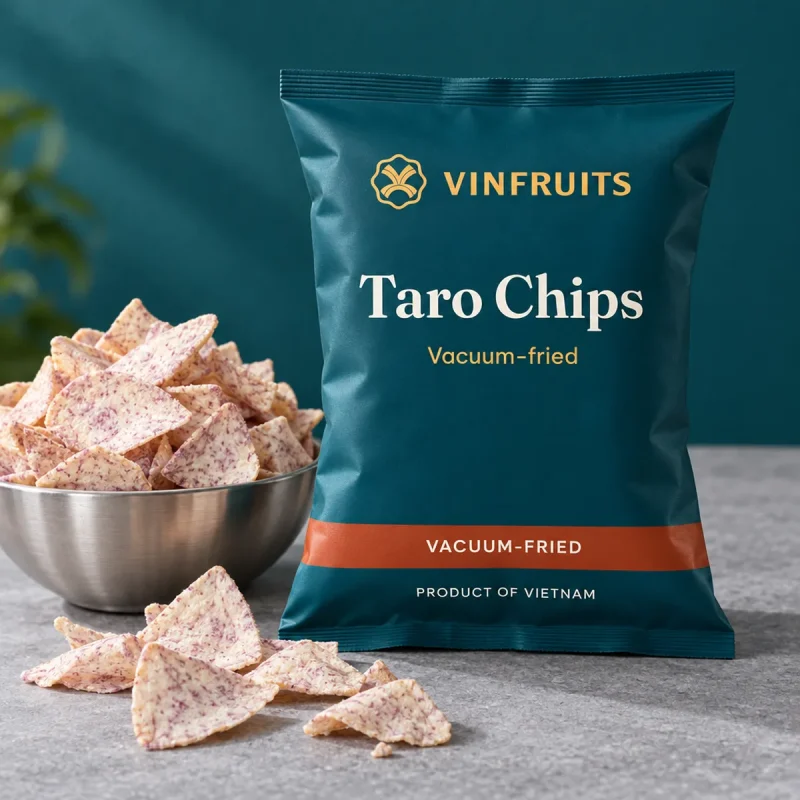
Vacuum-fried taro chips
Sliced taro fried under vacuum, de-oiled and nitrogen-packed, with fat, oil quality and acrylamide reported per lot.
- Format
- Slices, thickness per specification
- Shelf life
- 12 months ambient
- HS code
- 2008.99 (EU CN 2008 99 91)
- Trial
- LCL from 500 kg per flavour
Request taro chip pricing
Send volume and destination. We reply with the spec sheet and sample plan.
Request sent.
We'll reply from [email protected]. To speed things up, add specs on the full request form.
Product details
Everything your QC and R&D teams check before a sample.
Fresh taro, peeled and sliced, fried under vacuum, spun to remove surface oil and packed in nitrogen-flushed foil bags for 12 months ambient.
Taro chips sell on a dense, nutty crunch, but the oil decides most of your cost and shelf life. Vacuum frying lowers the frying temperature; it does not remove the oil, so we sell on measured fat and named oil.
Fat, peroxide value, acid value and acrylamide are on every lot COA, with the concentration factor for cadmium. VinFruits Global sources, specifies and exports; partner facility certificates come with the quotation.
Used in
- Retail snack bags and private label
- Trail mixes and snack blends
- Toppings for bowls, salads and desserts
| Parameter | Indicative value · basis | Why it matters |
|---|---|---|
| Product form | Vacuum-fried slices, thickness per specificationCalliper check on a sample | Thickness sets crunch and breakage. |
| Ingredients | Taro, vegetable oil (type stated in the specification), optional saltRecipe in the specification | EU retail labels must name the oil source. |
| Fat content | Measured per lotLaboratory result on the COA | Oil is a large share of the chip; plan labels on real data. |
| Peroxide and acid value | Reported on the COA at shipmentLaboratory method on the COA | Early signs of rancid oil before shelf life ends. |
| Moisture | ≤ 5%, typical buyer specificationOven moisture per lot | Above this, chips go soft in the bag. |
| Acrylamide | Reported per lot by LC-MS/MSLaboratory result on the COA | Buyers set their own limit for root chips. |
| Cadmium | Reported with the concentration factorReg (EU) 2023/915, Article 3 | Limits are set on fresh taro; chips lose most water. |
| Packing and shelf life | Nitrogen-flushed foil bags; 12 months ambientPartner's shelf-life test | Oxygen and light drive rancidity. |
| HS code | 2008.99 (EU CN 2008 99 91)CBP ruling N360422; CN line text | Starchy tubers, otherwise prepared; 2008.19 is wrong. |
Indicative values. The binding spec is the signed contract, with its test method, sampling point and settlement basis. Last reviewed 18 Oct 2026.
Taro chips come plain or salted. The choice changes your ingredient line, so tell us which one your product needs.
Plain
- Ingredients
- Taro, vegetable oil
- Taste
- Nutty, natural taro
- Best for
- Mixes where your recipe sets the salt
Salted
- Ingredients
- Taro, vegetable oil, salt
- Taste
- Seasoned, ready to eat
- Best for
- Stand-alone snack bags
- 1Peeling and slicing
Fresh taro peeled and sliced to the agreed thickness.
- 2Blanching and freezing
A common step before frying, to set texture.
- 3Vacuum frying and centrifuging
Fried under vacuum, then spun to remove surface oil.
- 4Sorting and nitrogen packing
Metal detection, then nitrogen-flushed foil bags.
Under vacuum, water boils at a lower temperature, so frying typically runs at about 90 to 120 °C instead of 160 to 190 °C for open frying. It lowers the heat, not the oil.
- Packing
- Nitrogen-flushed foil bags in 10 kg bulk cartons, or retail packs to your artwork.
- Storage
- Cool and dry, at or below 25 °C.
- Shelf life
- 12 months ambient, to be backed by the partner's shelf-life test.
- Typical lot
- One container; LCL from 500 kg per flavour.
- Terms
- FOB, CFR or CIF.
In your warehouse
- Keep bags sealed, cool and out of sun.
- Reseal opened bags; chips take up moisture fast.
- Rotate stock first in, first out.
With each lot
- Commercial invoice and packing list
- Lot COA: moisture, fat, peroxide and acid value, acrylamide, microbiology
- Certificate of origin
- Bill of lading
- Partner facility's registration details and certificates, shared with the quotation
What we will not offer
- Low-oil or low-fat claims on fried taro chips
- A label that says vegetable oil without naming it
- HS 2008.19 on the invoice
- A 12-month shelf life not backed by the partner's shelf-life test
Market access
EU and UK
Acrylamide rules in Reg (EU) 2017/2158 apply to potato products only, so taro chips carry no legal benchmark. Recommendation (EU) 2019/1888 still lists vegetable crisps for monitoring, which is why we report acrylamide per lot.
Japan and China
Japan applies combined acid and peroxide value limits to oil-containing confectionery; your importer confirms whether chips are covered. China: the producing plant needs GACC registration under Decree 280.
United States
The producing facility needs an FDA food facility registration. A low-moisture chip needs no scheduled-process filing.
Checked 18 Oct 2026. We reconfirm for each contract.
Before you order
What is the minimum order for taro chips?
One container, or LCL from 500 kg per flavour. A sample pack comes first so you can check crunch, colour and breakage before you commit to bulk or retail packs.
How much oil is in vacuum-fried taro chips?
It varies with frying time, temperature and centrifuging, so we report measured fat per lot on the COA instead of a promise. Retail vacuum-fried chips show roughly 19 to 44% fat, which is why we never call them low oil.
What is the correct HS code for taro chips?
2008.99, with EU line 2008 99 91 for starchy tubers with 5% or more starch and no added sugar. A 2026 US binding ruling on fried taro chips confirms heading 20.08. The old 2008.19 is the nuts and seeds subheading.
How do I get a price and a sample of taro chips?
Send the pack format, plain or salted, oil preference, volume and destination. We reply with a quotation and data sheet and send a sample pack for your own tasting and lab checks.
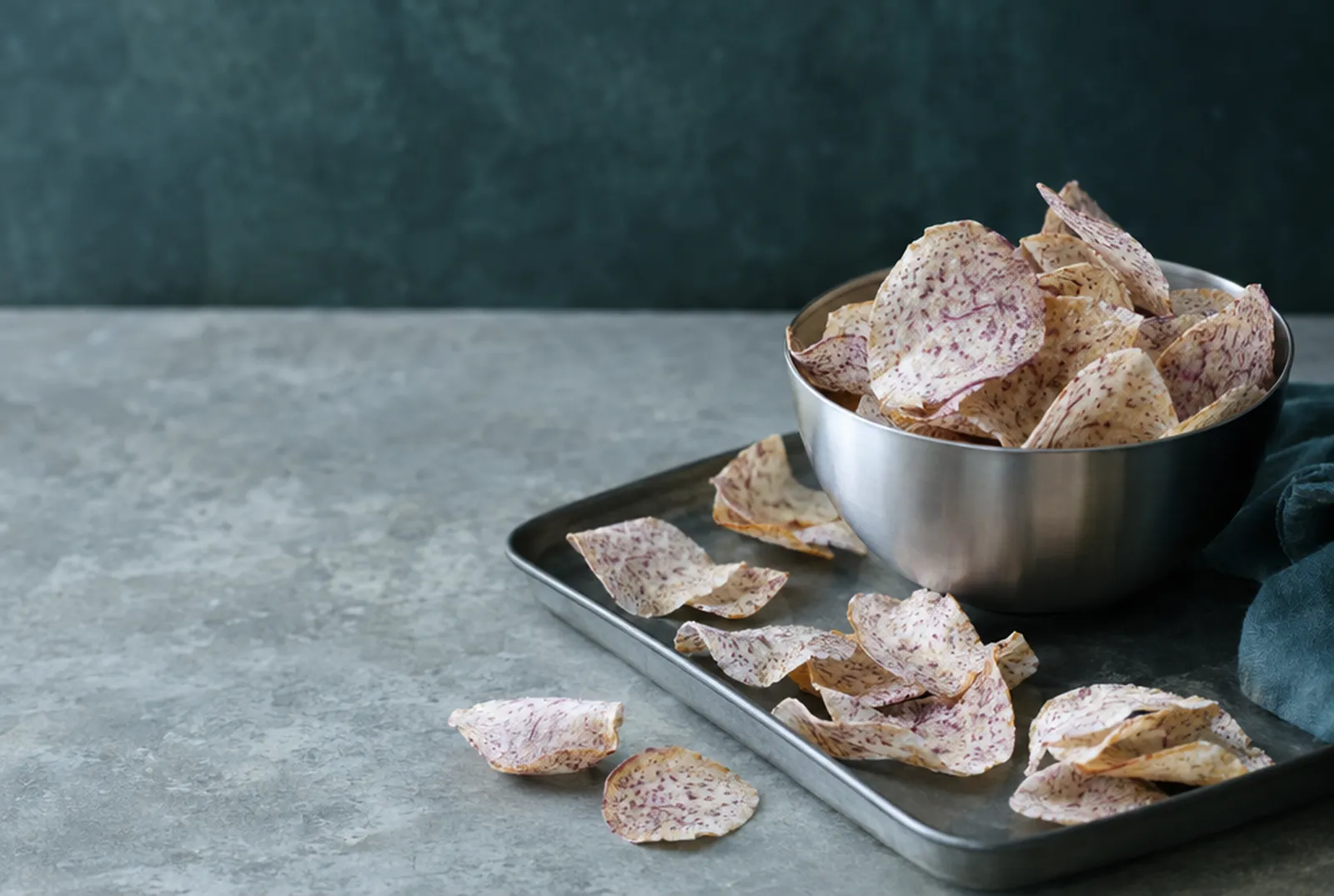
Ready for a sample?
Tell us the pack, oil preference and destination.
Request a quote
Tell us what you need. We reply by email with a spec sheet and the next step.
Request sent.
We'll reply from [email protected]. To speed things up, add specs on the full request form.