

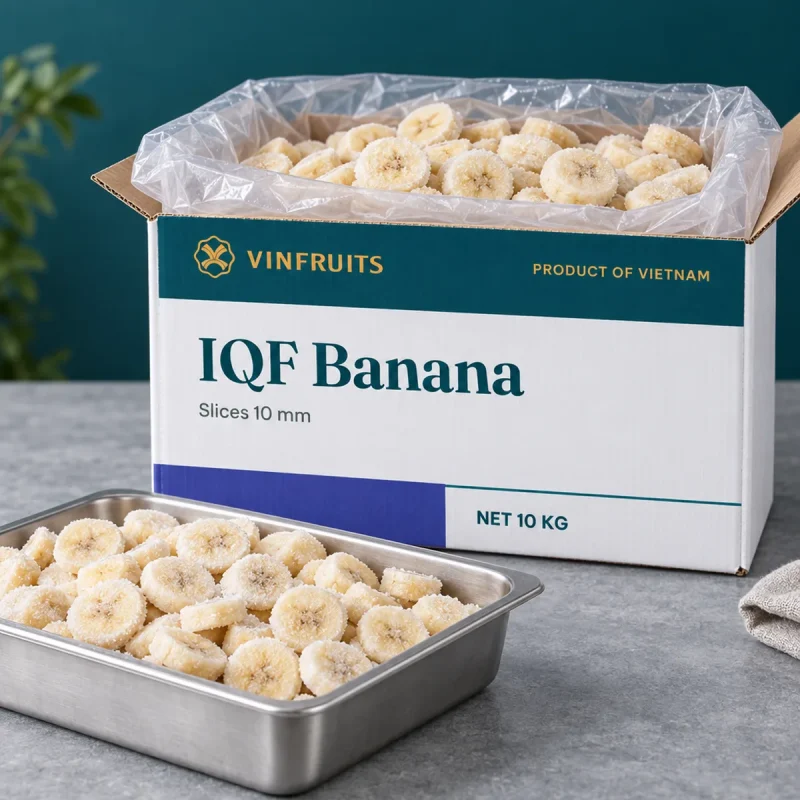
IQF banana slices, 10 mm
Ripe banana sliced to one thickness, dipped against browning and frozen piece by piece, for smoothie, bakery and dairy lines.
- Format
- Slices 10 mm, ±2 mm
- Shelf life
- 24 months at −18 °C
- Typical lot
- One 40-ft reefer, about 20 MT
- Trial
- LCL from 3 MT
Request IQF banana slice pricing
Send volume and destination. We reply with the spec sheet and sample plan.
Request sent.
We'll reply from [email protected]. To speed things up, add specs on the full request form.
Product details
Everything your QC and R&D teams check before a sample.
Vietnamese banana, ripened, peeled, sliced and frozen piece by piece at FSSC 22000- and HACCP-certified partner plants, then held at −18 °C for up to 24 months.
Banana browns within minutes of cutting and ripens unevenly, so slicing fresh fruit in your plant gives uneven colour. Slices frozen straight after an anti-browning dip arrive at one thickness and one ripeness.
Each lot is one ripeness stage, and the anti-browning agent is named on the data sheet. VinFruits Global sources, specifies and exports; the partner plant's registration and certificates come with the quotation.
Used in
- Smoothies
- Smoothie bowls
- Banana bread & muffins
- Ice cream & nice-cream bases
- Frozen yoghurt
- Cereal & bubble tea toppings
| Parameter | Indicative value · basis | Why it matters |
|---|---|---|
| Cut | Slices 10 mm, tolerance ±2 mmCalliper check on sample | Even thickness means even thawing and dosing. |
| Soluble solids | Min 18 °BxRefractometer, thawed sample | Separates ripe banana flavour from starchy, under-ripe fruit. |
| Anti-browning | Ascorbic or citric acid dip before freezing, declaredData sheet and label | Cut faces stay pale; the additive goes on your ingredient list. |
| Peel fragments | Limit agreed in the specificationVisual check, count per kg | The most common defect in IQF banana, left by hand peeling. |
| Chlorate | Within the EU limit of 0.3 mg/kgLot laboratory report | Chlorinated wash water can leave chlorate on cut fruit. |
| Microbiology | Salmonella not detected in 25 g; plate count and coliforms per destinationLot laboratory report | Smoothies and nice-cream have no kill step. |
| Freezing | Individually quick-frozen, core −18 °C or colderPlant freezing log | Free-flowing slices let you dose without thawing a block. |
| Packing | 10 kg carton, double food-grade PE linerBulk totes on request | Carton size decides how much you open per batch. |
| HS code | 0811.90 (frozen fruit)Fresh banana is 0803.90 | The frozen code is the one your broker declares. |
Indicative values. The binding spec is the signed contract, with its test method, sampling point and settlement basis. Last reviewed 18 Oct 2026.
- 1Ripening
Fruit ripened to an even colour and checked for Brix.
- 2Peeling and slicing
Hand peeled, then sliced to 10 mm.
- 3Anti-browning and IQF
A short acid dip, then individual freezing.
- 4Sorting and reefer
Peel and clumps removed, metal detection, then a reefer at −18 °C.
Why ripening comes first: slices from one colour stage taste and brown the same, so your batch does not drift.
- Packing
- 10 kg carton, double food-grade PE liner. Bulk totes on request.
- Label
- Product, slice size, anti-browning agent, origin, plant registration code, production and expiry date.
- Cold chain
- −18 °C or colder from plant to your store, with the reefer temperature record.
- Typical lot
- One 40-ft reefer, about 20 MT.
- Trial order
- LCL from 3 MT, enough for factory trials and a shelf-life check.
- Terms
- FOB, CFR or CIF.
At your plant
- Keep at −18 °C or colder until the day of use.
- Dose frozen; thawed slices darken and soften fast.
- Do not refreeze thawed banana.
With each lot
- Commercial invoice and packing list
- Lot report: Brix, microbiology, chlorate, pesticide residues
- Health certificate
- Certificate of origin
- Bill of lading and reefer temperature record
- Data sheet naming every additive and processing aid
What we will not offer
- A price without slice size, pack, volume and destination
- Slices from mixed ripeness stages in one carton
- An anti-browning agent that is not declared on the label
- Glaze counted as banana
Market access
Japan
Frozen fruit eaten without heating must meet the Food Sanitation Act: total plate count up to 100,000/g and negative coliforms. These limits go into the specification and each lot is tested.
EU
Chlorate is capped at 0.3 mg/kg for banana, and ready-to-eat cut fruit must show Salmonella not detected in 25 g throughout shelf life.
China
Frozen fruit needs no fresh-fruit protocol since August 2024. The plant must hold a GACC registration under Decree 280, and the fruit is peeled, quick-frozen to a core of −18 °C or colder and held at −18 °C or colder.
Checked 18 Oct 2026. We reconfirm for each contract.
Before you order
What is the smallest order of frozen banana slices?
The trial size is LCL from 3 MT, enough for factory trials and a shelf-life check. A full order is a 40-foot reefer of around 20 MT, packed in 10 kg cartons.
Why is there an anti-browning step, and what goes on my label?
Cut banana turns brown in minutes, so slices are dipped in ascorbic or citric acid before freezing. Every additive and processing aid is listed on the data sheet so your ingredient statement stays correct.
Can frozen banana slices go to Japan?
Yes, if the lot meets Japan's rules for frozen food eaten without heating: plate count up to 100,000/g and negative coliforms. We agree these limits in the specification and test each lot against them.
How do I receive a quotation and sample slices?
Send slice size, carton or tote, monthly volume and destination through the quote form. We reply with the quotation naming the partner plant, the data sheet and a sample proposal.
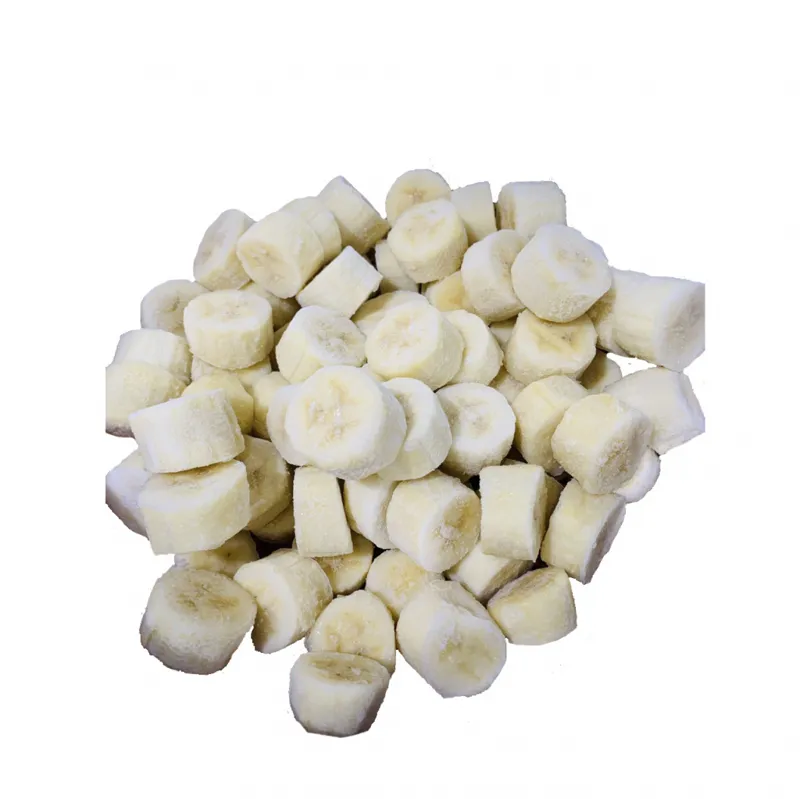
Ready for a sample?
Tell us the slice size, pack and destination.
Request a quote
Tell us what you need. We reply by email with a spec sheet and the next step.
Request sent.
We'll reply from [email protected]. To speed things up, add specs on the full request form.