

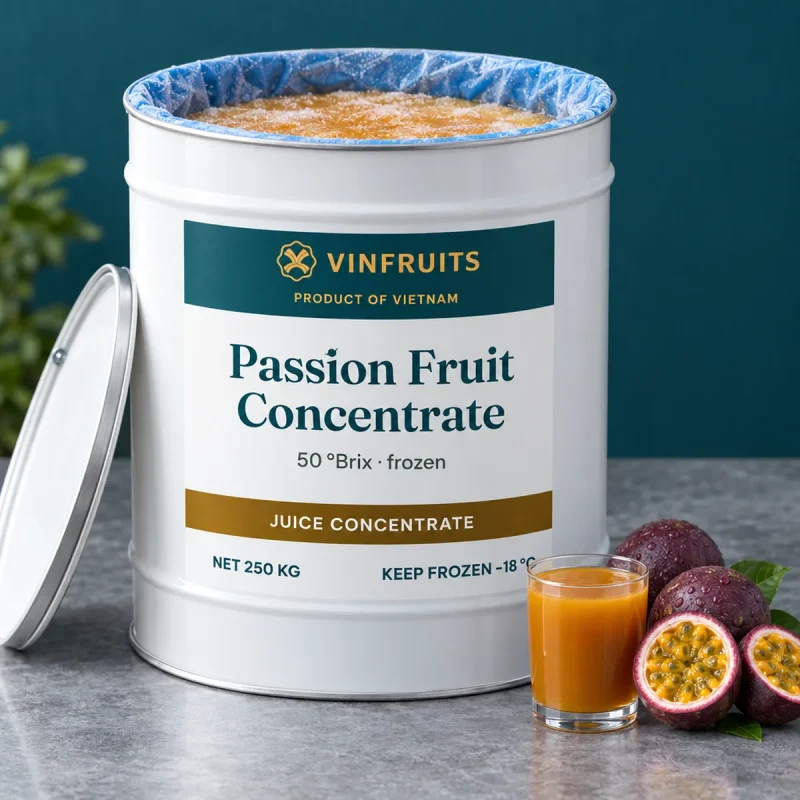
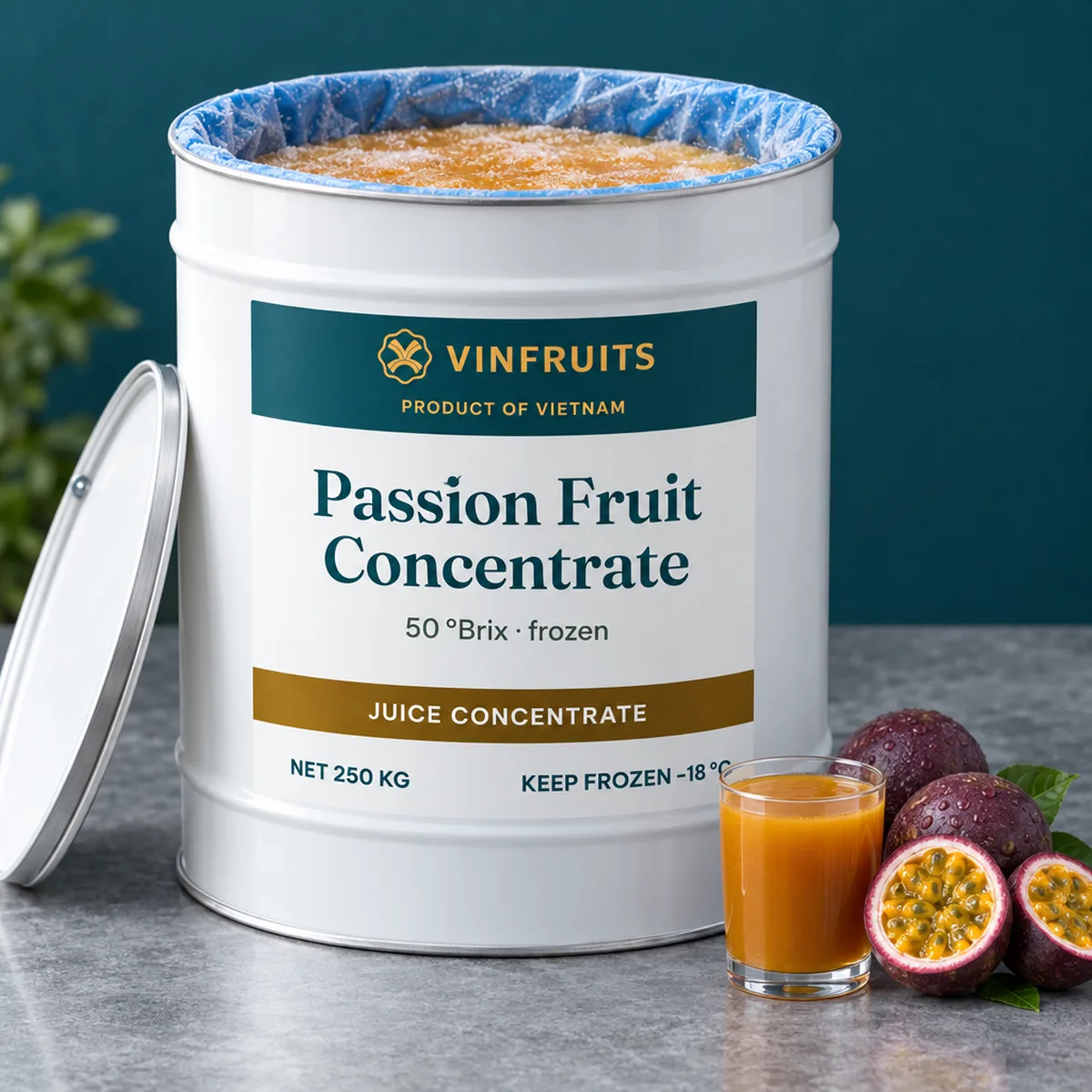
Passion fruit juice concentrate, 50 °Brix
Purple passion fruit juice concentrated to about 50 °Brix and frozen at −18 °C in PE-lined steel drums, for juice, dairy and ice cream makers.
- Brix
- 50 °Brix, per Vietnamese TDS
- Format
- Frozen, double PE bags in steel drum
- Shelf life
- 24 months at −18 °C, per TDS
- Typical lot
- One 20-ft or 40-ft reefer container
Request passion fruit concentrate pricing
Send volume and destination. We reply with the spec sheet and sample plan.
Request sent.
We'll reply from sales@vinfruits.com. To speed things up, add specs on the full request form.
Product details
Everything your QC and R&D teams check before a sample.
Juice from purple passion fruit, separated from seeds and shell, concentrated under vacuum to about 50 °Brix, then packed in double PE bags and frozen at −18 °C.
Single-strength passion fruit juice is strong, acid and seasonal. At 50 °Brix the concentrate holds the soluble solids of roughly four times its weight of juice, and its acidity carries the flavour through dilution in nectars and dairy.
Each lot is one Brix grade, frozen, with pulp declared (cloudy) or removed (clarified). Aseptic packs are possible by agreement, with partner capacity confirmed per order. VinFruits Global sources, specifies and exports; the partner plant's registration and certificates come with the quotation.
Used in
- Juices and nectars
- Yoghurt and fruit preps
- Ice cream and sorbet
- Syrups and jams
- Fillings and glazes
Availability
- J
- F
- M
- A
- M
- J
- J
- A
- S
- O
- N
- D
Peak harvest Concentrate ships all year
| Parameter | Indicative value · basis | Why it matters |
|---|---|---|
| Soluble solids | 50 °Brix (±1) on Vietnamese TDS; other grades by agreementRefractometer at 20 °C, acid-corrected where your standard asks | Sets dilution and what you pay per kg of solids. |
| Acidity | 10.0–16.0 % w/w as citric under TCVN 13941; 9–15 % on one TDSTitration to pH 8.1, on the COA | Passion fruit is bought for acid; it decides how far you dilute. |
| pH | 2.3–3.5 under TCVN 13941:2023pH meter | Low pH stops most bacteria, not acid-tolerant yeasts. |
| Pulp | Cloudy: 10–20 % on one Vietnamese TDS. Clarified on requestCentrifuge, % by volume | Pulp gives body in nectar and clouds a clear drink. |
| Reconstitution | 12.0 °Brix (EU, Codex) or 14.0 °Brix (US labelling)Directive 2001/112/EC Annex V; Codex CXS 247-2005; 21 CFR 101.30(h) | Your label law sets the Brix the diluted juice must reach. |
| Microbiology | Plate count, yeasts and moulds: limits agreed in the specificationLot laboratory report | Spoilage in concentrate usually comes from acid-tolerant yeasts. |
| Storage and shelf life | −18 °C or colder, minimum 24 monthsVietnamese producer TDS; reefer temperature record | Warm storage darkens colour and flattens aroma. |
| Packing | Double PE bags in steel drum, 250 kg net; 20 kg cartons or 18 kg pailsVietnamese producer TDS; pallet plan in the quotation | Drum size decides how much you open per batch. |
| HS code | 2009.89 (juice of any other single fruit)Common EU line for unsweetened concentrate: CN 2009 89 97 | Your broker declares the full national code. |
Indicative values. The binding spec is the signed contract, with its test method, sampling point and settlement basis. Last reviewed 19 Oct 2026.
Frozen is the standard format from Vietnamese plants and holds flavour longest. Aseptic only by agreement.
Frozen
- Pack
- Double food-grade PE bags in steel drum
- Storage
- −18 °C or colder
- Shelf life
- Minimum 24 months
- Best for
- Juice and dairy plants with frozen storage
Aseptic (by agreement)
- Pack
- Sterile aseptic bag in steel drum
- Storage
- Unopened, as the plant's TDS states
- Capacity
- Partner capacity confirmed per order
- Best for
- Plants without freezer space
- 1Intake
Ripe purple fruit sorted; wrinkled skin is accepted, mould and rot are removed.
- 2Extraction
Fruit cut open, juice and seeds separated from the shell, seeds screened out.
- 3Enzyme and evaporation
Pectin broken down, then water removed under vacuum to the agreed Brix.
- 4Fill and freeze
Heat-treated, filled into double PE bags in drums, frozen to −18 °C, then tested and released.
Why aroma matters: passion fruit aroma leaves with the water in the evaporator, so ask whether the plant recovers it and adds it back or sells it separately.
- Packing
- Double food-grade PE bags in a steel drum, 250 kg net on Vietnamese TDS; 20 kg cartons and 18 kg pails also listed.
- Label
- Product, Brix, lot, origin, plant registration code, exporter, production and expiry date.
- Cold chain
- Frozen drums at −18 °C or colder from plant to your store, with the reefer temperature record.
- Aseptic
- By agreement only; partner capacity confirmed per order.
- Typical lot
- One 20-ft or 40-ft reefer container. Drum count follows the pallet plan and is stated in the quotation.
- Trial order
- Trial drums by agreement after sample approval.
At your plant
- Keep frozen drums at −18 °C or colder until you thaw them.
- Thaw in a chill room and mix the drum before sampling.
- Once a bag is open, keep it chilled and use it promptly.
With each lot
- Commercial invoice and packing list
- Lot COA: Brix, acidity, pH, microbiology
- Certificate of origin (EUR.1 for the EU on request)
- Bill of lading and reefer temperature record
- Copies of the partner plant's certificates (HACCP, plus BRCGS, FSSC 22000 or SGF/IRMA where held)
What we will not offer
- A price before Brix, format, volume and destination are known
- Diluted or sweetened concentrate sold as 50 °Brix
- Cloudy and clarified grades mixed in one lot
- A preferential certificate of origin without proof the fruit is Vietnamese
Market access
EU and UK
Juice made from it must reach at least 12.0 °Brix and be sold as juice "from concentrate" under Directive 2001/112/EC. Many EU juice importers buy within the SGF/IRMA scheme, so ask which partner plants hold it.
United States
Concentrate is juice under 21 CFR 120, so the plant runs a juice HACCP plan and your importer verifies it. Label juice percentage is calculated against 14.0 °Brix.
China and Japan
China: the plant registers with GACC under Decree 280; juice is not among the 17 categories that need an official recommendation. Japan: your importer files an import notification under Food Sanitation Act Article 27.
Checked 19 Oct 2026. We reconfirm for each contract.
Passion fruit in other formats
Before you order
What volume do I need for a first passion fruit concentrate order?
Most buyers start with trial drums of one grade once the sample works in their recipe. Regular orders move in a 20-ft or 40-ft reefer container; the drum count follows the pallet plan and is stated in the quotation.
Frozen or aseptic: which format should I choose?
Frozen drums at −18 °C are the standard Vietnamese format, hold colour and aroma longest and carry at least 24 months shelf life. Aseptic bag-in-drum is possible only by agreement, once a partner plant confirms capacity for your order.
What Brix must my reconstituted juice reach?
In the EU and under Codex, juice from passion fruit concentrate must reach at least 12.0 °Brix. In the US, the juice percentage on the label is calculated against 14.0 °Brix. Tell us your market so the COA matches your label.
What if the lot arrives outside the specification?
The contract names the test method, sampling point and settlement basis before shipment. Deviations are handled against that clause, the lot COA and the temperature record, not by negotiation after arrival.
Ready for a sample?
Tell us the Brix, format and destination.
Request a quote
Tell us what you need. We reply by email with a spec sheet and the next step.
Request sent.
We'll reply from sales@vinfruits.com. To speed things up, add specs on the full request form.
