

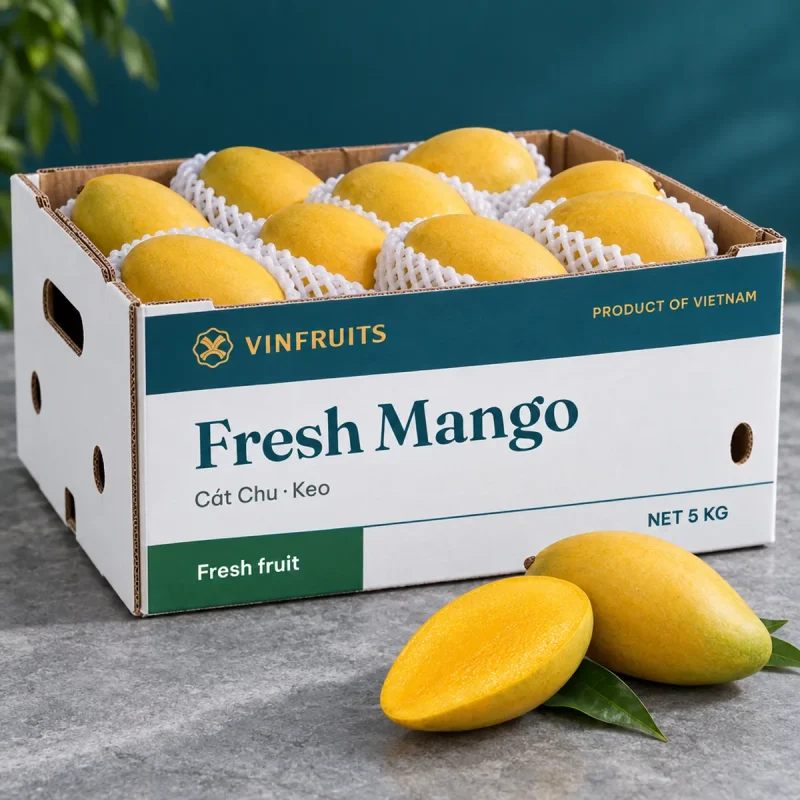
Fresh mango, Cát Chu and Keo
Size-graded export mango from coded orchards and packhouses, shipped at 10–13 °C.
- Size
- 300–600 g, 8–14 per 5 kg carton
- Shelf life
- 2–3 weeks at 10–13 °C
- Typical lot
- One 40-ft reefer or air pallets
- Season
- March to July, peak April to June
Request fresh mango pricing
Send volume and destination. We reply with the spec sheet and sample plan.
Request sent.
We'll reply from [email protected]. To speed things up, add specs on the full request form.
Product details
Everything your QC and R&D teams check before a sample.
Whole Vietnamese mango, harvested at export maturity from orchards with registered codes, graded and packed at coded packhouses, then cooled to 10–13 °C.
Mango loses value in two quiet ways: sap burn at the packhouse and chilling injury in the container. Neither shows until you open the cartons, so grading, treatment and temperature are fixed before loading.
Each lot is one variety. The destination decides which one, and whether the fruit needs irradiation or vapour heat treatment before it leaves Vietnam.
Used in
- Supermarket loose and pre-packed
- Wholesale distribution
- Fresh-cut counters
- Dessert and food service
Availability
- J
- F
- M
- A
- M
- J
- J
- A
- S
- O
- N
- D
Main harvest Other months on request
| Parameter | Indicative value · basis | Why it matters |
|---|---|---|
| Variety | Cát Chu or Keo, one per lotLabel and packing list | Japan accepts Cát Chu only. |
| Fruit size | 300–600 g, count 8–14 per 5 kg carton, sleevedCount per carton | Count fixes your retail unit. |
| Soluble solids | 14–20 °Bx when ripeRefractometer, ripened sample | Eating quality at the shelf. |
| Maturity | Harvested at export maturityPackhouse intake check | Fruit picked too green never reaches full flavour. |
| Packhouse defects | Sap burn and anthracnose excluded; limits agreed in the specificationCarton inspection at packing | Sap burn is the most common mango claim. |
| Storage | 10–13 °C, not colderData logger in the container | Colder pits the skin and stops ripening. |
| Shelf life | 2–3 weeksFrom packing | Too short for sea freight to the US. |
| HS code | 0804.50Mangoes, guavas and mangosteens | The code on the phytosanitary certificate. |
Indicative values. The binding spec is the signed contract, with its test method, sampling point and settlement basis. Last reviewed 18 Oct 2026.
Choose by market first, then by flavour. Cát Chu opens Japan; Keo suits markets without a variety restriction.
Cát Chu
- Origin
- Vietnamese variety, Đồng Tháp in the Mekong Delta
- Flavour
- Sweet, aromatic
- Flesh
- Fine fibre, deep yellow when ripe
- Markets
- Japan, Korea, China, retail programmes
Keo
- Origin
- Cambodian-type variety grown in the Mekong Delta
- Flavour
- Milder, less acid
- Flesh
- Firm, travels well
- Markets
- China, ASEAN, Middle East wholesale
- 1Coded orchard
Harvest at export maturity from an orchard with a registered planting-area code.
- 2Packhouse
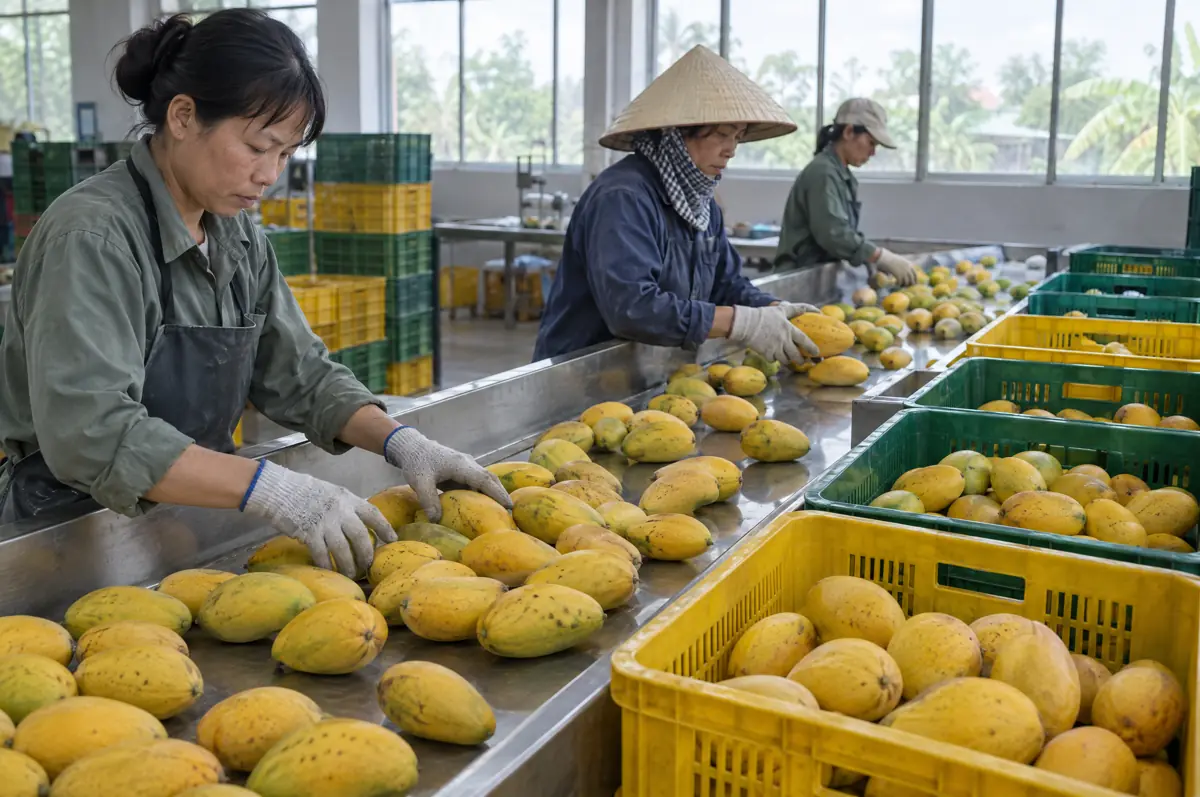
Stems cut and sap drained before washing, grading and packing.
- 3Treatment and cooling
Irradiation or vapour heat where the market requires it, then 10–13 °C.
- 4Reefer or air pallet
Data logger inside. Never loaded with bananas.
Why sap matters: latex from the stem burns the skin within hours, so it is drained before the fruit touches water.
- Packing
- 5 kg carton, 8–14 fruit, each in a foam sleeve.
- Label
- Variety, count, orchard and packhouse codes, exporter, packing date. Market-specific marks such as "For Korea".
- Temperature
- 10–13 °C from packhouse to your warehouse, with a data logger.
- Typical lot
- One 40-ft reefer by sea, or air-freight pallets for trials and short-life markets.
- Terms
- FOB, CFR or CIF; air shipments by quotation.
On arrival
- Keep at 10–13 °C; colder causes chilling injury.
- Ripen at room temperature or with your ripening programme before sale.
- Keep away from bananas and other ethylene sources in storage.
With each lot
- Commercial invoice and packing list
- Phytosanitary certificate with additional declarations
- Treatment certificate where required
- Certificate of origin
- Bill of lading or air waybill
- Orchard and packhouse codes on the documents
What we will not offer
- A price before variety, count, destination and freight mode are known
- Keo mango for Japan
- Ripe mango by sea to the United States
- Mango from an orchard or packhouse code not verified for that lot
Market access
United States, Australia, New Zealand
The US requires 400 Gy irradiation under APHIS monitoring, in practice done in Vietnam. Australia requires irradiation; New Zealand accepts irradiation or vapour heat treatment.
Japan and South Korea
Both require vapour heat treatment. Korea takes fruit from registered Mekong Delta orchards, treated until the core holds 47 °C for 20 minutes, in cartons marked "For Korea" with screened vents.
China and the EU
China requires no treatment, but orchard (PUC) and packhouse (PHC) codes must be GACC-approved; there is no mango-specific protocol. The EU controls mango through residue limits.
Checked 18 Oct 2026. We reconfirm for each contract.
Mango in other formats
Before you order
What is the minimum order for fresh mango?
One 40-foot reefer. For a trial, or a market that needs the fruit within days, we quote air-freight pallets. The season runs March to July, peaking April to June.
Should I choose Cát Chu or Keo mango?
Choose by market. Cát Chu is the Vietnamese variety Japan accepts and the most planted in the main southern growing province. Keo suits markets without that restriction.
Can fresh Vietnamese mango be shipped to the United States?
Yes, after irradiation under APHIS supervision. Sea transit takes 30–35 days, longer than the shelf life, so ripe mango goes by air. Irradiation slots are tight at peak.
How do I get a price and a sample?
Send variety, count, destination and seasonal volume through the quote form. We reply with a quotation naming the packhouse and treatment route, and agree a sample during the season.
Ready for a sample?
Tell us the variety, count and destination.
Request a quote
Tell us what you need. We reply by email with a spec sheet and the next step.
Request sent.
We'll reply from [email protected]. To speed things up, add specs on the full request form.