On this page
- What format does Vietnam actually publish for tropical puree?
- Does the fruit’s pH decide the format before cost does?
- What does each format prove about microbiology?
- Why is Alicyclobacillus the risk that ambient storage makes worse?
- Where do the published storage rules for aseptic puree disagree?
- What does each format cost to store and ship?
- Which format fits your line?
- Can the format change the HS heading?
- Which clauses turn the choice into a specification?
- Common questions
- Related insights
Aseptic fruit puree ships at ambient temperature in a dry container; frozen puree ships at −18 °C in a reefer. For Vietnamese tropical puree, frozen is the format with published data sheets, and pH settles part of the choice before cost does. Mango (pH up to 4.7) and guava (up to 5.0) cross the US 4.6 low-acid line, so ambient aseptic needs acidification written into the order.
What format does Vietnam actually publish for tropical puree?
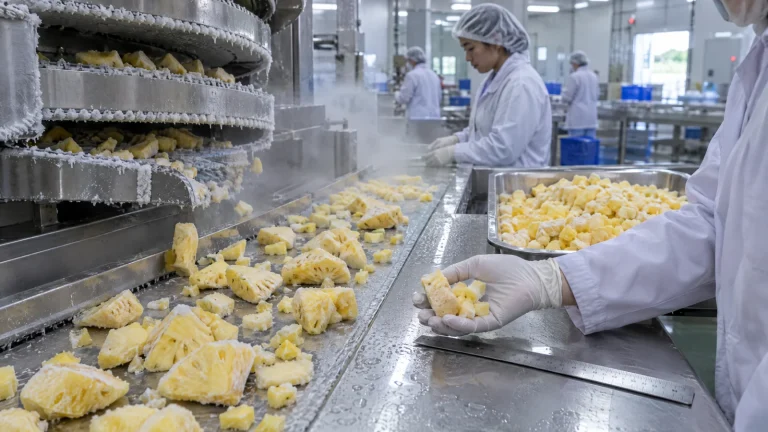
Vietnam publishes frozen puree. Every Vietnamese producer data sheet found for mango, passion fruit, guava, soursop and banana puree describes frozen product stored at −18 °C, with 24 months of shelf life from production. Aseptic is the exception. One producer lists 20 kg and 200 kg aseptic bags for passion fruit, but gives no shelf life and no storage temperature.
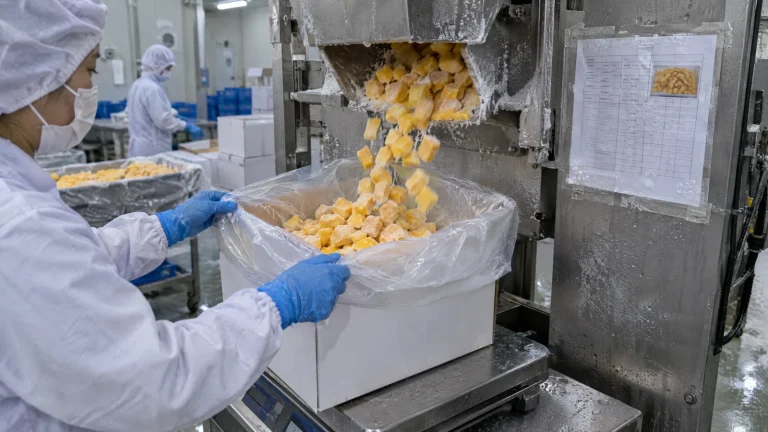
The published Vietnamese frozen pack is a double food-grade PE bag inside a steel drum of 180 kg net, or a 10 kg or 20 kg carton. Passion fruit also comes in 18 kg pails. The 180 kg figure is one producer’s general number for all its purees, so confirm it per fruit.
No Vietnamese plant’s aseptic capacity for mango, guava, soursop or banana puree has been verified from a published source. Public listings show the clearest Vietnamese banana puree supplier offering frozen only, while a Philippine producer sells “Aseptic Banana Puree 220kg”. The 215 kg, 220 kg, 230 kg and 250 kg aseptic weights you see quoted are figures published by Ghousia (India), Profood (Philippines) and 12taste, not Vietnamese ones. Whichever format you choose, check that the producing plant holds a GFSI-recognised scheme (BRCGS, IFS, FSSC 22000 or SQF). CBI named this the minimum for the EU market on 30 January 2024. The page on how certificates are attributed to the plant that holds them explains how to read a supplier’s certification claims.
Vietnam does have one national standard. TCVN 13941:2023 Chanh leo đông lạnh (frozen passion fruit) covers frozen pulp, puree, juice and concentrated forms. It requires storage no warmer than −18 °C, soluble solids after thawing of at least 13.5 %, pH 2.3–3.5, and titratable acidity of 2.5–5.0 % at single strength. No equivalent TCVN exists for frozen mango, guava or soursop puree. TCVN 7946:2008 mirrors Codex STAN 247-2005 and covers juices and nectars.
Does the fruit’s pH decide the format before cost does?
Yes, for two of the main tropical fruits. US rules draw the line at an equilibrium pH of 4.6. Above it, a shelf-stable product is a low-acid canned food under 21 CFR 113. At or below it, a low-acid fruit brought down with added acid is an acidified food under 21 CFR 114. Frozen puree sits outside that question, because it is pasteurised, held at −18 °C, and heated again in your own process.
| Fruit | Published pH range (pH units) | Ceiling vs 4.6 | Route to ambient aseptic | Source of range |
|---|---|---|---|---|
| Passion fruit | 2.3–3.5 | Below | Natural acid food | TCVN 13941:2023; Vietnamese producer TDS |
| Soursop | 3.4–4.4 | Below, narrow margin | Natural acid food if lots hold the range | Vietnamese producer TDS |
| Mango | 3.0–4.7 | Above | Acidify, or run a low-acid process | Vietnamese producer TDS |
| Guava | 3.3–5.0 | Above | Acidify, or run a low-acid process | Vietnamese producer TDS |
| Banana | 4.5–5.2 (natural) | Above | Almost always acidified with citric or ascorbic acid | Published natural pH range of the fruit |
Read the ceiling, not the midpoint. A mango lot at pH 4.7 is fine in a −18 °C chain. In an ambient drum the same lot becomes a different regulatory product. There are two ways to fix that. You can acidify, which puts citric acid on the ingredient list and removes any “nothing added” claim. Or you can run a low-acid botulinum cook. For banana that means F₀ ≥ 3, which browns and caramelises the puree until it cannot be sold.
The market default does not protect you. In a survey of six commercial banana puree specifications, two ran at pH 4.7–5.1. A Costa Rican spec labelled acidified still read 4.7–5.1. A buyer ordering “aseptic” on that spec can be importing a low-acid food without the filings it requires. USDA Commercial Item Description A-A-20252B, Purees, Fruit, Aseptic, makes acidification a formal contract option (“Acidification 1 – Acidified” / “Acidification 2 – Not acidified”). Its permitted agents are citric acid, ascorbic acid, lemon juice and lemon juice concentrate.
Three measurement rules matter here:
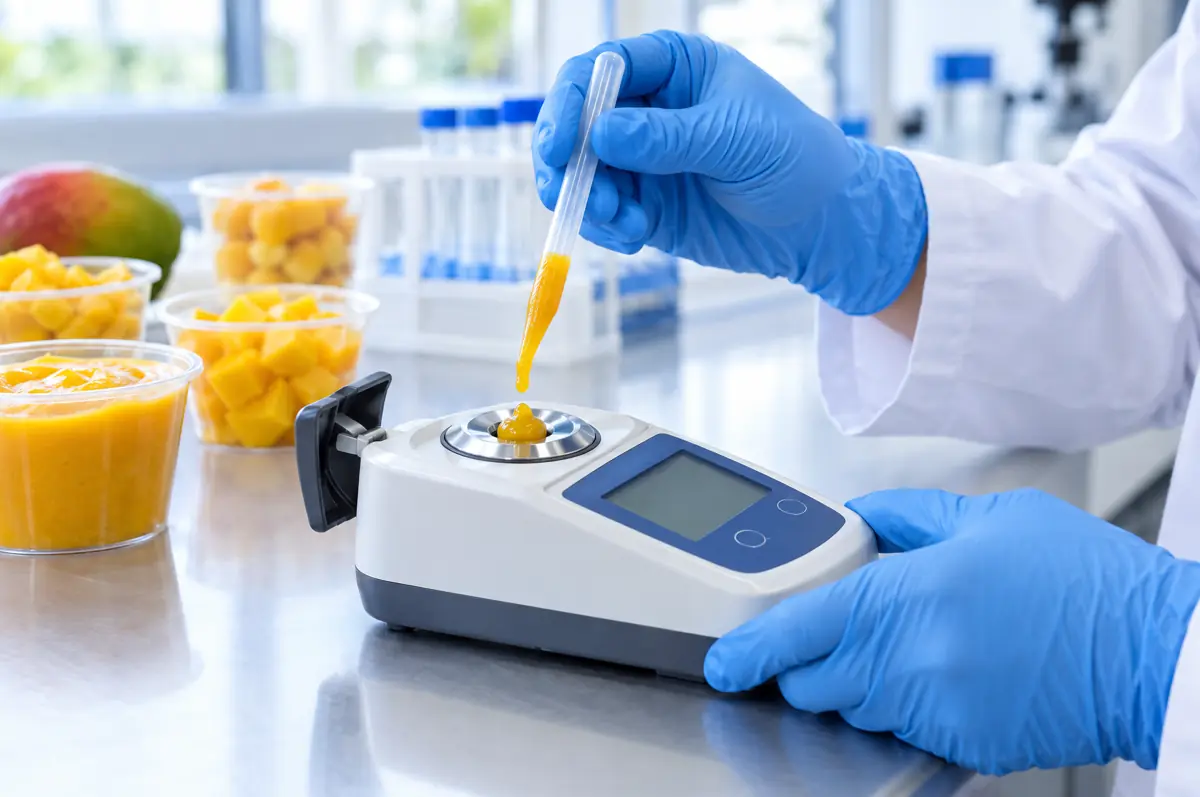
- Use a pH meter. Under 21 CFR 114, pH above 4.0 must be measured potentiometrically. Paper strips and colour comparison are not allowed.
- Use the equilibrium pH, not the instantaneous reading.
- Bind titratable acidity as well as pH. If the contract limits pH alone, a plant can pass it by switching acid.
For any puree meant to be shelf-stable, a design limit of pH 4.40 leaves real margin under the legal line, where a limit of 4.5 or 4.6 does not. Treat 4.40 as a reasoning step for your own spec, not as a published standard.
What does each format prove about microbiology?
Aseptic product claims commercial sterility. Frozen product claims only that it was pasteurised. The two formats are built to different limits, and they need different evidence. The US federal reference documents show the gap between them.
| Parameter | Unit | Aseptic limit | Frozen limit | Instrument |
|---|---|---|---|---|
| Total / aerobic plate count | CFU/g | <1,000 | <50,000 | USDA A-A-20252B (aseptic); USDA frozen fruit commodity spec, 6/2017 |
| Yeast and mould | CFU/g | <100 combined | <10,000 yeast; <10,000 mould | Same two instruments |
| Coliform | CFU/g | <10 | <100 | Same two instruments |
| Commercial sterility | pass/fail | Required | Not required | A-A-20252B |
The frozen specification also sets E. coli below 3/g and Salmonella negative in 25 g. No Vietnamese frozen data sheet publishes numeric microbiology limits. They are agreed in the specification, and the honest wording on a frozen page is: frozen puree is pasteurised, not sterile, so plan your own heat step.
A negative plate count does not show commercial sterility. Only an incubation test shows it, and the plant normally runs that test under its scheduled process. For aseptic lots, ask for the incubation-test record and a letter of process authority, not a lab COA alone. The guide to reading a fruit certificate of analysis covers which lines a COA can and cannot prove.
If the puree goes into a beverage for the US market, 21 CFR 120 (Juice HACCP) treats puree as juice. It requires either a 5-log pathogen reduction or a thermal step that makes the product shelf-stable, and the importer holds records under 120.14.
Why is Alicyclobacillus the risk that ambient storage makes worse?
Alicyclobacillus is a spoilage organism that survives the pasteurisation used for acid fruit puree and leaves no visible sign. It does not swell the bag, change the colour or shift the pH. A lot can pass its COA and still be spoiled. Pall gives its growth range as pH 2.0–6.5 and 25–70 °C. Merck gives pH 2–6 and 20–70 °C. The spores are heat-resistant: Pall reports D₉₀ of 16–23 minutes and D₉₅ of 0.06–5.3 minutes, Merck D₉₅ of 2–15 minutes. A normal acid-food process at about 93–95 °C therefore does not kill them. Spoilage shows as guaiacol, a medicinal, antiseptic off-note, which appears at 10⁴–10⁵ CFU/mL. Its sensory threshold in apple juice is about 2.23 ppb. Tropical puree at pH 4.2–5.1 held in a 28–35 °C port warehouse sits inside both published growth ranges. Frozen puree at −18 °C does not.
Spores occur in 15–75 % of juice concentrates. In one industry survey, 60 % of companies reported a spoilage incident and 35 % attributed it to A. acidoterrestris. None of five commercial puree specifications surveyed included a criterion for it.
The method is IFU MM12:2019. It uses a heat shock at 80 °C for 10 minutes, and the usual criterion is “not detected in 10 g”. Check the number carefully. IFU No.12 is a different method (HMF), and a contract that cites it instead invites a dispute. VinFruits Global writes an Alicyclobacillus line, IFU MM12:2019, not detected in 10 g, into every puree specification whether the lot ships frozen or aseptic, because none of the commercial puree specifications the company reviewed included one.
Adding heat at the end does not solve the problem, because more heat burns the puree before it kills the spores. Control starts at fruit intake: brushing and washing the peel, sanitised wash water, and rejecting mud-soiled fruit.
Where do the published storage rules for aseptic puree disagree?
They disagree on banana, the one fruit with a documented ambient storage rule, and they point in opposite directions. The Global Cold Chain Alliance’s WFLO guidance sets a floor:
“Banana puree should not be held at temperatures lower than 60 °F (15.6 °C).”
Below that temperature, WFLO says, the natural starch forms lumps, called gel balls. Its storage band is 15.6–26.7 °C, with one year of shelf life. Gel balls come from storage and transport, not production. They show up only when you pour the opened bag through a sieve. Supplier data sheets go the other way and keep the product cold to slow browning:
| Source | Storage band (°C) | Shelf life stated | Document type |
|---|---|---|---|
| WFLO | 15.6–26.7, never below 15.6 | 1 year | Cold-chain storage guidance |
| 12taste | 0–4 | 18 months | Supplier TDS |
| Ghousia (India) | <15, preferably <7 | Not stated | Supplier TDS |
| Banalight | 5–15 optimum; accepts 16–30 | 12 months | Supplier TDS |
| Indian supplier TDS (general) | Not stated | 12–18 months | Supplier TDS |
Neither side is wrong. Cold storage protects colour but risks gel balls, and warm storage avoids gel balls but browns the puree slowly. Your contract has to choose one. Commercial practice is often described as 18–24 months, and that figure should be fixed by a shelf-life study at the storage temperature you actually contract. US federal purchasing requires at least 9 months of shelf life remaining at delivery.
The 15.6 °C floor applies to banana only. The mechanism is banana starch. No published source sets a storage floor for aseptic mango, passion fruit, guava or soursop. That band belongs in the contract and should be backed by the producer’s own shelf-life data at two temperatures. One rule does apply to every fruit: aseptic packaging is “not designed for frozen use… plastics can become brittle and/or break” (WFLO). Never freeze aseptic product.
What does each format cost to store and ship?
Frozen costs more to move, and aseptic costs more to pack. Frozen puree needs a reefer and a −18 °C store at both ends. Aseptic needs an ordinary dry container and a warehouse whose temperature band you control. Tridge’s banana puree cost breakdown of 22 May 2026 puts logistics at 10 % of final cost for aseptic and 20 % for frozen. It puts packaging plus QA at 14 % for aseptic and 10 % for frozen. That leaves a net gap of about six points in aseptic’s favour, and the gap widens with distance. Treat this as a share structure on its date, not as a current freight cost.
Acidification is a hidden cost of the aseptic route. It changes the ingredient list, so the label, claims and recipe have to change with it.
The frozen chain has firm numbers. Under Codex CXC 8-1976, quick-frozen food is kept at −18 °C or colder, and the warmest package must not exceed −12 °C in distribution. The tolerance for a non-destructive check between cartons is 2.8 °C. To measure core temperature, drill at least 2.5 cm with a pre-chilled tool and use a probe accurate to ±0.5 °C. Thawing and refreezing darkens colour and flattens aroma in mango, soursop and guava puree, and frost on cartons is the visible sign of it.
Two rules apply to both formats. Put three data loggers in each container, at the door, the middle and the far end. Keep the puree out of any store holding seafood, onion, garlic or other strong-odour goods.
Which format fits your line?
Choose by what your plant can receive, store, open and dose without adding a hazard you have not planned for. Trade grading tables generally rate frozen as keeping colour and aroma better, with fewer cooked notes, and aseptic as free of the cold chain. That is a generalisation, not a measured result for any one lot.
| Your line | Frozen fits when | Aseptic fits when | Governing instrument or test |
|---|---|---|---|
| Ice cream, dairy | You have −18 °C storage and a heat step | Fruit is natural-acid or acidification is acceptable on the label | Codex CXC 8-1976; IFU No.11 pH |
| Bakery filling | Colour and aroma drive the brief | Cold storage is limited | IFU No.80 colour; sieve at 6.35 mm |
| Beverage blending (US) | Your process gives the 5-log reduction | The incubation record and process letter are on file | 21 CFR 120; A-A-20252B |
| No frozen store on site | Not practical | Your warehouse band can be held and logged | Contract storage band; loggers |
| High-pH fruit, no added acid | Mango, guava and banana stay frozen | Only with a filed low-acid process | 21 CFR 113 / 114 |
Frozen has one gap that no source fills. There is no published thaw time or thaw method for a 180 kg drum, and no standard for how long thawed puree lasts. Your own HACCP plan sets both. The opened life of an aseptic bag is not standardised either, so take it from the supplier’s data sheet for each lot.
On the supplier side, aseptic needs plant that frozen does not. A typical line runs intake, wash, crush, finisher, deaeration, acidification, sterilisation, aseptic filling and storage. Deaeration decides colour, because the browning enzyme PPO needs oxygen. It also keeps heat transfer even, since air pockets leave under-sterilised spots. Low density on the COA (IFU No.1a) points to entrained air.
The filler must hold overpressure and the correct H₂O₂ concentration and temperature, and it must stop itself on any deviation. That makes it a critical control point, under 21 CFR 113 where the product is low-acid. Established filler makers include Bertuzzi, CFT/Rossi & Catelli, JBT FranRica and Alfa Laval, which bought Astepo in 2010. Aseptic lines run long campaigns, and each change of SKU costs hours of CIP. Vietnamese fruit lines are full from March to August and slack from October to January, so if a partner plant’s aseptic capacity is confirmed for your fruit, a trial run is easier to schedule in the slack months.
Can the format change the HS heading?
It can. Frozen, uncooked puree is commonly entered under 0811.90. Pasteurised puree is commonly classified in 2008.99. Puree “obtained by cooking”, meaning heat that raises viscosity by removing water, goes to 2007.99 under Chapter 20, Note 5. In a dated precedent, CBP ruling NY N320885 of 16 December 2021 classified aseptic organic mango pulp in 2008.99.40. That product was 99.8 % mango and 0.2 % citric acid, heated at 90 °C for 20 seconds and 100 °C for 30 seconds, and packed in 55-gallon drums. The US tariff names soursops at 2008.99.23 and guavas at 2008.99.30.
Classification depends on the process. Whether pasteurised frozen puree stays in 0811.90 is not settled by any document here. Get a binding ruling at destination (an EU BTI or a CBP ruling) before the first shipment.
Which clauses turn the choice into a specification?
These clauses can go into a purchase order as written, with your values filled in:
- Format: frozen at −18 °C or colder, or aseptic and commercially sterile. Aseptic packs shall not be frozen at any point.
- pH and acidity: equilibrium pH ≤ [limit] at every sampling point, measured by pH meter (IFU No.11 / AOAC 981.12). Titratable acidity [range] as citric acid (IFU No.3, to pH 8.1). Acidification [1 – Acidified / 2 – Not acidified], agent [citric acid].
- Sterility evidence: for aseptic lots, an incubation-test record and a letter of process authority with each first lot. A plate count does not demonstrate commercial sterility.
- Spoilage: Alicyclobacillus not detected in 10 g, IFU MM12:2019, every lot, both formats.
- Brix: IFU No.8 / AOAC 932.12 at 20 °C. Read it after thawing for frozen lots. For reference, Directive 2012/12/EU Annex V gives the minimum Brix of reconstituted juice and puree as mango 13.5, passion fruit 12.0 and guava 8.5, and 21 CFR 101.30 gives the Brix used for juice-percentage labelling as mango 13.0, passion fruit 14.0, guava 7.7 and soursop 16.0. These are reference values for reconstituted product and labelling, not limits for single-strength puree; set your own single-strength Brix in the contract.
- Cold chain: frozen, warmest package not above −12 °C in transit. Aseptic, the storage band and floor written for this fruit. Three loggers per container, with records supplied.
- Shelf life and weight: remaining shelf life at delivery ≥ [x] months, and net kg per drum stated.
- Opening check: pour at least 5 L through a 6.35 mm sieve. A-A-20252B states “Lumps must not exceed 6.35 mm diameter”. Bag swell is a critical defect: AQL 0, reject the lot.
- Raw fruit: Howard Mould Count (FDA MPM V-9) or ergosterol (IFU No.81).
- Consistency: IFU has no consistency method and there is no calibration standard for the Bostwick consistometer. Fix sample temperature, volume, trough levelling and who calibrates.
Common questions
Is Vietnamese mango puree available aseptic?
Published Vietnamese mango puree data sheets describe frozen product at −18 °C with 24 months of shelf life. No Vietnamese plant’s aseptic mango capacity has been verified from a public source. The published mango pH range runs to 4.7, above the US 4.6 low-acid line, so an ambient aseptic mango lot normally needs acidification written into the purchase order and confirmed per production run.
Can aseptic fruit puree be frozen to extend shelf life?
No. Aseptic drums, totes and bag-in-box packs are not designed for frozen use, and WFLO warns that the plastics can become brittle or break. Freezing an aseptic pack risks the seal that keeps the product commercially sterile. If you need frozen storage, order frozen puree in PE-lined drums from the start, and write a no-freezing clause for aseptic lots into the contract.
What pH limit should an aseptic puree specification carry?
The US legal line between acidified and low-acid food is an equilibrium pH of 4.6. A shelf-stable specification is safer with margin, for example 4.40, measured by pH meter under IFU No.11 at every sampling point. Bind titratable acidity as well, and state whether the lot is acidified, using the A-A-20252B options Acidification 1 or Acidification 2.
Does a clean COA prove an aseptic lot is sterile?
No. A negative plate count cannot show commercial sterility. Only an incubation test shows it, and the plant runs that test under its scheduled process. Ask for the incubation-test record and a letter of process authority. Add an Alicyclobacillus test by IFU MM12:2019, not detected in 10 g, because that organism survives acid-food pasteurisation and passes routine COA checks.
What temperature should aseptic banana puree be stored at?
Published sources conflict. WFLO sets 15.6 to 26.7 °C and never below 15.6 °C, because banana starch forms gel balls in the cold. Supplier data sheets cite 0 to 4 °C, below 7 °C, or 5 to 15 °C to slow browning. The contract must choose one band. The 15.6 °C floor applies to banana only and should not be copied to other fruits.