On this page
- Which mango varieties will a Vietnamese offer actually contain?
- Which variety goes into which product line?
- Why does harvest maturity at intake differ by variety?
- Is Keo mango Vietnamese or Cambodian?
- Which variety is in Vietnamese canned mango?
- Where is the variety a legal gate for fresh mango?
- When is the buying window for each variety?
- How should the variety line be written in a purchase order?
- Common questions
- Related insights
Vietnam mango varieties that reach processing do different jobs. Cat Chu is the flavour variety for IQF dice and soft-dried slices, and the one Japan’s 2015 fresh opening covered. Keo is the volume variety for IQF dice. Cat Hoa Loc stays mostly in fresh and premium lines. Green-skin elephant and Taiwanese fruit feed large frozen cheek. The delta main crop runs March to July; no public source names the canned-mango variety.
Which mango varieties will a Vietnamese offer actually contain?
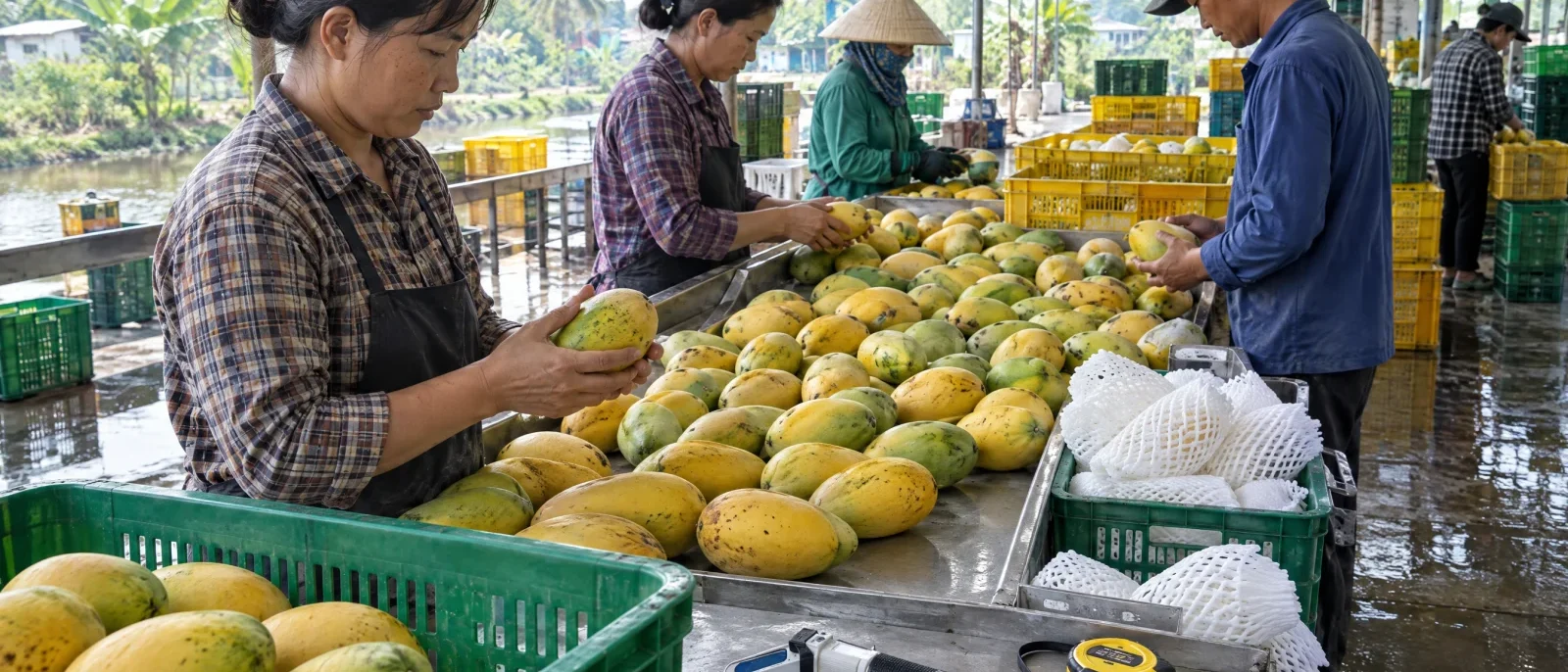
An offer that says “Vietnamese mango” can draw on at least five varieties. Three are the named delta varieties: Cat Chu (Cát Chu), Cat Hoa Loc (Cát Hòa Lộc) and Keo. The other two are green-skin elephant mango (xoài tượng da xanh) and Taiwanese mango, both very large fruit of 700 g to 1.5 kg that are eaten green and hard-fleshed.
Dong Thap is the core mango province, with about 14,000 ha concentrated around Cao Lanh. The published variety shares for that area do not add up, and you should treat them as rough. One set of figures gives Cat Chu about 60% of Dong Thap’s mango area and Cat Hoa Loc about 30%. Vietnamese press reporting puts green-skin and Taiwanese fruit at 20 to 30% of the same area. Keo is grown there as well. Nobody has published a reconciled split, and nobody should build a supply plan on one.
The variety names also carry geography. Cat Hoa Loc is named after Hoa Loc in Tien Giang, where it originated. Keo is grown in Dong Thap, Tien Giang and An Giang, and it is also the main variety of Cambodia. The north grows a different set of varieties. In Yen Chau, Son La, most of the 740 ha of mango is Taiwanese and “round” mango, according to VietnamPlus in May 2026. Tu Quy, a large-fruited variety eaten green or ripe, crops year-round. The Australian variety R2E2 is grown in Vietnam, but its area is not published.
At national level, output is about 1 million t a year, according to VnExpress in 2025. The last official figures, about 87,000 ha and 893,200 t, are for 2020. Quote them with their year or not at all.
Which variety goes into which product line?
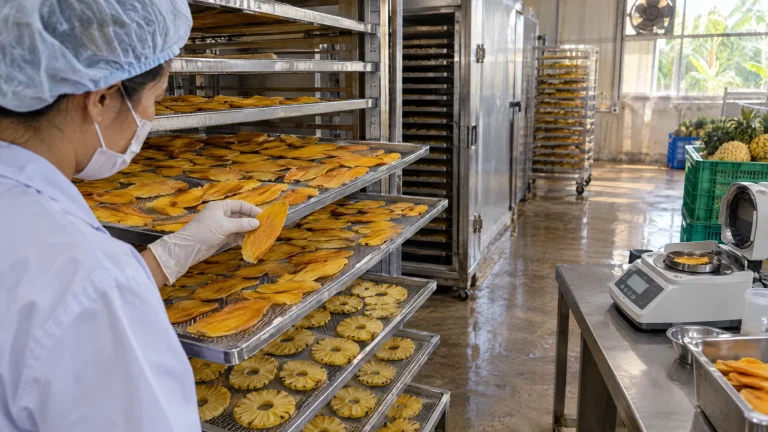
Cat Chu and Keo are the varieties named for Vietnamese IQF mango. Cat Chu is also the variety named for soft-dried slices. Cat Hoa Loc is kept out of routine frozen lines. Green-skin elephant, Taiwanese and Tu Quy fruit go to large frozen cheek and green-mango lines. The table maps each variety to its lines using published variety descriptions and market-access decisions.
| Variety | Published character | Processed lines | Fresh market gate | Main crop (months) | Basis |
|---|---|---|---|---|---|
| Cat Chu | Sweet, aromatic; deep yellow, fine fibre; travels better than Hoa Loc | IQF dice, chunk and cheek for sorbet, smoothies and mango-forward desserts; soft-dried slices | Covered by Japan’s 2015 opening, with vapour heat treatment | March–July, peak April–June | Published IQF and soft-dried specifications; Japan 2015 market opening |
| Keo (Keo Romeat, “Kaew”) | Milder, less acid; firm, uniform colour | IQF dice for yoghurt, bakery and fruit mixes; green-mango lines | Markets without a variety restriction; not covered by Japan’s 2015 opening | An Giang peak March–May; Cambodia February–June | Published IQF specification; HungHau published comparison; Dan Viet, April 2026 |
| Cat Hoa Loc | Aromatic, low fibre, thin skin that makes long-distance transport difficult | Kept out of routine frozen lines; premium soft-dried where processed | Not in Japan’s 2015 opening; older reports mention a lot | April–May; off-season from early September | Dan Tri, August 2026 |
| Green-skin elephant, Taiwanese, Tu Quy | Very large fruit, 700 g–1.5 kg, eaten green and hard-fleshed | Large frozen cheek and chunk; frozen and brined green mango | Not established | Tu Quy crops year-round | VietnamPlus (fruit size, area); processing use per the correction below |
Vietnamese processors position Keo IQF as the volume product and Cat Chu IQF as the flavour product. For soft-dried mango, Cat Chu is the variety a published specification names, one variety per lot. Off-variety pieces in a soft-dried lot show up as pale, hard or sour slices, which is why the sugar route and the variety have to be fixed together. The trade-offs on that line are covered in soft-dried mango sugar options.
Vietnamese press says green-skin and Taiwanese mango cannot be dried or processed. That claim is too broad. The fruit makes poor soft-dried product and poor purée, because of low sugar and pale colour. Large frozen cheek and green-mango lines still use it, so the boundary is the product form, not the variety. Purée is the line where the variety most often goes unstated. A Vietnamese processor’s published frozen mango purée data sheet gives a Brix floor and leaves the variety line blank.
Why does harvest maturity at intake differ by variety?
Vietnamese processors harvest Keo and Cat Chu at different points, so a colour tolerance on finished dice means different things for each variety. HungHau Foods, a Vietnamese IQF processor, publishes a comparison of IQF Kaew (Keo) and IQF Cat Chu mango from Vietnam. In it, Keo is harvested for IQF at 75–80% maturity, with 30–50% of the peel yellow, and gives a mildly sweet, low-acid dice. Cat Chu is harvested at 80–85% maturity, with about 70% of the peel yellow, and gives a strongly sweet dice that turns slightly acid if the fruit is not fully ripe. The same comparison places Keo growing areas in Dong Thap and Tien Giang, and Cat Chu in Dong Thap and Ninh Thuan. A mango purchase specification that names no variety cannot hold a supplier to either harvest point. A colour, Brix or acidity limit on IQF mango dice is only enforceable once the variety is written into the order.
The practical result shows up in the certificate of analysis. A Brix result for a Keo lot and one for a Cat Chu lot are not comparable against a single limit. Brix also moves with the month of harvest, and no published data set gives Brix by variety and month. Buyers set it per variety and per season in the contract annex and state the measurement temperature. How to check those lines on the document itself is covered in how to read a fruit certificate of analysis.
Is Keo mango Vietnamese or Cambodian?
Keo is both, and in the main season you cannot tell which from the fruit. Keo is the main Cambodian variety, sold there as Keo Romeat. It makes up about 80% of Cambodia’s output, which runs to about 2.25 million t a year according to Vietnam’s Ministry of Industry and Trade and FreshPlaza in 2025. The spelling “Kaew” also appears in Vietnamese processors’ English. Keo, Kaew and Keo Romeat name one variety family, and offers written in different spellings may describe the same fruit.
Cambodian Keo Romeat runs from February to June, almost exactly on top of the delta main crop. Most of Cambodia’s early-season mango exports go to Vietnam. The fruit crosses at border gates in An Giang, Tay Ninh and Dong Thap and goes to Vietnamese processors. That overlap is also why raw-material supply is heaviest from March to June.
This matters for preferential origin. Cambodia is a party to ACFTA, RCEP and ATIGA, but not to EVFTA, CPTPP or VKFTA. Keo grown in Cambodia and frozen in Vietnam is not wholly obtained in Vietnam. Whether the change from 0804.50 to 0811.90 satisfies the product-specific rule depends on each agreement’s annex, and no written ruling on it has been found. If the claim fails, the importer’s preference can be reversed at post-clearance audit, with duty recovered at the importer’s end.
VinFruits Global has the partner plant confirm in writing that Keo fruit was grown in Vietnam before a preferential certificate of origin is issued, because Keo that crossed from Cambodia does not originate under the EVFTA. A buyer importing Keo under any of the three agreements should ask any supplier for the same confirmation.
Which variety is in Vietnamese canned mango?
Nobody publishes it. No Vietnamese plant could be confirmed from public sources as canning mango slices at export scale. The only public evidence found is a retail can of Vietnamese-origin mango slices on sale in Czechia, and the variety in it is not published. The canned mango specification on this site records the variety per lot as not yet recorded. If you buy canned Vietnamese mango, the variety line is yours to write.
The international standard does not do it for you. Codex CXS 319-2015, Standard for Certain Canned Fruits, carries a mango annex and replaced CXS 159-1987. The annex fixes styles and defect allowances, and the variety is left to the contract. Its styles are cut from peeled fruit: whole (with or without stone), halves, slices, pieces and dice.
| Parameter | Regular pack (unit as shown) | Solid pack (unit as shown) | Instrument |
|---|---|---|---|
| Fill of container | ≥90% of water capacity | ≥90% of water capacity | Codex CXS 319-2015 |
| Minimum drained weight | 50% of water capacity | 70% of water capacity | Codex CXS 319-2015, mango annex |
| Blemish and excess trim | 30% by count | 3 pieces per 500 g | Codex CXS 319-2015, mango annex |
| Bruising | 5% by weight | Not applicable | Codex CXS 319-2015, mango annex |
| Peel | ≤6 cm² per 500 g | ≤12 cm² per 500 g | Codex CXS 319-2015, mango annex |
| Harmless extraneous material | 2 pieces per 500 g | 3 pieces per 500 g | Codex CXS 319-2015, mango annex |
Drained weight is calculated on water capacity, not net weight. For packing media, the Codex CXG 51 draft, India’s FSSAI and 21 CFR 145.135 agree on light syrup at 14–18 °Bx and heavy syrup at 18–22 °Bx. A Gulf draft standard for canned mango, notified to the WTO as KWT/15_0811, sets heavy syrup at 18 to under 24 °Bx. In the EU, tin in canned food is limited to 200 mg/kg under Regulation (EU) 2023/915, and BPA in can coatings is banned under Regulation (EU) 2024/3190.
Ripeness decides the US route. FDA’s Approximate pH of Foods gives ripe mango at pH 3.40–4.80 and green mango at 5.80–6.00. Ripe fruit straddles the 4.6 line, so canners add citric acid. The Czech retail can lists E330. Under 21 CFR 114 that makes canned mango an acidified food. Before a US lot is offered, the plant needs FCE registration and a scheduled process filed for each product and can size.
Where is the variety a legal gate for fresh mango?
For fresh mango, the importing authority sets the variety and the treatment. For processed mango, no importing authority asks about variety at all. Japan opened to fresh Vietnamese mango in September 2015 for Cat Chu, with vapour heat treatment mandatory. Older Vietnamese press reporting mentions a Cat Hoa Loc lot reaching Japan. The current MAFF list has not been read for this article, so check it through Vietnam’s Plant Protection Department before contracting any variety other than Cat Chu. The official treatment temperature and time are not reproduced here for the same reason.
The United States requires fresh Vietnamese mango to be irradiated at a minimum of 400 Gy in Vietnam, at an APHIS-approved facility, with a phytosanitary certificate per lot covering 18 target pests. The rule, Importation of Fresh Mango Fruit From Vietnam Into the Continental United States, took effect on 29 December 2017. Check the current conditions in APHIS ACIR. The varieties accepted by the US, Korea, Australia and New Zealand are not established in the sources used here.
The EU requires no heat or irradiation treatment. The phytosanitary certificate covers Tephritidae, through area freedom or effective treatment, and CBI gives Class I as the minimum quality. Mango is not on the enhanced-controls list for Vietnam. Annex II of Regulation (EU) 2019/1793 lists Vietnamese chilli, okra, dragon fruit and durian, not mango. China requires GACC-approved planting-area and packhouse codes, and no mango-specific protocol date has been found. Separately, Dong Thap’s registered export planting-area codes, which are not specific to China, numbered 353 covering 10,030.17 ha in 2026 against 327 covering 5,948 ha in 2022, according to nongnghiepmoitruong.vn and VietnamPlus reporting dated 7 June 2026 and 7 August 2022. Fresh mango quality classes sit in CODEX STAN 184-1993 and UNECE FFV-45.
Processed lines move the requirements to the plant: FDA facility registration, HACCP and, in practice, BRCGS or FSSC 22000. CBI states that mango purée needs no phytosanitary certificate for the EU. That has not been confirmed for IQF mango, so check with the importing member state.
When is the buying window for each variety?
The season sets the buying window, not the delivery window. The Mekong Delta main crop runs from March to July and peaks from April to June. Within it:
- Keo in An Giang peaks from March to May.
- Cambodian Keo Romeat runs from February to June.
- Canners buy raw mango from March to June, while the delta and Cambodian crops overlap.
- Cat Hoa Loc’s main crop is April to May, and its off-season harvest starts in early September.
- Son La in the north runs roughly from May to September, with the heart of it in June to August. Its varieties are Taiwanese and round mango, not the delta three.
Most of Dong Thap’s mango area is also cropped off-season by flower induction, which spreads fresh supply but does not move the processing peak. Vietnam’s main crop meets Thai and Philippine supply, which also runs from March to June. A frozen, dried or canned order placed after the delta season is filled from stock packed in that window. Settle the variety question before March.
How should the variety line be written in a purchase order?
Name the variety and one variety per lot, and never write “Vietnamese mango”. No Codex standard exists for quick-frozen mango or for soft-dried mango. Codex has quick-frozen standards for vegetables (CXS 320-2015) and for four temperate fruits (CXS 52, 69, 75 and 103-1981). EU marketing standards apply only to fresh fruit. For IQF and soft-dried mango, the variety line exists only if your contract writes it. Clauses to adapt:
- Variety: Cat Chu, or Keo, named. One variety per lot. No mixing. Mixed lots are rejected.
- Harvest maturity at intake for IQF: state the peel-colour window for the named variety.
- Brix: a range for the named variety and harvest month, with the measurement temperature stated.
- Raw material grade: processing grade (misshapen, off-size or skin-marked fruit, flesh clean). Fresh intake excludes sap burn, anthracnose, fruit-fly damage and jelly seed.
- Origin, for Keo under a preference claim: written confirmation that the fruit was grown in Vietnam before the certificate of origin is issued.
- Canned: variety named, style per CXS 319-2015, packing medium in °Bx, and, for the US, the acidification route under 21 CFR 114.
The variety line also travels with the tariff line. Fresh and plain dried mango fall under 0804.50, which groups mangoes with guavas and mangosteens, so trade data for that heading is not mango alone. Frozen mango is 0811.90, and canned mango and sugar-infused soft-dried mango are 2008.99.
Common questions
Which Vietnamese mango variety is used for IQF?
Two varieties are named for Vietnamese IQF mango. Keo is the volume variety for dice in yoghurt, bakery and fruit mixes: firmer, milder, less acid and more uniform in colour. Cat Chu is the flavour variety for sorbet, smoothies and mango-forward desserts. Large frozen cheek also uses green-skin elephant, Tu Quy and Taiwanese fruit. Specify one named variety per lot, because no Codex standard for quick-frozen mango exists to do it for you.
Is Cat Hoa Loc used for processing?
Rarely. Cat Hoa Loc is the best-eating Vietnamese mango, aromatic and low in fibre, but its thin skin makes long-distance transport difficult, and Vietnamese press reports it fetching the highest farm-gate price of the three delta varieties. It is kept out of routine frozen lines. Where it is processed, it goes into premium soft-dried product, and the lot should name it rather than blend it into Cat Chu.
Which mango variety does Japan accept from Vietnam?
Japan opened its market to fresh Vietnamese mango in September 2015 for the Cat Chu variety, with vapour heat treatment mandatory. Older Vietnamese press reports mention a Cat Hoa Loc lot reaching Japan, and the current MAFF list has not been read here, so check it through Vietnam’s Plant Protection Department before contracting any other variety. Frozen and dried mango carry no variety restriction from the importing authority.
Is Keo mango Vietnamese or Cambodian?
Both. Keo is grown in Dong Thap, Tien Giang and An Giang, and the same variety, Keo Romeat, makes up about 80% of Cambodia’s mango output. Cambodia’s season runs February to June, over the delta main crop, and most of its early-season exports go to Vietnam through border gates in An Giang, Tay Ninh and Dong Thap. For an EVFTA, CPTPP or VKFTA preference claim, get written confirmation that the fruit was grown in Vietnam.
When is the Vietnamese mango season for processing?
The Mekong Delta main crop runs March to July, peaking April to June. Keo in An Giang peaks March to May, Cambodian Keo runs February to June, and canners buy raw fruit in March to June. Cat Hoa Loc has an off-season crop from early September, and Son La in the north runs roughly May to September on different varieties. Frozen, dried and canned orders placed later are filled from stock packed in that window.