On this page
- Is there a standard to inspect frozen tropical fruit against?
- What counts as one lot in a frozen fruit inspection?
- How many cartons does the inspector open?
- What does the inspector measure, and in what state?
- Is the residue sample part of the same inspection?
- What should happen to the retained sample?
- Who pays for inspection, a failed lot and a referee test?
- Clauses to paste into the purchase order
- Common questions
- Related insights
A pre shipment inspection frozen fruit buyers can enforce rests on the contract, because frozen tropical fruit has no Codex, USDA or EU product standard. Write in Codex CXS 233-1969 sampling at AQL 6.5, Inspection Level I, with lot size counted in cartons per production lot; a jointly sealed retained sample held at −18 °C or colder; and inspection costs allocated by outcome.
Is there a standard to inspect frozen tropical fruit against?
No. Frozen banana, mango, jackfruit, dragon fruit, passion fruit, pineapple, papaya, durian, longan, lychee and pomelo have no Codex standard, no USDA grade standard and no EU marketing standard. EU marketing standards cover fresh fruit only. Whatever the inspector checks on a reefer of Vietnamese IQF fruit, the purchase specification is the only document that defines it.
Codex does publish standards for neighbouring products: Quick Frozen Vegetables (CXS 320-2015) and individual temperate fruits, including strawberries (CXS 52-1981), raspberries (CXS 69-1981), peaches (CXS 75-1981) and blueberries (CXS 103-1981). None of them applies to tropical fruit, but their structure can be borrowed by reference. The peach standard is the most useful model. It scores defects as minor, major or serious against a points ceiling. It sets a sample unit of 20 whole fruit, 30 halves or quarters, or 300 g drained weight for slices, dice and pieces, and it samples at AQL 6.5.
The practical consequence is blunt. A contract that says the goods will conform “to international standards” points to a standard that does not exist, and an inspector cannot fail a lot against it. Each limit has to be written into the specification with its method, as set out in the IQF mango specification guide.
What counts as one lot in a frozen fruit inspection?
One lot should be one production lot, and the contract must say so. EU law defines a lot by production conditions, not by what fits in a container. Directive 2011/91/EU ties a lot to sales units produced or packaged under practically the same conditions. Regulation (EC) 2073/2005 defines a batch as product from one process, at one place, within one defined production period.
A 40-foot reefer often carries cartons from several production lots. If the inspector treats the whole container as one lot, a bad production lot can hide inside the acceptance number of a larger lot size. The table’s own figures show the effect. Take a hypothetical shipment of 2,400 cartons of 10 kg. Treated as one lot, it falls in the 2,001–7,200 band, so 21 cartons are opened and up to 3 defectives are accepted. If those cartons come from three production lots of 800 each and each lot is judged separately, each falls in the 601–2,000 band. That means 13 cartons per lot, 39 in total, with up to 2 defectives allowed in each lot. The sample grows and the tolerance per lot shrinks.
Three further conditions make the lot definition hold:
- Each lot code must trace back to the raw-material intake date and the raw-material supplier.
- A missing or illegible lot code or best-before date is zero tolerance, and loss of traceability means rejection.
- The certificate of analysis must carry the lot code of the lot received. A COA for a different lot proves nothing, and the test date should be checked against the production date, as described in how to read a fruit certificate of analysis.
Where the inspection sits in the shipping sequence is covered on the export process page.
How many cartons does the inspector open?
The inspector opens the number set by the Codex CXS 233-1969 table at AQL 6.5. That number depends on two things: lot size counted in packages, not kilograms, and package weight. Inspection Level I is the routine level, and Level II is used when a dispute arises. A 10 kg export carton and a 1 kg retail bag in the same container go through different bands.
| Cartons opened (n) | Defectives allowed (c) | Lot size N, packages >4.5 kg net | Lot size N, packages >1 to 4.5 kg | Lot size N, packages ≤1 kg | Instrument |
|---|---|---|---|---|---|
| 6 | 1 | ≤600 | ≤2,400 | ≤4,800 | Codex CXS 233-1969, AQL 6.5 |
| 13 | 2 | 601–2,000 | 2,401–15,000 | 4,801–24,000 | Codex CXS 233-1969, AQL 6.5 |
| 21 | 3 | 2,001–7,200 | 15,001–24,000 | 24,001–48,000 | Codex CXS 233-1969, AQL 6.5 |
| 29 | 4 | 7,201–15,000 | 24,001–42,000 | 48,001–84,000 | Codex CXS 233-1969, AQL 6.5 |
| 38 | 5 | 15,001–24,000 | 42,001–72,000 | 84,001–144,000 | Codex CXS 233-1969, AQL 6.5 |
| 48 | 6 | 24,001–42,000 | 72,001–120,000 | 144,001–240,000 | Codex CXS 233-1969, AQL 6.5 |
| 60 | 7 | >42,000 | >120,000 | >240,000 | Codex CXS 233-1969, AQL 6.5 |
Name one sampling system. Contract drafts in circulation often cite ISO 2859-1 in one clause and CXS 233-1969 in another. They are different systems. CXS 233 is a fixed AQL 6.5 plan built for prepackaged food, banded by package weight. ISO 2859-1 is a general attribute-sampling system in which the buyer chooses the AQL and the level. A contract that uses both, for example ISO 2859-1 at AQL 2.5 for majors and CXS 233 for minors, runs two systems and has to say so explicitly.
Severity bands are a contract choice, not a Codex value. A common split treats critical defects as zero tolerance with lot rejection. Critical defects include metal, glass, hard plastic, a Salmonella or Listeria positive, an untraceable lot code, or a core above −12 °C. Majors such as peel fragments, clumping or browning over limit, short weight, torn bags and wrong labels go to AQL 2.5. Minors stay at AQL 6.5, which matches Codex. One AQL applied across legal limits, safety limits and commercial tolerances lets a supplier negotiate on limits that are not negotiable.
What does the inspector measure, and in what state?
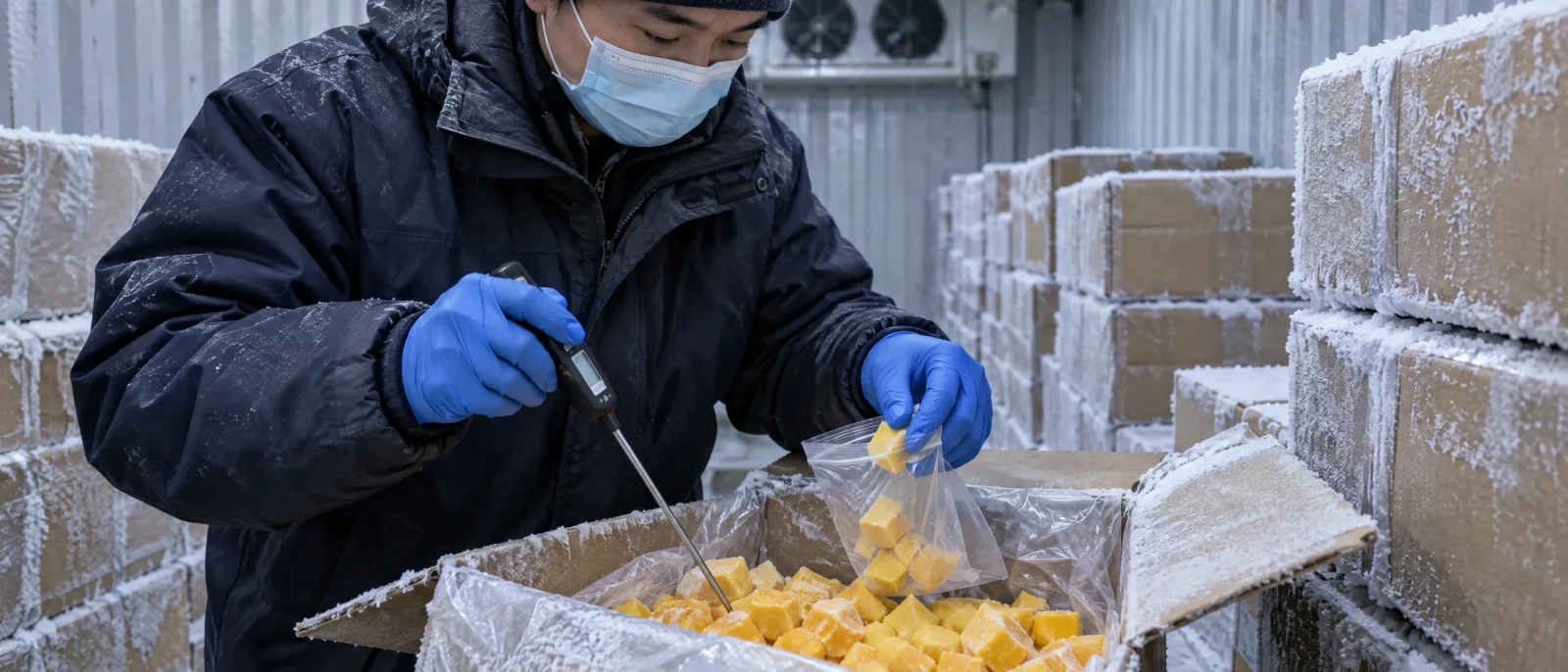
The inspector measures each parameter in a stated sample state. Core temperature is taken frozen, by drilled probe. Broken pieces are sieved frozen. Defects are counted after a thaw regime written into the contract. A percentage reported without its sample size and state is not a result: 1% on a 200 g sample and 1% on a 1 kg sample are two different tests.
| Parameter | Value and unit | Method | Instrument |
|---|---|---|---|
| Core temperature at release | −18 °C or colder after thermal stabilisation | Hole drilled ≥2.5 cm with pre-chilled tool, probe accurate to ±0.5 °C | Codex CXS 75-1981; CXC 8-1976 |
| Warmest package in distribution | not above −12 °C | Non-destructive reading between cartons, 2.8 °C tolerance | Codex CXC 8-1976 |
| Net weight | declared mass, glaze excluded | Weigh after glaze removal | Codex CXS 320-2015 |
| Sample unit, dice and pieces | 300 g drained weight | Borrowed structure, stated in contract | Codex CXS 75-1981 (peaches) |
| Foreign material, Class 4 hazardous | 1 per 150 units | Visual, by class | USDA AMS Foreign Material Manual |
| Thaw regime before defect count | 4 °C for 18 h, or 20 °C for 1 h | Chosen and written in contract | No standard; contract term |
Four rules decide whether these readings survive a dispute. First, sieve while frozen and count after thaw. Sieving thawed product breaks pieces and biases every broken-percentage result against the seller, who will reject it. Second, check smell as soon as the carton is opened, before thawing. Third, if drip loss is specified, write the method beside the limit: 200 g frozen on a 2 mm sieve, thawed at 4 °C for 18 h, drained solids weighed. Fourth, visual defect scores depend on who scores them. Only a reference photo set signed by both parties settles that.
Timing matters as well. The USDA Commodity Specification for Frozen Fruit (June 2017) requires inspection not more than 60 days before delivery, a sensible ceiling to copy into private contracts. VinFruits Global’s specification template does not accept a quality line until it states the sample size, the sampling point and who measures before loading, because a tolerance with no sampling plan cannot be proved once the reefer has sailed. A limit such as “no more than 1% peel”, written without sample size, thaw method or the person weighing, is a dead limit.
Is the residue sample part of the same inspection?
No. Pesticide-residue sampling follows its own plan, Codex CAC/GL 33-1999. Under that plan, a lot over 500 kg takes 10 primary samples, and the laboratory sample weighs at least 1 kg. One “pre-shipment inspection” therefore runs two sampling plans, and the contract should name both.
Microbiology adds a third variable: sample mass. A Salmonella test on 25 g and one on 375 g are different tests. Large buyers ask for 375 g for Salmonella and 125 g for Listeria, by ISO 6579-1 and ISO 11290-1 and -2. If the product is declared ready-to-eat, Regulation (EC) 2073/2005, category 1.19, applies Salmonella at n=5, c=0, not detected in 25 g, throughout shelf life.
For residues, the EU enforcement rule allows for measurement uncertainty. SANTE/11312/2021 sets a default expanded uncertainty of 50% (k=2, 95% confidence) and states:
Compliance with the MRL must be checked by assuming that the MRL is exceeded if the measured value exceeds the MRL by more than the expanded uncertainty.
In plain terms, a result of 2.2 mg/kg against an MRL of 1 mg/kg is non-compliant, because 2.2 − 1.1 = 1.1, which exceeds 1.0. A commercial contract has no such rule unless it writes one. The same lab result can therefore be compliant for an EU authority and a breach of a buyer’s specification. Choose “x > limit” or “x − U > limit”, and write it down.
What should happen to the retained sample?
The retained sample is the only physical evidence of the lot’s state at release from the plant, and no published standard sets how much is kept, at what temperature, for how long or by whom. The contract has to fix each term. Even internal contract drafts disagree on duration, which shows the gap is real.
A retained-sample clause for frozen fruit works when it fixes four things. The first is quantity per production lot. A common structure is three samples: one held by the producer, one shipped to the buyer with the lot, and one sealed and signed by both parties as the referee sample. The second is storage: −18 °C or colder with a continuous temperature record, because a sample stored at the wrong condition is no longer a valid comparison. The third is timing: the referee sample is drawn and sealed at the original sampling before loading, never drawn fresh after a dispute starts. The fourth is duration, stated as shelf life plus a number of months that the parties agree, since no standard supplies it. The producer should also deliver lot records within a set number of days: intake weights, production log, freezing and cold-store temperature charts, metal-detector results, the COA and the raw-material lot list for one-up, one-down trace.
Official controls offer a model. Regulation (EU) 2017/625, Article 35, gives the operator a right to a second expert opinion at its own expense, including analysis of the remaining sample material. The right does not apply where re-analysis is technically impossible or irrelevant, as with some microbiological tests. The same limit binds a commercial referee: retesting a different sample cannot overturn a first Salmonella or Listeria positive.
Who pays for inspection, a failed lot and a referee test?
For most reefers of frozen fruit, who pays is whatever the contract says. Incoterms® 2020 places the checking operations needed to deliver (quality, measuring, weighing, counting) on the seller under A8. It allocates mandatory pre-shipment inspection under A7/B7 by which country imposes it. A voluntary quality inspection ordered by the buyer falls outside both, so the contract has to allocate it.
Allocation by outcome needs no price and holds up in a dispute. One option to write in:
- The buyer appoints the third-party inspector and pays for routine inspection.
- After a critical failure, the whole lot is rejected, and storage, destruction or re-export costs fall on the seller.
- After a major failure over AQL, the options in order are 100% re-sorting at the seller’s cost, a downgrade with a deduction from a schedule agreed in advance, or return. Returning a frozen lot to Vietnam usually costs more than the price difference, so downgrading is usually the better choice.
- The referee laboratory is named in the contract, with a back-up, and is ISO/IEC 17025 accredited for the disputed test. ISO/IEC 17025 accredits specific tests on specific matrices, so check that the scope line covers the analyte, the method and frozen fruit. The referee tests only the jointly sealed sample. Its result is final, and the party whose result deviated pays.
Before blaming a laboratory, check the sample. Most lab disagreements are sample disagreements: a different sampling point, different storage, or frozen versus thawed state. A lab chosen and paid by the producer is fine for routine control but should not be the acceptance basis for high-value lots.
If payment is by letter of credit, do not make an inspection certificate signed by the buyer a required document. Exporters’ bank advisers treat that as a soft clause, because it lets the buyer decide whether to pay, and will ask for it to be struck. Name an independent inspection body instead.
Clauses to paste into the purchase order
Each clause below is a suggested wording. Bracketed values are blanks for the parties to fill.
- Acceptance sampling: Codex CXS 233-1969, AQL 6.5, Inspection Level I; Level II in case of dispute. Lot size N is the number of cartons from a single production lot. Each production lot is accepted or rejected separately.
- Measurement state: broken pieces and fines are sieved frozen; defects are counted after thaw at [4 °C/18 h or 20 °C/1 h]. Core temperature is measured by drilled probe at ≥2.5 cm depth, accurate to ±0.5 °C.
- Retained samples: three sealed samples per production lot, one held by the producer, one shipped with the lot and one signed by both parties as the referee sample, stored at −18 °C or colder with a continuous temperature record for [shelf life + __ months].
- Burden of proof: if [the producer] cannot provide the retained sample or batch records when requested, [the producer] is deemed unable to demonstrate compliance with the specification for that lot.
- Referee laboratory: [named lab, back-up lab], ISO/IEC 17025 accredited for the disputed test, testing the jointly sealed sample; result final and binding; cost borne by the party whose result deviates.
- Compliance rule: a result exceeds a limit when [x > limit, or x − U > limit].
- Optional: temperature data loggers at the door, middle and rear of the container; a recorded breach is grounds for rejection independent of the sensory result.
A producer with real traceability accepts clause 4 quickly. Hesitation at that line tells you something about the records behind the lot.
Common questions
How many cartons should be opened in a pre-shipment inspection of frozen fruit?
Under the Codex CXS 233-1969 table at AQL 6.5, Inspection Level I, a lot of 601 to 2,000 cartons over 4.5 kg net calls for 13 cartons opened, with up to 2 defectives accepted. The number depends on lot size counted in cartons and on package weight, so the contract must define the lot as one production lot.
Is a whole container one lot for sampling purposes?
Not unless it holds a single production lot. EU law defines a lot by production under practically the same conditions. Treating a mixed container as one lot raises the acceptance number and can let a bad production lot pass, so each production lot should be sampled and judged on its own.
How long should retained samples of frozen fruit be kept?
No published standard sets a duration, quantity or holder for frozen fruit retained samples. The contract must fix it, usually as shelf life plus an agreed number of months, with samples stored at −18 °C or colder under a continuous temperature record and a referee sample sealed by both parties at loading.
Who pays for pre-shipment inspection of frozen fruit?
Incoterms 2020 does not allocate a voluntary quality inspection ordered by the buyer, so the contract decides. A common split has the buyer pay routine inspection, the seller pay re-sorting and the costs of a critical failure, and the party whose result the referee laboratory contradicts pay the referee test.
Can a referee test overturn a positive Salmonella result?
No. Retesting a different sample cannot overturn a first Salmonella or Listeria positive, because a negative on other material does not show the first portion was clean. Regulation (EU) 2017/625, Article 35, also excludes a second opinion where re-analysis is technically impossible or irrelevant, which covers some microbiological tests.