On this page
- What does “60 °Brix” actually commit a supplier to?
- Is pineapple juice concentrate HS 2009.41 or 2009.49?
- How much juice does 1 kg of concentrate make?
- Will the reconstituted juice meet the US standard, 21 CFR 146.185?
- Which microbiology and residue lines belong in the contract?
- Cloudy or clarified: what does a Vietnamese data sheet describe?
- Frozen drum or aseptic bag?
- Where does Vietnamese pineapple concentrate come from?
- What should the purchase order say?
- Common questions
- Related insights
Pineapple juice concentrate is traded at 60 ±1 or 65 ±1 °Brix and classified under HS 2009.49 because it exceeds 20 °Brix. It is reconstituted to 12.8 °Brix under Codex, EU and US rules. A workable order fixes five things: the Brix method (IFU No.8 at 20 °C), acidity expressed as anhydrous citric acid, the Brix/acid ratio, pulp, and frozen or aseptic packing.
What does “60 °Brix” actually commit a supplier to?
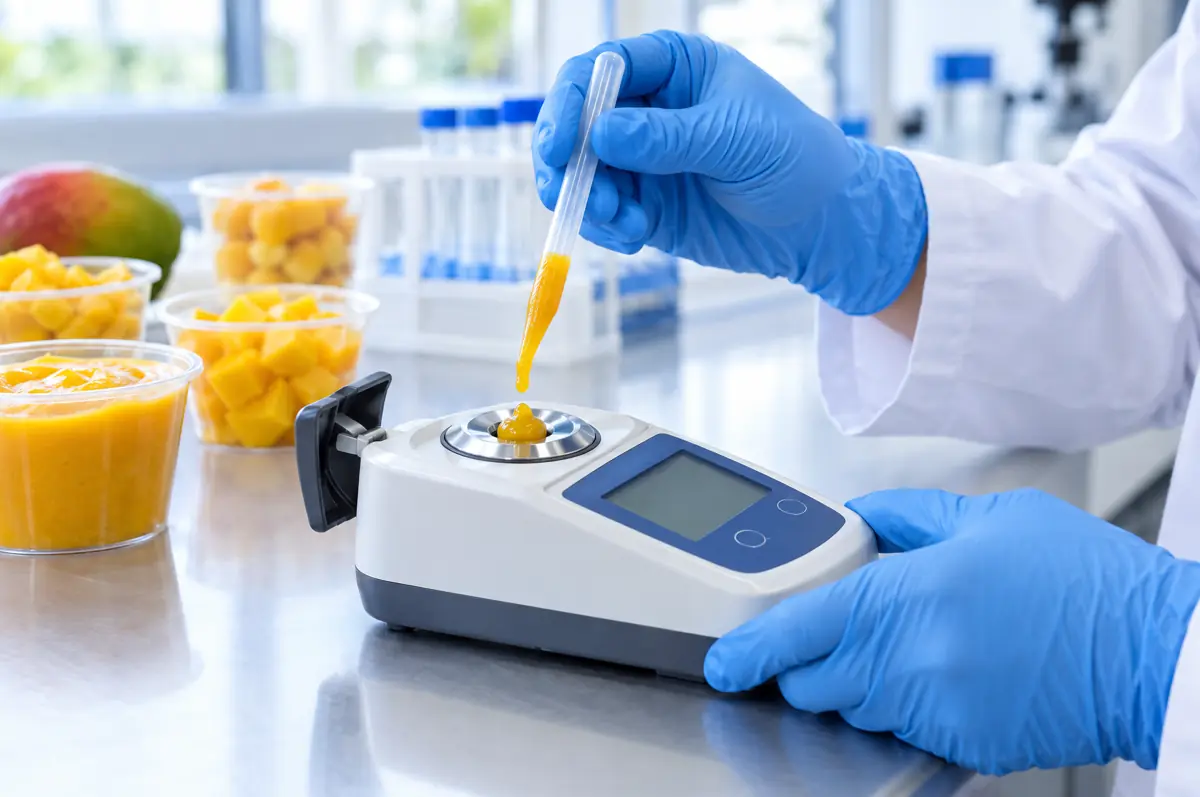
A grade of 60 ±1 °Brix commits the supplier to a refractometer reading between 59 and 61. That commitment only holds once the contract names how the reading is taken. IFU No.8, equivalent to AOAC 932.12, reads at 20 °C and records the measurement temperature. Frozen lots are read after thawing. The guide to reading a fruit certificate of analysis sets out the method and temperature fields to look for. If the contract does not name these conditions, two laboratories can report the same drum as two different numbers.
The word “concentrate” itself has no single floor. Four texts draw four lines for the same product:
| Text | Threshold (°Brix) | Measurement basis | Instrument |
|---|---|---|---|
| Codex general standard for juices | at least 19.2 (50 % above 12.8) | reconstituted level of 12.8 °Brix | CXS 247-2005; TCVN 7946:2008 (identical) |
| Harmonized System | above 20 | Brix read at 20 °C | HS Chapter 20 subheading note; 2009.41 / 2009.49 |
| Vietnamese sector standard Nước dứa cô đặc | at least 27 % soluble solids | refractometer at 20 °C, acid-corrected | 10TCN 417-2000, Decision 56/2000/QĐ-BNN-KHCN |
| Trade grades | 60 ±1 and 65 ±1 | refractometer, method per contract | published Vietnamese producer data sheets |
The gap between these texts runs from 19.2 to 27 °Brix. A product at 22 to 26 °Brix is concentrate under Codex and classified in 2009.49 under the HS, but it falls below the floor of the Vietnamese sector standard. That case is real: one Vietnamese beverage-trade listing quotes a range of 22 to 60 °Brix. The same standard, 10TCN 417-2000, also gives the frozen product its own name, nước dứa cô đặc lạnh đông (frozen pineapple juice concentrate).
The second divergence concerns the acid correction. 10TCN 417-2000 asks for an acid-corrected reading. The pineapple figure in Annex V of Directive 2012/12/EU also assumes a density and acid correction. A certificate that reports a plain refractometer value is not measuring the same quantity. Check the word “corrected” on the certificate before you compare it with anything. For frozen lots, the sampling-state point is covered in the comparison of aseptic and frozen fruit purée.
Is pineapple juice concentrate HS 2009.41 or 2009.49?
At 60 or 65 °Brix, pineapple juice concentrate is HS 2009.49. Subheading 2009.41 covers pineapple juice of a Brix value not exceeding 20. Subheading 2009.49 covers the rest. Under the Chapter 20 subheading note, Brix is read at 20 °C. Because the Codex concentrate floor sits at 19.2 °Brix and the HS line at 20, a product between those two values is concentrate under Codex and TCVN 7946:2008 but still classified in 2009.41.
Write 2009.49 into the purchase order and onto the commercial invoice in the same words. This article publishes no EU duty rate for 2009.49. Look up the rate and any EVFTA staging in TARIC against your own entry date.
How much juice does 1 kg of concentrate make?
By mass, 1 kg of 60 °Brix concentrate makes about 4.69 kg of 12.8 °Brix juice, because 60 ÷ 12.8 = 4.69. That means adding about 3.69 kg of water. The same calculation gives about 5.08 kg of juice from 1 kg of 65 °Brix concentrate. These figures are approximate, because °Brix only approximates percent soluble solids by mass. That is why contracts settle on a Brix value measured by a named method.
Dilution ratios quoted in parts by volume run higher than mass ratios. A litre of 65 °Brix concentrate weighs considerably more than a litre of juice. If you read a volume ratio as kilograms, the yield per kilogram is overstated, and any price comparison built on that figure inherits the error.
The clean way to compare a 60 °Brix offer with a 65 °Brix offer is to convert both to kilograms of soluble solids. One kilogram of 60 °Brix carries 0.60 kg of solids, and one kilogram of 65 °Brix carries 0.65 kg. Divide each price by that figure. Settle the delivered quantity on the same basis, measured by IFU No.8 at 20 °C. Then a lot that arrives at 59.2 °Brix is paid as 59.2, not as 60.
Will the reconstituted juice meet the US standard, 21 CFR 146.185?
Under US 21 CFR 146.185, pineapple juice made from concentrate must meet four conditions. It must reach at least 12.8 °Brix. It must carry no more than 1.35 g of acid per 100 mL, expressed as anhydrous citric acid. It must hold a Brix/acid ratio of at least 12. Its label must say “from concentrate”.
The Brix/acid ratio of pineapple juice concentrate does not change when water is added, because Brix and acidity fall by the same factor. A buyer can therefore test a 60 °Brix certificate of analysis before any dilution. The reconstituted juice meets the US ratio floor only if titratable acidity on the concentrate is 5.0 % or less (60 divided by 12).
One published Vietnamese producer data sheet gives titratable acidity of 1.7 to 4.0 % and a ratio of 15 to 35. That clears the US floor across its whole range. Acidity should be measured by IFU No.3, titrated to pH 8.1.
Two traps sit inside the same certificate.
The first is the acid basis. The US text counts anhydrous citric acid. A certificate that expresses acidity as citric acid monohydrate reads about 9 % higher for the same juice, because the molar masses are 210.14 and 192.12. Converted to the anhydrous basis, a lot that looks borderline on a monohydrate certificate may pass. The contract should state which acid the result is expressed as.
The second trap is which limit binds. At exactly 12.8 °Brix, a ratio of 12 permits less acid than the 1.35 g/100 mL cap allows. So at label-minimum Brix, the ratio floor binds before the acidity cap does. If you dilute to the legal minimum, the ratio on the certificate is the number that decides compliance.
Under 21 CFR 120.1, “juice” includes concentrates. The producing plant therefore needs a juice HACCP plan, and the US importer verifies the supplier under 21 CFR 120.14.
Which microbiology and residue lines belong in the contract?
Two lines matter most: Alicyclobacillus and pesticide residues. Neither appears with a numeric limit on any published Vietnamese pineapple concentrate data sheet. Both therefore have to be written into the specification.
Alicyclobacillus spores survive the thermal steps of juice processing. Pall reports a D₉₅ of 0.06 to 5.3 minutes, and Merck reports 2 to 15 minutes. On either figure, a normal acid-food process at about 93 to 95 °C does not reliably kill them. The industry figures published by those two companies put the spores in 15 to 75 % of juice concentrates. They also report that 60 % of companies in the sector have had a spoilage incident, and that 35 % attribute it to A. acidoterrestris. The spoilage signal is guaiacol, a medicinal, antiseptic note detectable at about 2.23 ppb in apple juice. The method to name is IFU MM12:2019, with a heat shock of 80 °C for 10 minutes and a criterion of not detected in 10 g. Do not cite IFU No.12 here: that number belongs to a different method, for HMF, and citing it by mistake invites a dispute.
VinFruits Global writes an Alicyclobacillus line into every juice and concentrate specification: IFU MM12:2019, not detected in 10 g. A spore that survives the evaporator passes the certificate and shows up later as an antiseptic off-note in the buyer’s tank.
Residues are concentrated along with the juice. Evaporation removes water and leaves pesticide residue behind, scaled up by the concentration factor. Take a fruit lot carrying 60 % of its MRL and concentrate it five-fold: the product now carries 300 % of that level. In the EU, Article 20 of Regulation (EC) No 396/2005 applies MRLs to processed products through a processing factor. Guidance SANTE/10704/2021 Rev 1, applicable from 19 March 2025, sets out the approach: the processed-product limit equals the processing factor multiplied by the MRL of the raw commodity. The due-diligence burden sits with the food business operator.
For pineapple, the specific risk is ethephon, which growers use to force flowering. EFSA reviewed ethephon MRLs in 2024 (EFSA Journal 2024;22:8757). Look up the current pineapple limit in the EU Pesticides Database rather than relying on a figure in a data sheet. Heavy metals now fall under Regulation (EU) 2023/915, which replaced Regulation 1881/2006. Read the juice entries in its Annex I directly. Peeling does not lower metals, because they enter the fruit from the soil through the roots.
Cloudy or clarified: what does a Vietnamese data sheet describe?
Published Vietnamese data describes cloudy pineapple concentrate. No Vietnamese technical data sheet for a clarified grade has been found. Clarified product is therefore specified by agreement, with a turbidity method named in the contract. A 65 °Brix figure does not mean clarified: one producer lists 65 ±1 °Brix with clarity unstated.
| Parameter | Published Vietnamese figure | Unit | Test method |
|---|---|---|---|
| Soluble solids | 60 ±1; 65 ±1 | °Brix | IFU No.8 / AOAC 932.12, 20 °C |
| Titratable acidity | 1.7 to 4.0 | % (acid basis to be stated) | IFU No.3, to pH 8.1 |
| Brix/acid ratio | 15 to 35 | ratio | calculated from the two lines above |
| Pulp (cloudy) | 4 to 8 | % v/v | centrifuge, speed and time stated |
| pH | not published | pH units | IFU No.11 / AOAC 981.12 |
| Alicyclobacillus | not published | per 10 g | IFU MM12:2019 |
No Vietnamese source publishes a pH for pineapple concentrate. Ask the plant for one, and bind it in the contract alongside titratable acidity. If the contract specifies pH alone, a plant can pass by changing the acid it measures against.
US data sheets do publish pH ranges, of 3.2 to 4.0 for one producer and 3.0 to 4.5 for one distributor. They describe US product and are not a substitute for a figure from the plant you are buying from.
Frozen drum or aseptic bag?
One published Vietnamese data sheet describes frozen product; another producer page lists ambient storage. The frozen sheet gives a storage temperature of −18 °C or colder, a minimum shelf life of 24 months, and packing in steel drum, carton or pail with double poly liners. No Vietnamese source gives a net weight for a frozen pineapple concentrate drum, so that figure has to come from the quotation.
| Format | Storage (°C) | Shelf life (months) | Container | Instrument or source document |
|---|---|---|---|---|
| Frozen, Vietnamese data sheet | −18 or colder | minimum 24 | reefer | published Vietnamese producer data sheet |
| Ambient drum, Vietnamese product page (read as aseptic) | ambient | 24 | dry container | published Vietnamese producer page |
| Frozen, US producer sheet (contrast only) | frozen | 36 | reefer | US producer technical data sheet |
| Frozen, distribution limit | −18; warmest package not above −12 | not set | reefer | Codex CXC 8-1976 |
The two 24-month figures describe different products. One is frozen at −18 °C. The other sits on a product page next to ambient storage, alongside a drum weight of 260 kg net and 277 kg gross. That drum weight belongs to the ambient format and should not be applied to a frozen order.
Two packing rules hold regardless of supplier. Frozen concentrate travels in a reefer, and aseptic concentrate travels in a dry container. An aseptic bag must never be frozen: warehouse guidance from WFLO notes that aseptic packaging is not designed for frozen use, because the plastics can become brittle or break.
Where does Vietnamese pineapple concentrate come from?
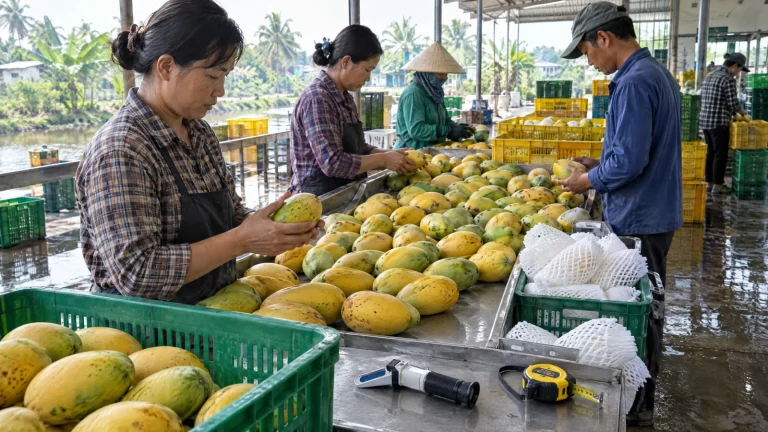
In Vietnam, pineapple concentrate is made from cannery peel, core and trim that is pressed, filtered and concentrated to 60 °Brix, so production runs beside a canning line. The main processing regions are Ninh Bình (Đồng Giao and Tam Điệp), Thanh Hóa and Nghệ An, and Cayenne and Queen are the processing varieties. Variety matters less for concentrate than for canned fruit, because the specification turns on juice and Brix rather than on the appearance of the fruit.
That supply route carries into the order at the following points.
Season. The main crop runs from April to June. Government reporting in August 2025 put off-season fruit, forced with ethephon, at 30 to 40 % of planted area. That is the reason to require an ethephon result on every lot.
Origin. Trade data shows Vietnam importing pineapple concentrate from Indonesia and China. A lot leaving Vietnam is therefore not automatically wholly obtained there. Write into the contract a plant declaration that the fruit in each lot is Vietnamese-grown.
Destination filings. For China, GACC Decree 280 took effect on 1 June 2026. Juice does not appear to be among the categories needing official recommendation, so plants register themselves through CIFER. For Japan, an import notification is filed for each consignment under Article 27 of the Food Sanitation Act.
What should the purchase order say?
The purchase order should turn each line of the data sheet into a test with a method attached. The clauses below close the gaps described above. Fill the bracketed values from your own specification.
- Product: pineapple juice concentrate, 60 ±1 °Brix, [cloudy / clarified]. HS 2009.49. Origin Vietnam. The producer declares in writing, for each lot, that the fruit is 100 % Vietnamese-grown.
- Brix: IFU No.8 at 20 °C, [acid-corrected / uncorrected], measured after thawing for frozen lots. Quantity is settled on kg of soluble solids by this method.
- Titratable acidity: [range] % w/w as anhydrous citric acid, IFU No.3 to pH 8.1. pH: [range], IFU No.11. Brix/acid ratio: [range]. If US-bound, the reconstituted juice meets 21 CFR 146.185.
- Pulp (cloudy): [range] % v/v by centrifuge, with speed and time stated. Clarified: [limit], with the turbidity method stated.
- Alicyclobacillus: not detected in 10 g, IFU MM12:2019, every lot.
- Residues: the finished concentrate complies with destination MRLs as applied under Article 20 of Regulation (EC) No 396/2005. The lot report includes ethephon.
- Frozen packing: double food-grade PE bags in a steel drum, at −18 °C or colder. The warmest package is not above −12 °C in transit. Net kg per drum is stated. Aseptic packs, if agreed, are never frozen.
Common questions
What HS code is pineapple juice concentrate?
Pineapple juice concentrate at 60 or 65 °Brix is classified under HS 2009.49. Subheading 2009.41 covers pineapple juice of a Brix value not exceeding 20, read at 20 °C under the Chapter 20 subheading note. Anything above 20 °Brix falls into 2009.49. Check the duty rate and any EVFTA staging in TARIC for your entry date.
How much juice does 1 kg of 60 °Brix pineapple concentrate make?
By mass, about 4.69 kg of juice at 12.8 °Brix, the reconstitution level used by Codex, the EU and the US. That means adding about 3.69 kg of water. A 65 °Brix concentrate makes about 5.08 kg. Ratios quoted in parts by volume run higher, so compare offers on kilograms of soluble solids.
Do Vietnamese producers publish cloudy or clarified pineapple concentrate?
Published Vietnamese data describes cloudy pineapple concentrate. One producer data sheet gives pulp of 4 to 8 %. No Vietnamese technical data sheet for a clarified grade has been found, and a 65 °Brix figure does not by itself mean clarified. A clarified grade is specified by agreement, with a turbidity method named in the contract.
Should pineapple concentrate be bought frozen or aseptic?
One published Vietnamese data sheet describes frozen product: steel drum with double poly liners, at −18 °C or colder, with a minimum shelf life of 24 months; another producer page lists ambient storage. Frozen concentrate ships in a reefer and aseptic concentrate in a dry container. No Vietnamese frozen drum weight is published, so the net weight comes from the quotation. An aseptic bag must never be frozen.
Will Vietnamese pineapple concentrate meet the US standard after dilution?
Check the certificate before dilution. The Brix/acid ratio does not change when water is added. 21 CFR 146.185 requires a ratio of at least 12, which at 60 °Brix means titratable acidity of 5.0 % or less. One Vietnamese data sheet gives 1.7 to 4.0 % with a ratio of 15 to 35. Confirm that acidity is expressed as anhydrous citric acid.