On this page
- What is the difference between NFC juice and juice from concentrate?
- What does the Brix figure mean in each spec?
- What does Vietnam’s TCVN 13941:2023 say about the two forms?
- Where does “concentrate” begin, and does it change the HS code?
- What does concentration cost in aroma, residues and spoilage risk?
- What does each form force on the EU and US label?
- How much water does NFC ship, and how much juice does a kilo of concentrate make?
- When should a buyer choose NFC, and when concentrate?
- What clauses belong in the purchase order?
- Common questions
- Related insights
NFC juice is single-strength juice taken from the fruit and never concentrated. From-concentrate juice is evaporated to 50-60 °Brix, shipped, and diluted back to a legal minimum such as 12.0 °Brix for passion fruit under Directive 2012/12/EU. The same Brix figure therefore describes the fruit in one spec and a legal target in the other. That difference drives acid bands, aroma, residues and label wording.
What is the difference between NFC juice and juice from concentrate?
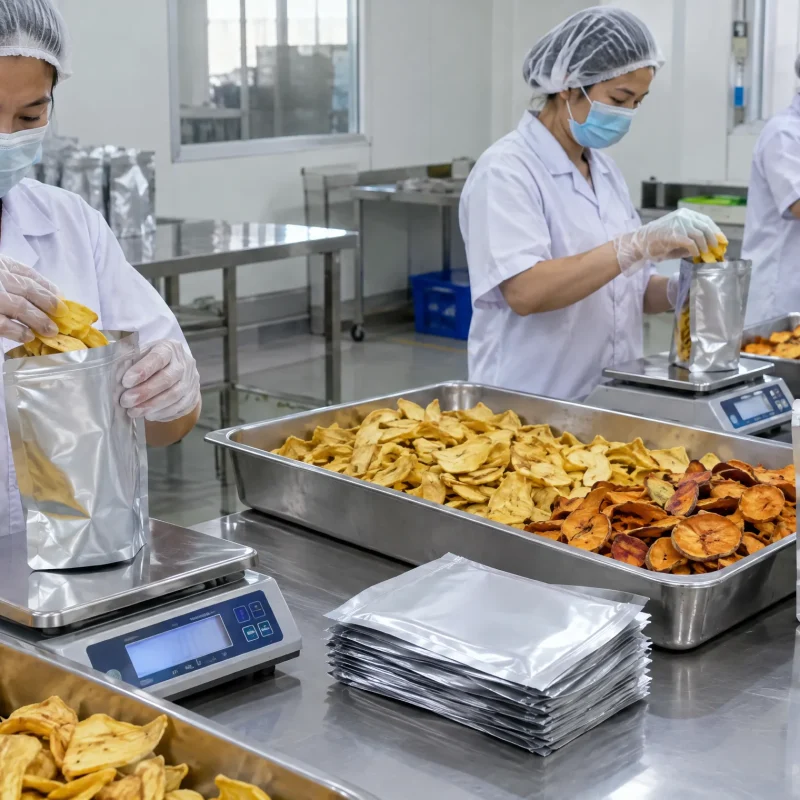
NFC (not from concentrate) juice or purée is extracted, pasteurised and frozen at single strength. Concentrate has most of its water removed and is reconstituted with water by the bottler. On Vietnamese data sheets both ship frozen at −18 °C with a 24-month shelf life. What separates them is freight mass, aroma, residue concentration and the label each one forces.
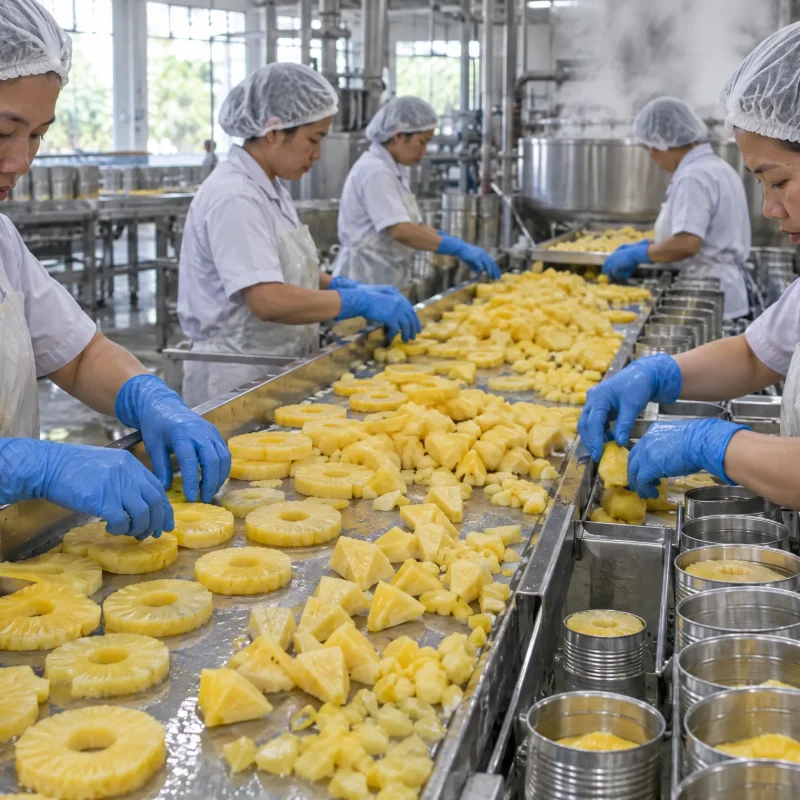
The concentration route on a typical Vietnamese line runs as follows. Pectinase cuts viscosity. A multi-effect vacuum evaporator then takes the juice from about 15 °Brix to 50-60 °Brix, with optional aroma recovery, followed by UHT and filling. NFC skips the evaporator. The fruit’s own volatiles stay in the pack, and so does all of its water.
Frozen NFC is pasteurised, not sterile. The buyer plans its own heat step. If you are weighing frozen drums against ambient packs as well, the trade-offs are set out in aseptic versus frozen fruit purée.
What does the Brix figure mean in each spec?
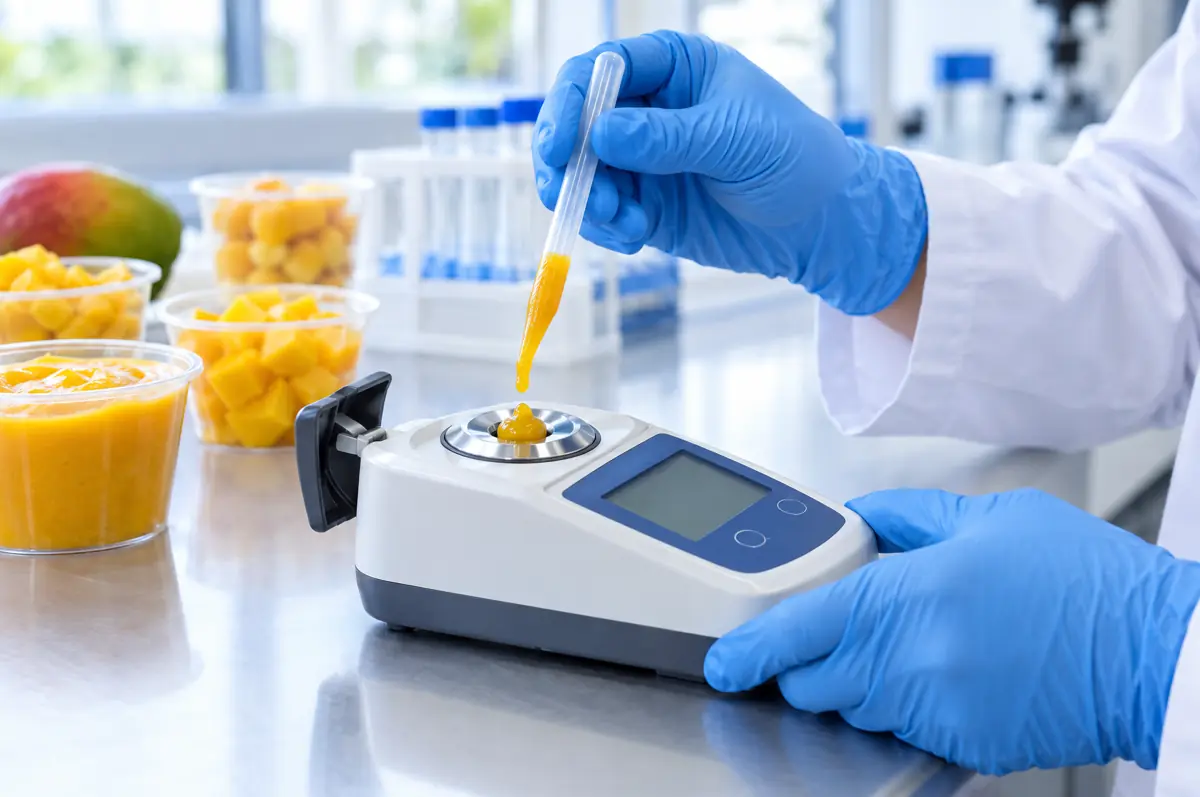
In an NFC spec, Brix describes what the fruit delivered that season. In a from-concentrate spec, Brix is the reconstitution target set by the label law you sell under, and EU law, US law and Codex set it differently. Copying a legal reconstitution figure into an NFC order asks for something the supplier never promised.
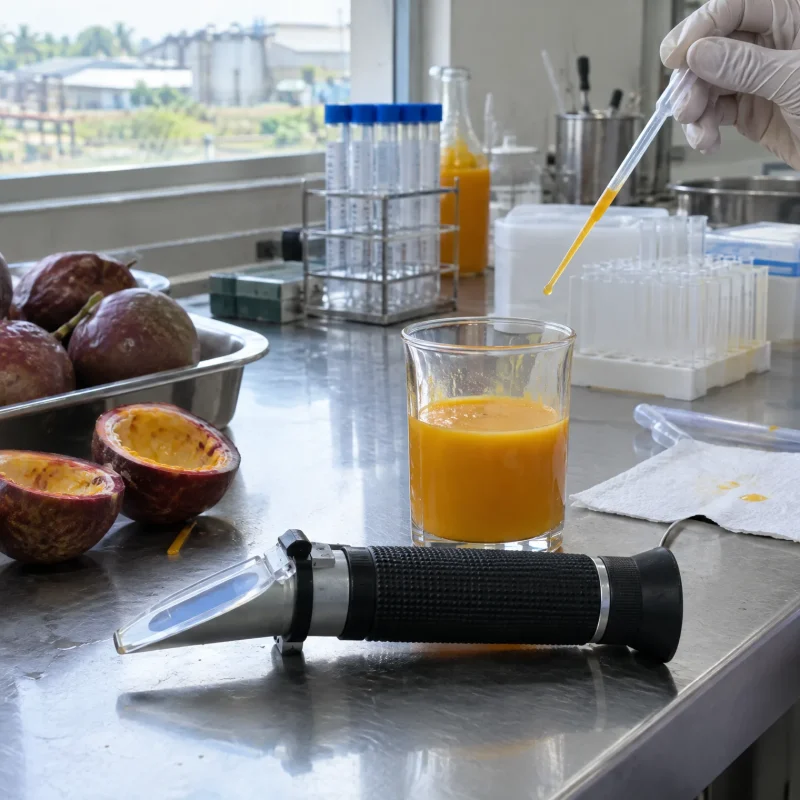
The Brix figures in Directive 2001/112/EC Annex V, as replaced by Directive 2012/12/EU, and in 21 CFR 101.30(h)(1) are reconstitution figures. They give the soluble solids that a juice or purée made from concentrate must reach, or the basis on which percentage juice is declared. EU law sets passion fruit at 12.0 °Brix, pineapple at 12.8, mango purée at 13.5 and guava purée at 8.5. The US table sets passion fruit at 14.0 °Brix, pineapple at 12.8, mango at 13.0, guava at 7.7 and soursop at 16.0. Vietnamese single-strength data sheets publish lower floors for three tropical fruits: mango purée at 11.5 °Brix, guava purée at 7 and soursop purée at 11. Passion fruit NFC is the exception. Its floor of 13.0 °Brix, read by refractometer at 20 °C after thawing, clears the EU 12.0 but not the US 14.0. A buyer who copies an Annex V figure into an NFC purchase order is asking for a Brix that the Vietnamese sheet does not promise.
| Fruit | Vietnamese NFC floor (°Brix) | EU Annex V (°Brix) | US 21 CFR 101.30(h)(1) (°Brix) | Codex CXS 247-2005 (°Brix) | Instrument behind the Vietnamese floor |
|---|---|---|---|---|---|
| Passion fruit | 13.0 (sheet) / 13.5 (TCVN) | 12.0 | 14.0 | 12.0 | Producer data sheet; TCVN 13941:2023, refractometer at 20 °C after thawing |
| Mango purée | 11.5 | 13.5 | 13.0 | 13.5 | Producer data sheet |
| Guava purée | 7 | 8.5 | 7.7 | not held | Producer data sheet |
| Soursop purée | 11 (12.0 on one listing) | no entry | 16.0 | 14.5 | Producer data sheet |
| Pineapple | not held | 12.8 | 12.8 | 12.8 | No Vietnamese NFC sheet held |
Two consequences follow. A from-concentrate mango built to the EU minimum can be sweeter than the NFC of the same fruit, at 13.5 against 11.5. And for passion fruit sold in Europe, the figures disagree. EU law and Codex say 12.0. CBI’s market guidance says 13.5 reconstituted. CBI also reports that the AIJN reference of 12.4 is under review towards 10.5. The legal figure is 12.0. A lot that lands between 12.0 and 13.5 is legal and may still fail a buyer who wrote the CBI number into the contract.
What does Vietnam’s TCVN 13941:2023 say about the two forms?
TCVN 13941:2023 Chanh leo đông lạnh (frozen passion fruit) covers frozen pulp, purée, juice, and concentrated purée and juice in one document. It sets different bands for the two forms. Those bands do not line up once you dilute concentrate back to single strength.
For the single-strength form, the standard sets soluble solids at 13.5 % minimum after thawing. Titratable acidity is 2.5-5.0 %, pH is 2.3-3.5, and storage is no warmer than −18 °C. For concentrate, it sets titratable acidity at 10.0-16.0 %. The soluble-solids clause for the concentrate form is in the paywalled part of the text and has not been read. This article therefore states no TCVN Brix for concentrate.
The arithmetic matters here. Dilute the TCVN concentrate band from 50 °Brix to the EU minimum of 12.0 °Brix, and 10.0-16.0 % becomes 2.40-3.84 %. The bottom of that range sits below TCVN’s own single-strength floor of 2.5 %. This assumes both bands are % w/w on the same basis, which the standard’s method clause should confirm. In other words, juice reconstituted from a TCVN-compliant concentrate can fail TCVN’s own NFC acid band. For a passion fruit contract, name the standard and say which Brix floor binds, 13.0 from the producer sheet or 13.5 from TCVN. The concentrate side of this is covered in passion fruit concentrate at 50 °Brix.
Where does “concentrate” begin, and does it change the HS code?
For pineapple, three texts draw three different lines, and only the HS line moves the customs code. For passion fruit, the HS draws no line at all: NFC and concentrate share heading 2009.89.
| Text | Concentrate begins at (°Brix) | How the line is drawn | Measurement |
|---|---|---|---|
| Codex CXS 247-2005 / TCVN 7946:2008 | 19.2 | At least 50 % above the 12.8 reconstituted level | Brix of the product |
| HS Chapter 20 | above 20 | 2009.41 at 20 °Brix or less, 2009.49 above | Brix at 20 °C (subheading note) |
| 10TCN 417-2000, Decision 56/2000/QĐ-BNN-KHCN | 27 | Minimum soluble solids for nước dứa cô đặc | Refractometer at 20 °C, acid-corrected |
| Commercial grade (producer sheets) | 60 or 65 | Traded specification, ±1 | Refractometer at 20 °C |
A pineapple juice at 22 °Brix counts as concentrate under Codex and TCVN 7946. It is 2009.49 under the HS. It is not concentrate under 10TCN 417-2000. Check that the declared HS line matches the Brix on the certificate of analysis against the 20 °Brix split.
Passion fruit juice is 2009.89 whether NFC or 50 °Brix concentrate. The common EU line is CN 2009 89 97 for unsweetened tropical juice up to 67 °Brix. Purée with pulp may go to 2008.99; CBP ruling N320885 classed aseptic mango pulp there. The customs code cannot tell you which passion fruit form you bought, so the label and the COA’s Brix have to. The full heading map is in HS codes for fruit purée, pulp and concentrate.
What does concentration cost in aroma, residues and spoilage risk?
Concentration costs aroma unless the plant recovers it. It multiplies residues by the Brix ratio. It does nothing to remove the spore-former that spoils both forms. NFC keeps the fruit’s volatiles and carries residues at roughly field level.
Aroma. Passion fruit aroma is carried by volatile esters that heat drives off in the evaporator. Concentrate made without aroma recovery is known in the Vietnamese trade as dead-aroma (chết hương) and is discounted or rejected. Plants that run recovery often sell the aroma fraction as a separate product. Ask on each COA whether aroma was recovered, and whether it was returned to the concentrate or sold off. Pectin also matters to the buyer indirectly. Passion fruit juice is rich in it, and it fouls evaporators, so enzyme dose and temperature decide how hard the line has to run.
Residues. Pressing gives a processing factor of about 1, or above 1 for water-soluble substances. Concentration raises residues by the Brix ratio. From 13.5 to 50 °Brix is a 3.7× mass concentration. As an illustration rather than measured data, a residue at 30 % of a limit in NFC arrives at about 110 % in the concentrate. Article 20 of Regulation (EC) No 396/2005 applies MRLs to processed products through processing factors. In practice, the raw fruit for concentrate should be held to roughly the MRL divided by the concentration factor. No public processing factors exist for named actives in passion fruit or pineapple concentrate, so the contract has to carry the requirement.
Alicyclobacillus. Spores are found in 15-75 % of juice concentrates. In one industry survey, 60 % of companies reported a spoilage incident and 35 % attributed it to A. acidoterrestris. The organism survives acid-food pasteurisation at about 93-95 °C. It does not swell the pack or shift the pH, and its off-note is guaiacol, read as medicinal or antiseptic. It applies to NFC and concentrate alike. The method is IFU MM12:2019 with an 80 °C × 10 min heat shock. Do not confuse it with IFU No. 12, which is an HMF method.
What does each form force on the EU and US label?
The label follows the form. In the EU, juice reconstituted from concentrate is a different legal product from fruit juice, and it carries the words from concentrate. In the US, the from-concentrate declaration and the percentage-juice basis both depend on the Brix tables. NFC is a trade term in both markets, not a defined legal name.
In the EU, Directive 2001/112/EC, as amended, defines separate products: fruit juice, fruit juice from concentrate, concentrated fruit juice, and water-extracted and dehydrated juices. The legal name for what the trade calls NFC is simply fruit juice. Juice from concentrate is labelled from concentrate or made from concentrate next to the product name. A blend of the two is labelled partially from concentrate. Directive 2012/12/EU removed added sugars from the products authorised as fruit juice. It also deals with restoring flavour to juice from concentrate. If you bottle in the EU, a concentrate made without aroma recovery leaves you sourcing the aroma elsewhere.
In the US, 21 CFR 146.185 requires pineapple juice made from concentrate to reach at least 12.8 °Brix, with acidity not more than 1.35 g anhydrous citric acid per 100 mL and a Brix/acid ratio of at least 12. It is labelled “from concentrate”. More generally, 21 CFR 102.33 requires the name of a juice made from concentrate to say so, as from concentrate or reconstituted. The 101.30(h)(1) table is the Brix basis for declaring percentage juice. Whether and how that table treats directly expressed juice, such as NFC mango at 11.5 °Brix, has not been settled here. Read 101.30(h) in full before printing a percentage on a blend.
Because the label wording depends on the form, the form has to be traceable at the drum. VinFruits Global specifies the NFC status on the drum label beside the lot and plant registration code, so the form that decides your label wording travels with the drum rather than only with the paperwork.
US food safety adds a separate requirement. Under 21 CFR 120.1, juice includes purées and concentrates, so both forms fall under juice HACCP, and the importer verifies under 120.14. Section 120.24 requires a 5-log pathogen reduction. It exempts certain thermal processes, including a concentration step that treats all of the juice. Frozen NFC is pasteurised, not sterile, so for NFC into the US, the processor’s own plan has to carry a validated 5-log step.
How much water does NFC ship, and how much juice does a kilo of concentrate make?
Per tonne of fruit solids, passion fruit NFC ships 3.7 times the mass of 50 °Brix concentrate. Pineapple NFC ships 4.7 times the mass of 60 °Brix concentrate. Both travel frozen at −18 °C, so the whole reefer-freight gap comes from the water, not from a storage difference.
| Product | Brix (°Brix) | Mass per tonne of solids (t) | Yield per kg concentrate (kg) | Basis |
|---|---|---|---|---|
| Passion fruit NFC | 13.5 | 7.41 | n/a | TCVN 13941:2023 floor; °Brix as % solids by mass |
| Passion fruit concentrate | 50 | 2.00 | 4.17 at 12.0 / 3.70 at 13.5 / 3.57 at 14.0 | EU Annex V / TCVN / 21 CFR 101.30(h)(1) |
| Pineapple NFC | 12.8 | 7.81 | n/a | Reconstitution figure; °Brix as % solids by mass |
| Pineapple concentrate | 60 | 1.67 | 4.69 at 12.8 | EU, US and Codex share 12.8 |
Treating °Brix as percent soluble solids by mass is an approximation. That is why a contract names its Brix method and whether the reading is acid-corrected. To compare an NFC offer with a concentrate offer, put both on kg of soluble solids at the same Brix method, and add the reefer freight on the water NFC carries.
When should a buyer choose NFC, and when concentrate?
Choose NFC when the fruit’s own aroma and a not-from-concentrate label are the product. Choose concentrate when you dilute to a target Brix on your own line and freight per kg of solids decides the cost.
| Factor | Choose NFC when | Choose concentrate when |
|---|---|---|
| Label | You sell fruit juice, not from concentrate, and the fruit’s aroma is the selling point | You label from concentrate and work to one reconstitution Brix across seasons |
| Freight | You can carry reefer freight on 3.7-4.7× the mass | Freight and frozen storage per kg of solids decide the cost |
| Residues | Your residue screen has little headroom | Your raw-material control holds residues to MRL ÷ concentration factor |
| Processing | You want minimal adjustment on your line | You blend, adjust acid and add back aroma |
| US food safety | Your plant runs its own validated 5-log step | Your HACCP plan relies on the thermal concentration step and you have documented it |
Storage does not separate the two forms. Both run −18 °C and 24 months on Vietnamese sheets. Supply timing can still matter. Vietnamese passion fruit is harvested all year with a peak from June to December, while pineapple’s main crop runs April to June. Concentrate lets a buyer carry a peak season’s solids into the off-season at a quarter of the mass.
What clauses belong in the purchase order?
Write the form, the Brix and its method, the acid basis and the micro criterion into the order. Do not leave them to the data sheet. These clauses can be adapted directly:
- NFC: Single-strength juice / purée, not from concentrate, nothing added. Soluble solids ≥13.5 °Brix, refractometer at 20 °C after thawing (TCVN 13941:2023 for passion fruit). Titratable acidity 2.5-5.0 % as citric, titrated to pH 8.1. Stored and shipped at −18 °C or colder with the reefer temperature record. Pasteurised; buyer applies its own validated heat step.
- Concentrate: 50 ±1 (or 60 ±1) °Brix, refractometer at 20 °C, acid-corrected yes/no. Bought for reconstitution to 12.0 / 12.8 / 14.0 °Brix under Directive 2012/12/EU Annex V or 21 CFR 101.30(h)(1). Quantity settled on kg of soluble solids. Each COA states whether aroma was recovered and whether it was returned to the concentrate.
- Both forms: Alicyclobacillus not detected in 10 g, IFU MM12:2019, every lot.
- Concentrate: Residues comply with destination MRLs as applied to the processed product under Article 20 of Regulation (EC) No 396/2005.
- Pineapple concentrate into the EU: The exporter supplies the plant’s written confirmation that the concentrate is made from Vietnamese-grown pineapple. Vietnam also imports pineapple concentrate from Indonesia and China, so this letter comes before any EUR.1.
Common questions
What does NFC mean on a juice specification?
NFC means not from concentrate: single-strength juice or purée taken from the fruit, pasteurised and frozen, never evaporated and diluted back. It is trade usage rather than a defined EU legal name; under Directive 2001/112/EC the product is simply fruit juice. On a Vietnamese data sheet an NFC Brix figure describes what the fruit delivered, for example passion fruit at 13.0 °Brix minimum, read by refractometer at 20 °C after thawing.
Does EU law set a minimum Brix for NFC juice?
Not directly. Annex V of Directive 2001/112/EC, as replaced by Directive 2012/12/EU, sets the minimum Brix for juice and purée reconstituted from concentrate: 12.0 for passion fruit, 12.8 for pineapple, 13.5 for mango purée and 8.5 for guava purée. An NFC spec should take its Brix floor from the fruit, the supplier’s data sheet or a standard such as TCVN 13941:2023, which sets 13.5 °Brix for single-strength passion fruit.
How much single-strength juice does 1 kg of concentrate make?
By mass, treating °Brix as percent soluble solids, 1 kg of 50 °Brix passion fruit concentrate makes 4.17 kg at the EU minimum of 12.0 °Brix, 3.70 kg at 13.5 and 3.57 kg at the US figure of 14.0. One kilogram of 60 °Brix pineapple concentrate makes 4.69 kg at 12.8 °Brix, the figure EU law, US law and Codex share.
Do NFC juice and concentrate have different HS codes?
For pineapple, yes: HS 2009.41 covers pineapple juice of 20 °Brix or less, read at 20 °C, and 2009.49 covers the rest, so NFC and 60 °Brix concentrate split. For passion fruit, no: both fall under 2009.89, and the common EU line is CN 2009 89 97. The customs code cannot tell you which passion fruit form you bought; the label and the Brix on the certificate of analysis have to.
Which keeps longer frozen, NFC or concentrate?
Neither, on Vietnamese data sheets. Both forms are stored at −18 °C or colder with a 24-month shelf life, and TCVN 13941:2023 sets the same storage ceiling for single-strength and concentrated passion fruit. What separates them is the 3.7 to 4.7 times more mass NFC ships per tonne of fruit solids, the aroma lost in evaporation, and residues concentrated by the Brix ratio.