On this page
- Which banana variety goes into Vietnamese soft-dried banana?
- Can the variety change the HS code for soft-dried banana?
- What does “no added sugar” rest on, and what can a Brix figure prove?
- How does the recipe change the tariff line and the label?
- What moisture and water activity should you specify for soft-dried banana?
- Which colour, contaminant and residue lines belong on the COA?
- How should soft-dried banana be packed and stored for export?
- What should a soft-dried banana purchase specification contain?
- Common questions
- Related insights
Vietnamese soft dried banana is made from chuối sứ (Siamese banana, genome group ABB) and chuối bơm, not the Cavendish sold fresh in Europe. “No added sugar” rests on a written recipe declaration, not a Brix figure, and the recipe sets the tariff line: 0803.90 plain, 2008.99 sugar-infused. No published norm exists for moisture or water activity, so both go into the contract with the method named.
Which banana variety goes into Vietnamese soft-dried banana?
Vietnamese soft-dried banana is made mainly from chuối sứ, also called xiêm and sold in English as Siamese banana, and from chuối bơm. Drying and purée plants around Thống Nhất and Trảng Bom in Đồng Nai province buy these two types for drying. Cavendish runs in a separate fresh and IQF chain.
A buyer comparing offers tends to picture the banana on a European shelf. That fruit is Cavendish, genome group AAA, and it is the only variety Vietnam exports fresh on a commercial scale. Chuối sứ is ABB and is used for drying, frying, purée and the domestic market. Chuối bơm is classed ABB or AAB and is a low-cost drying raw material. The colour, the dense chew and the sweetness of the finished piece start with that choice.
An offer that does not name the variety leaves the producer free to switch between lots. The defensible specification line gives the Vietnamese name with the English trade name beside it, and records both on the specification and the commercial invoice. Where a programme needs consistency, the contract can require one variety per lot. No published drying-yield figure separates the two types, so any yield claimed by variety should come with the trial it was measured on.
Can the variety change the HS code for soft-dried banana?
Yes. HS heading 0803 splits bananas into 0803.10, plantains, and 0803.90, other bananas, each fresh or dried. Chuối sứ is sometimes treated as a cooking banana. If a buyer or customs officer reads it as plantain, plain dried banana moves from 0803.90 to 0803.10.
In the United States that move changes the duty. HTSUS 0803.90.00.45, other bananas, dried, is Free. HTSUS 0803.10.20.00, “Plantains, dried”, is 1.4%, per the USITC schedule read on 17 October 2026. Neither figure includes 2026 additional duties on Vietnamese goods, which this article does not cover. In the EU the move changes the code and the origin trail, not the rate. CN 0803 90 90, “Bananas, dried (excl. plantains)”, and CN 0803 10 90, “Plantains, dried”, both carry 16% MFN.
No customs ruling on chuối sứ itself has been found, so this is a risk to close rather than a problem on record. Closing it is cheap: name the variety on the specification and the invoice, and for a large US programme obtain a CBP binding ruling before the first lot. The 75 EUR per tonne EVFTA duty that appears in banana costings belongs to the fresh line 0803 90 19, not to dried banana. The full 0803, 0813 and 2008 argument is in the banana chips classification article.
Earlier versions of the soft-dried banana sheet on this site printed 0813.40. The tariff check of 17 October 2026 placed plain dried banana in 0803.90, and the sheet was corrected. What moves banana out of Chapter 8 is the syrup step or frying, not the dryer. For China, dried banana is one of the 25 plant-food items whose producers must be registered through the Vietnamese authority under GACC Decree 280, in force since 1 June 2026, as set out in Vietnamese SPS Office notice 172/SPS-BNNVN of 23 March 2026.
What does “no added sugar” rest on, and what can a Brix figure prove?
“No added sugar” rests on a written recipe declaration stating sugar status and any anti-browning dip. A Brix figure cannot prove it. Soluble solids measured on a dried piece show how far drying concentrated the fruit’s own sugars; they cannot show whether the fruit was soaked in syrup before drying.
This site’s own record shows how easily the two get confused. The soft-dried banana sheet carried “No added sugar” and “Brix ≥ 65 °Bx” side by side until 17 October 2026. The Brix line was removed because no source supported it and it contradicted the sugar claim. On a soft-dried piece, a Brix minimum is jam and syrup vocabulary. An offer that presents one as evidence of no added sugar has mixed up a concentration measurement and a recipe fact, and that is a reason to ask for the recipe before asking for a sample.
VinFruits Global sends a written recipe declaration with each soft-dried banana lot, stating sugar status and any anti-browning dip, because a Brix figure cannot tell an infused piece from a plain one and the declaration is what the label and the tariff line rest on. The declaration travels in the same document set as the certificate; how to read a fruit certificate of analysis covers what each line on that certificate should carry.
An EU “no added sugars” nutrition claim on the retail pack falls under Regulation (EC) No 1924/2006. Read its conditions on EUR-Lex before the claim is printed.
How does the recipe change the tariff line and the label?
The recipe decides the heading. Plain dried banana with no sugar and no oil stays in Chapter 8 at EU CN 0803 90 90. Banana infused with sugar and then dried moves to Chapter 20, heading 20.08, where the EU line depends on pack size. Fried banana without sugar sits at 2008 99 99.
The Chapter 20 mechanism comes from rulings on mango, UK ATaR 600005639 and US CBP NY N230016: the syrup step moved dried fruit into 20.08, while plain and freeze-dried fruit stayed in Chapter 8. No ruling on sugar-infused banana itself has been found; the same mechanism is expected to apply to banana, so confirm it with a binding ruling.
| Recipe | Pack size | EU CN line | EU MFN duty (%) | EVFTA preference | Source |
|---|---|---|---|---|---|
| Plain dried, other banana | Any | 0803 90 90 | 16 | 0% | EU CN 2026, TARIC data of 8 October 2026 |
| Plain dried, read as plantain | Any | 0803 10 90 | 16 | Check TARIC | EU CN 2026, TARIC data of 8 October 2026 |
| Sugar-infused, then dried | Over 1 kg | 2008 99 49 | 17.6 | Reported 0%; confirm ten-digit line | EU CN 2026, TARIC data of 8 October 2026 |
| Sugar-infused, then dried | 1 kg or less | 2008 99 67 | 20.8 | Reported 0%; confirm ten-digit line | EU CN 2026, TARIC data of 8 October 2026 |
The packing point most offers miss sits in the last two rows. The plain product has one EU line from a 10 kg carton to a 200 g pouch. The infused product has two lines, split at exactly 1 kg, at different MFN rates, and a private-label buyer who repacks infused bulk into retail pouches inherits that split. The zero EVFTA rate needs EUR.1 or REX proof of origin. Chapter 20 goods also need a product-specific origin rule, and where the sugar came from can matter to the claim, so settle it with your broker before the first shipment. A wrong heading costs more than the duty difference: origin rules are written by chapter and heading, and the ingredient list on the pack is what exposes a mismatch at post-clearance audit.
The label follows the same recipe. Added sugar goes on the ingredient list. Citric acid, ascorbic acid or sulphite used to hold colour must be declared, and the pack can no longer say “100% banana”. Sulphite above 10 mg/kg as SO₂ must be declared in the EU under Regulation (EU) No 1169/2011, Annex II, point 12, and above 10 ppm in the US under 21 CFR 101.100, where it is a mandatory declaration, not a major allergen. “No preservatives” is stricter than a result under 10 mg/kg: it requires that no sulphite was added at all.
What moisture and water activity should you specify for soft-dried banana?
No published moisture or water-activity figure exists for Vietnamese soft-dried banana, so both limits have to be set in the purchase contract, with the test method named and the result reported on every certificate of analysis. Moisture and water activity, not Brix, are the parameters that control soft-dried banana in the carton, because an under-dried banana moulds from the centre. The EU marketing standard for bananas, Delegated Regulation (EU) 2023/2429, applying since 1 January 2025, covers fresh fruit only, so every tolerance on dried banana is a contract tolerance. Published Vietnamese work on a comparable soft-dried product shows how wide the band runs: passion-fruit rind dried at 70 °C for 4 hours reached 16.10% moisture (Nguyễn Xuân Hồng et al., 2026, DOI 10.52714/dthu.ns.2816.1882), and at 60 °C for 7 to 8 hours reached 10 to 11.5% (Bùi Thị Hồng Phương et al., 2026).
Those are not banana values and are not targets. They show that soft drying in published Vietnamese work runs at 60 to 70 °C, which is why “low-temperature dried” came off this site’s banana copy, and that final moisture varies by several points. The process line you can specify is convective or heat-pump drying until the centre is chewy, not wet. Agree the oven-moisture and a_w meter methods with your destination lab so both sides measure the same thing. The only fixed water-activity line in US law, acidified foods at pH 4.6 or below with a_w above 0.85 under 21 CFR Part 114, does not govern a shelf-stable dried banana.
Which colour, contaminant and residue lines belong on the COA?
The certificate panel for soft-dried banana covers moisture, water activity, SO₂, chlorate, pesticide residues and microbiology, with the recipe declaration alongside. Colour is specified against a signed reference, not an adjective.
Banana carries very high polyphenol oxidase and peroxidase activity, and polyphenol oxidase works best at pH 6 to 7 with oxygen present, so time from peel to dryer decides colour. No colour standard exists for soft-dried banana. The enforceable clause is a signed reference photo set plus a retained sample held at the label’s storage condition. A measured method exists: published work on freeze-dried banana scored browning with a chroma meter index, which a contract can name if both labs hold the instrument.
Chlorate has an EU limit of 0.3 mg/kg for banana under the framework of Regulation (EU) 2020/749. In a processing plant it usually comes from chlorinated wash water rather than the field, so wash-water control belongs in the plant audit. For residues, the EU banana MRL is set on the whole fruit after removal of the crown, peel included, under Commission Regulation (EU) No 752/2014, product code 0163020. Dried banana is peeled pulp, concentrated by drying, so the result is judged under Article 20 of Regulation (EC) No 396/2005 with guidance SANTE/10704/2021 Rev 1, in force since 19 March 2025. Some US limits are stricter for pulp: azoxystrobin is 0.1 ppm on pulp against 2.0 ppm on whole banana under 40 CFR 180.507. Microbiological criteria are agreed in the contract, with methods named.
How should soft-dried banana be packed and stored for export?
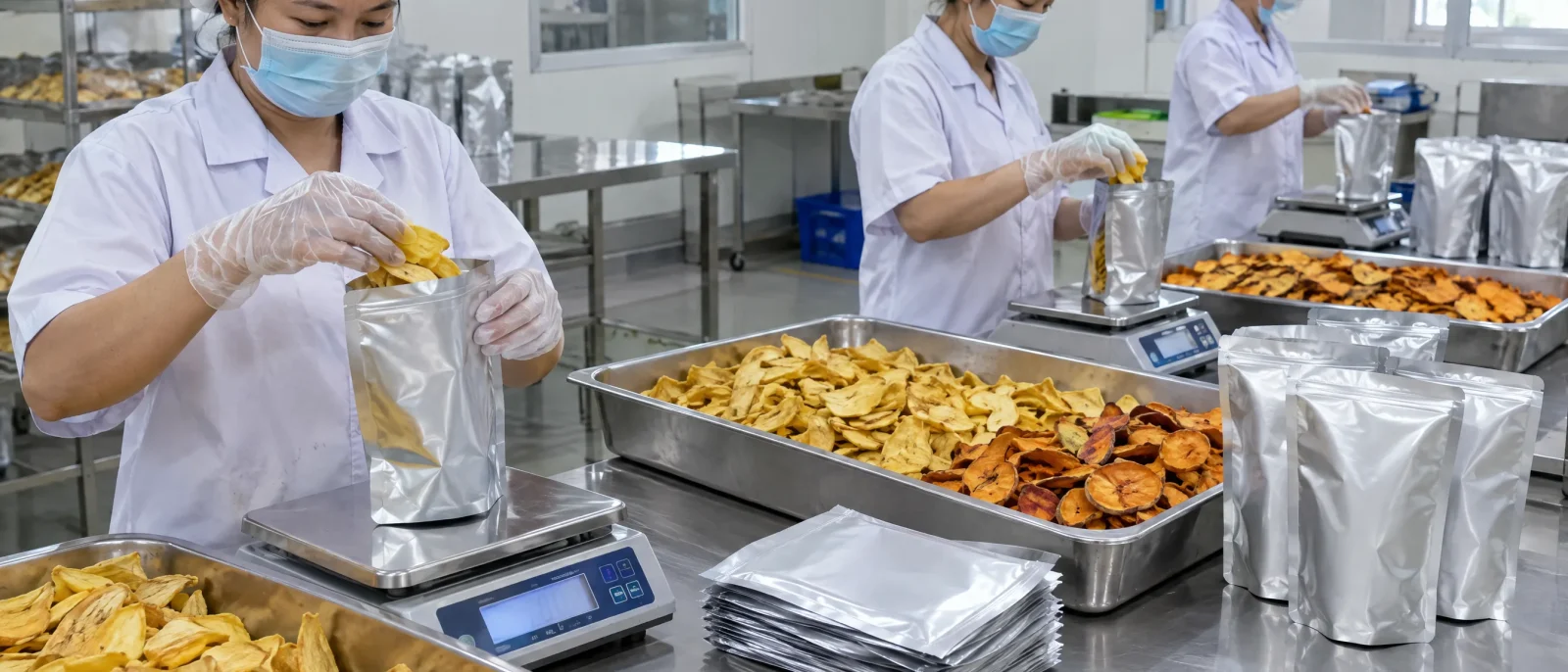
Packing exists to protect the moisture you specified. The common bulk format is a 10 kg carton with a sealed food-grade PE liner. Write the liner gauge and colour into the specification; blue is recommended so fragments are detectable on the line. Retail formats follow the buyer’s artwork, and the 1 kg boundary matters only for infused product.
The supplier-stated storage condition is cool and dry, at or below 25 °C and below 65% relative humidity, with 12 months ambient shelf life from production. No published storage trial behind those figures has been found, so treat them as the supplier’s statement and confirm them with a_w and colour checks on retained samples. Opened cartons should be resealed, because dense banana picks up moisture at the surface, and stock rotated first in, first out.
Three clauses belong beside the packing line: testing no more than 60 days before shipment, at least 75% of shelf life remaining on arrival, and retained samples kept to shelf life plus six months at the label condition.
What should a soft-dried banana purchase specification contain?
Every line needs five cells: the parameter, the limit with unit and basis, the test method, the sample size and sampling point, and who measures and when. A line missing any of them cannot be enforced in a dispute. The specification is a signed annex with version and date, with third-party pre-shipment inspection rights.
| Line | Limit and basis | Method or limit basis | Who measures, when |
|---|---|---|---|
| Variety | Named, e.g. chuối sứ (Siamese banana), ABB | Intake record; named on spec and invoice | Producer, every lot |
| Recipe | Sugar status, any dip, full ingredient list | Written recipe declaration | Producer, every lot |
| Moisture (%) | Limit agreed in contract | Oven moisture, method agreed with destination lab | Lab, per lot, on COA |
| Water activity (a_w) | Limit agreed in contract | a_w meter, method named | Lab, per lot, on COA |
| Colour | Within signed reference photo set | Photo set; retained sample | Inspector, per lot |
| SO₂ (mg/kg) | Below 10 if the label carries no declaration | Limit basis: Reg (EU) 1169/2011 Annex II pt 12; 21 CFR 101.100; method named in contract | Lab, per lot, on COA |
| Chlorate (mg/kg) | 0.3, EU orders | Limit basis: Reg (EU) 2020/749 framework; method named in contract | Lab, per lot, on COA |
| Residues | Processed-product MRL | Limit basis: Reg (EC) 396/2005 Art. 20; 40 CFR 180.507 for US; method named in contract | Lab, multi-residue panel, per lot |
| Microbiology | Criteria agreed in contract | Methods named in contract | Lab, per lot, on COA |
| Packing | 10 kg carton, sealed liner, gauge and colour stated | Signed annex | Inspector, pre-shipment |
| Defects | Critical AQL 0, major 2.5, minor 6.5 | Signed defect photo set | Inspector, pre-shipment |
| HS line | Per recipe and variety | Binding ruling at destination | Buyer and broker, before first lot |
Sampling follows Codex CXS 233-1969 at AQL 6.5, Inspection Level I, with disputes at Level II. For cartons over 4.5 kg: up to 600 cartons, n=6, c=1; 601 to 2,000, n=13, c=2; 2,001 to 7,200, n=21, c=3; 7,201 to 15,000, n=29, c=4. For retail units of 1 kg or less: up to 4,800, n=6, c=1; 4,801 to 24,000, n=13, c=2. Critical defects such as metal, glass, hard plastic, a Salmonella positive or an untraceable lot code reject the lot outright.
Common questions
What banana variety is Vietnamese soft-dried banana made from?
Mainly chuối sứ, also called xiêm and sold as Siamese banana, genome group ABB, plus chuối bơm, classed ABB or AAB. Drying plants in Thống Nhất and Trảng Bom, Đồng Nai province, buy these types. Cavendish, the variety Vietnam exports fresh, runs in a separate chain. Name the variety on the specification and the commercial invoice so it cannot change between lots.
Does a Brix figure prove a dried banana has no added sugar?
No. Soluble solids on a dried piece show how far drying concentrated the fruit’s own sugars, not whether it was soaked in syrup first. The evidence for no added sugar is a written recipe declaration stating sugar status and any anti-browning dip, supplied with each lot. A sheet offering a Brix minimum as proof of no added sugar has confused the two.
What HS code is soft-dried banana, and can the variety change it?
Plain dried banana is HS 0803.90, EU CN 0803 90 90, at 16% MFN and 0% under EVFTA. Sugar-infused banana moves to 2008.99. If chuối sứ is read as plantain, plain dried banana moves to 0803.10; in the US that means 1.4% instead of Free. Put the variety on the invoice and obtain a binding ruling for large US programmes.
What moisture and water activity should I specify?
No published moisture or water-activity value exists for Vietnamese soft-dried banana, and the EU banana marketing standard covers fresh fruit only. Set both limits in the contract, name the test method agreed with your destination lab, and require the result on every certificate of analysis. Validate them on retained samples kept at the label storage condition.
Do a 10 kg carton and a retail pouch carry the same EU tariff line?
Yes if the banana is plain dried: both sit in CN 0803 90 90, which has no pack-size split. No if it is sugar-infused: packs over 1 kg go to 2008 99 49 at 17.6% MFN and packs of 1 kg or less to 2008 99 67 at 20.8% MFN. EVFTA is reported at zero on both; confirm the ten-digit line in TARIC.