On this page
- Where does Vietnamese IQF banana actually ship?
- Why does an IQF banana line have no kill step?
- Is IQF banana a ready-to-eat food, and who decides?
- Can IQF banana slices be sold as a single ingredient?
- Which standard covers IQF banana slices?
- Why does aseptic purée beat frozen on the route to Europe?
- What does IQF banana wholesale cost at the border?
- What should you ask the plant for before you sign?
- Common questions
- Related insights
Vietnamese IQF banana goes to the United States, Australia, South Korea, Japan and domestic re-import, together more than 75% of shipments on Volza bill-of-lading data to December 2025, with no European destination in the top five. The reasons are structural and nameable: no kill step under Commission Regulation (EC) No 2073/2005, an anti-browning dip that ends the single-ingredient claim, and a reefer where aseptic purée needs none.
Where does Vietnamese IQF banana actually ship?
Volza’s bill-of-lading dataset, running to December 2025, records 1,730 Vietnamese frozen banana shipments across 417 buyers and 269 exporters, with the United States, Australia, South Korea, Japan and Vietnamese re-import accounting for more than 75% of them. No European destination appears in that top five. The one traceable EU importer in the whole Vietnamese banana complex, VEGGIE FRUIT S R O in the Czech Republic with 162 shipments, buys banana flower, not IQF banana.
Read that dataset for what it is. US bills of lading are public; EU, Chinese, Japanese and Korean bills are not, so the count systematically under-reports exactly the markets in question. The honest statement is that the EU does not appear in the top five, not that the EU buys none.
The demand is not missing. CBI, writing on 30 January 2024, puts the EU at 36.6% of the world frozen fruit market with roughly 70% of its frozen fruit imports going into industrial processing rather than retail, and names Crop’s NV, Greenyard Frozen, Ardo, Dirafrost, Lamex and Binder as the industrial buyers. What is missing is a specification the two sides agree on, and three decisions sit in front of it.
Why does an IQF banana line have no kill step?
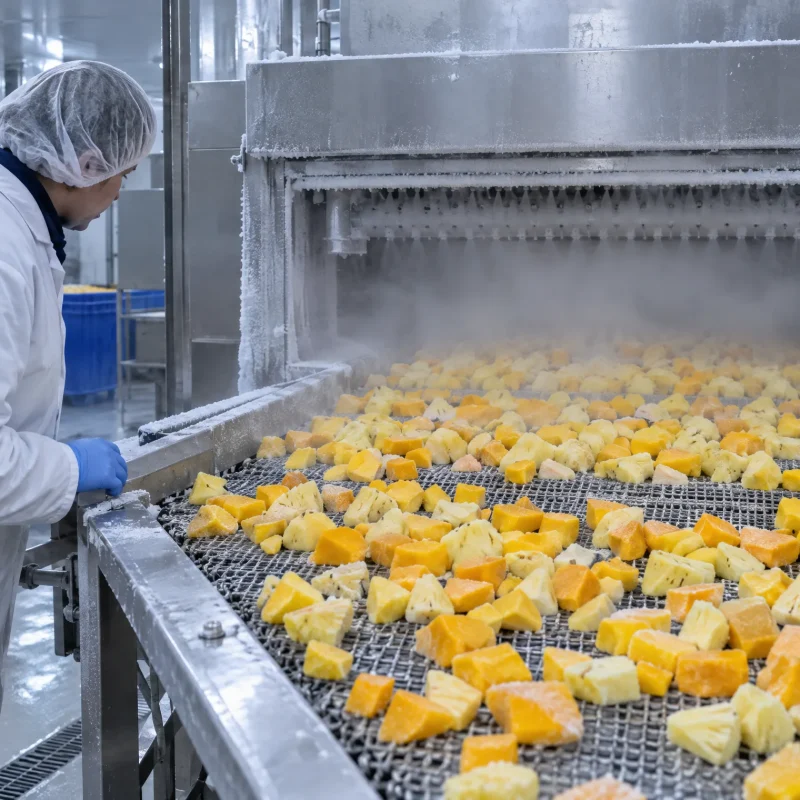
Because there is nothing on the line that kills anything. There is no blanch and no pasteurisation, and freezing suspends microorganisms rather than inactivating them. Whatever arrives on the fruit and on the peelers’ hands leaves in the bag.
Peeling is the sharp end of that. Bertuzzi, one of the leading banana line builders, specifies manual peeling on a dedicated belt conveyor, because no machine peels ripe banana at purée quality. Manual peeling is Vietnam’s cost advantage in this product and it is also the category’s principal hepatitis A and norovirus route. The advantage and the hazard sit at the same bench, which is why frozen produce carries the outbreak history it does: hepatitis A in frozen strawberries across 32 US states, the Greenyard/Baja listeriosis outbreak with 53 cases and 10 deaths, and SunOpta/Sunrise Growers recalling roughly 162,000 cases in June 2023.
Two consequences follow for the buyer. First, the food-safety burden sits with the plant, not the farm: on the frozen route the document that matters is the processor’s GFSI certificate, which CBI records as de facto minimum entry criteria for EU buyers even though no law requires it. Ask which scheme, which certificate number and which scope, and read the certificate against the site of manufacture. Second, chlorate is a plant residue, not a field residue on this product: the limit for banana is 0.3 mg/kg under Regulation (EU) 2020/749, and the source is the chlorinated wash water in the packhouse and the processing hall.
Is IQF banana a ready-to-eat food, and who decides?
You do, on the specification, before the first RFQ. If the product is sold for consumption without cooking, Commission Regulation (EC) No 2073/2005, Annex I, Chapter 1, point 1.19 applies to it as pre-cut ready-to-eat fruit:
Salmonella: n = 5, c = 0, not detected in 25 g, applicable throughout the shelf life of the product.
On a product with a 12 to 24 month declared life at −18 °C, holding that result is not a certificate of analysis. It is an environmental monitoring programme, a testing frequency and a recall exposure. The Listeria monocytogenes criteria for ready-to-eat foods sit at points 1.1 to 1.3 of the same chapter, with revised ready-to-eat criteria that took effect on 1 July 2026.
There is a documented and entirely legitimate way out, and exactly one supplier page in the category publishes it. Foodnet in the UK states on its frozen banana page that the product is a raw material and must be heated to at least 75 °C for 30 seconds before consumption. That declaration of intended use takes the product out of the ready-to-eat regime. It also takes it out of the smoothie and açaí-bowl channel, because a beverage manufacturer cannot buy an ingredient labelled must be cooked. Foodnet publishes the sentence without publishing what the sentence costs.
Whether a given lot sold into the beverage trade is legally ready-to-eat in a given member state is a question for a food lawyer in the importing country, and it is not settled by the supplier’s wording alone. Japan draws the same line differently: under the Food Sanitation Act, frozen food not intended to be heated before eating must show total plate count of 100,000/g or lower and coliforms negative, tested at 0.01 g in duplicate on desoxycholate medium.
Can IQF banana slices be sold as a single ingredient?
Usually not. Banana has the strongest enzymatic browning of the common fruits, with high polyphenol oxidase and peroxidase activity, and the commercial answer is an ascorbic and citric acid dip immediately after cutting, with the hall held at or below 15 °C because ripe banana at 30 °C browns within minutes. Both acids are declarable ingredients under EU labelling, so the pack cannot be declared 100% banana.
Steam blanching is the more complete fix. Work published in European Food Research and Technology found steam-blanched banana showed no appreciable discolouration through a freeze–thaw cycle, and that microwave blanching does not achieve it; the effective time and temperature are not stated in that source. Most commercial IQF banana is not blanched at all, only acid-dipped.
This is where the category contradicts itself in public. Vietnamese plants advertise no preservatives, no artificial colour or flavour while running a process that includes an acid dip, and Foodnet publishes the dip openly. No preservatives and single ingredient are different claims, and only the first survives an ascorbic dip. Sulphites are a separate line: above 10 mg/kg they are declarable under Regulation (EU) No 1169/2011, Annex II, and many EU and Japanese buyers require sulphite-free on frozen fruit outright.
VinFruits Global asks the partner facility for the anti-browning bath formulation and the ingredient declaration it produces in the same request, because a dip that is real in the plant and absent from the label is two different products. No published concentration or immersion time for IQF banana exists in any free source, so the bath is specified in the contract or it is not specified at all. Say the number you want, or accept the plant’s and have it written down.
Which standard covers IQF banana slices?
None. There is no Codex standard for quick frozen banana, no USDA Standard for Grades of Frozen Bananas, and no EU marketing standard, because EU marketing standards apply to fresh fruit only. Regulation (EU) No 1333/2011, Annex I, tells you exactly what a Class I fresh banana is, down to minimum length 14 cm, minimum transverse thickness 27 mm and scarring of no more than 2 cm² per fruit. Slice the same banana and freeze it and every tolerance becomes private law between two companies. The word that separates the two regimes is fresh.
So somebody writes the specification, and whoever writes it first sets the terms. The workable analogues are Codex CXS 320-2015 for quick frozen product requirements, Codex CXC 8-1976 for handling, Codex CXS 233-1969 for sampling, and the USDA grades for frozen peaches, pineapple and strawberries for the defect frame. Vietnam has adopted CXS 320 as TCVN 11511:2024 for frozen vegetables; no Vietnamese national standard for frozen fruit was retrievable.
| Test | Method | Reference figure | Instrument the figure comes from |
|---|---|---|---|
| Drip loss (%) | Weigh 200 g frozen, drain on a 2 mm sieve, thaw 18 h at 4 °C, reweigh the solids | 8% maximum, as a working target | No published banana threshold; the buyer sets it in the contract |
| Clumping (% by weight) | Tip 1 kg still frozen onto a tray, separate by light hand pressure, weigh the clustered fraction | 2% max; clumps of 3 pieces or fewer under 3% | CBI EU mango specification; GG-2616 IQF mango spec |
| Broken and fines (% by count) | Sieve 1 kg while still frozen, since thawed banana disintegrates | Grade A 10%, Grade B 25% | USDA Standards for Grades of Frozen Pineapple |
| Peel fragments (% by weight) | Thaw 1 kg, spread on a black tray, pick and weigh | Under 1%, no fragment over 8 mm | GG-2616 analogue; USDA Frozen Peaches Grade A, 1 in² per 16 oz |
| Size band (% of pieces) | Measure against the declared cut band | 85% of pieces inside the band | CBI EU mango specification, 12–18 mm |
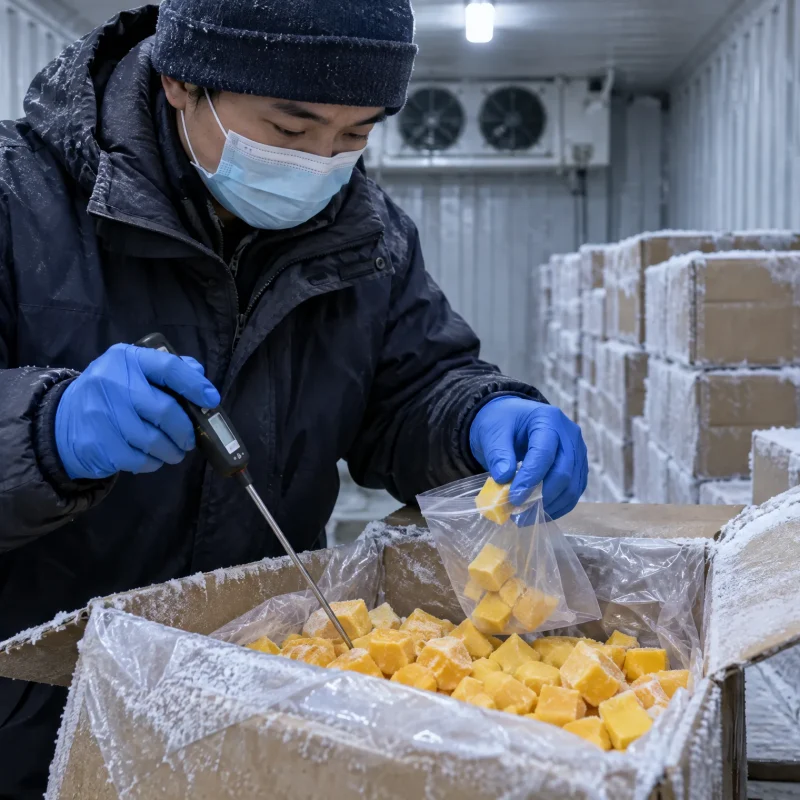
| Core temperature (°C) | Bore a hole 2.5 cm or deeper with a pre-chilled tool, probe accuracy ±0.5 °C | −18 °C or colder at core | Codex CXS 320-2015; Codex CXC 8-1976 |
Cold chain is the other half of the specification. Codex CXC 8-1976 sets two limits, in separate provisions, that the contract should restate: the product should pass rapidly through the zone of maximum ice-crystal formation, −1 °C to −5 °C, and in distribution the warmest package should not exceed −12 °C. In practice that means a straight-belt IQF tunnel at −35 to −40 °C for 20 to 40 minutes, and it also rules a machine out: fluidised-bed freezers do not work on banana, because soft sticky slices will not fluidise and impingement air lifts and flips them.
Four clauses are worth copying verbatim into the purchase order: sampling to Codex CXS 233-1969 at AQL 6.5, Inspection Level I and Level II on dispute, which for units over 4.5 kg gives n = 6, c = 1 on a lot of 600 cartons or fewer and 13/2 up to 2,000; declared net weight excluding glaze, per CXS 320-2015; the label carrying quick frozen, the product name, the style of cut and the size; and the USDA Commodity Specification for Frozen Fruit of June 2017 requirement that inspection be no more than 60 days before delivery.
Why does aseptic purée beat frozen on the route to Europe?
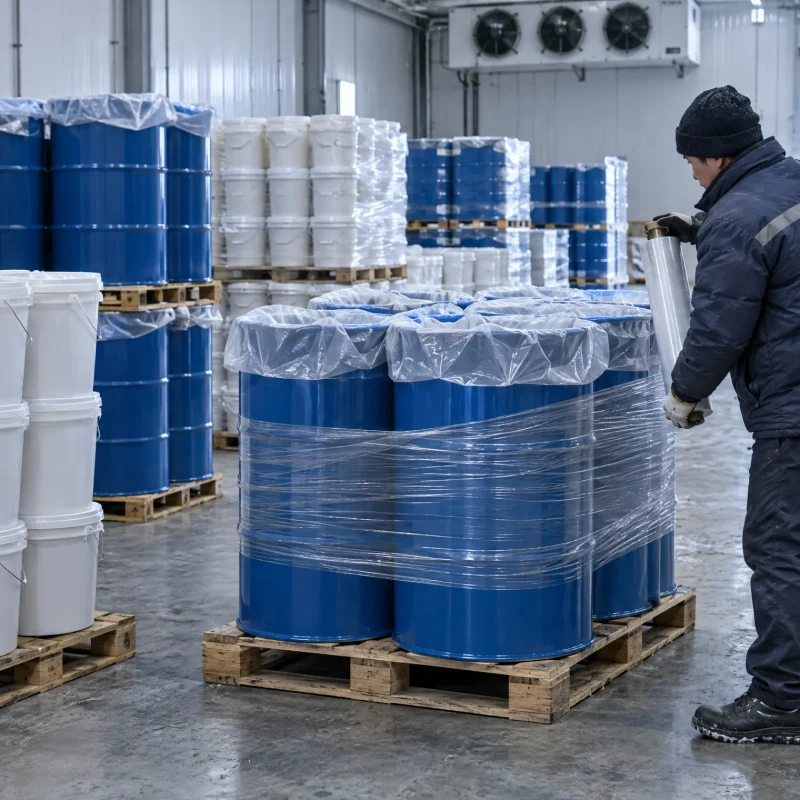
On the container, not on the fruit. Aseptic banana purée travels in bag-in-drum at ambient temperature in an ordinary dry box: 230 kg in a 55-gallon drum, 250 kg in a 60-gallon conical, up to 1,500 kg in a Goodpack. IQF banana and frozen purée need a 40-foot reefer, plugged in, for the 28 to 32 days of sea transit. Future Market Insights, publishing on 9 July 2025, put aseptic at 48.6% of banana purée volume against 51.4% conventional, beverages at 58.6% of application, and the market at USD 454.5 million in 2025 growing at 9.2% a year. Frozen holds its share on shorter routes, and the destinations that dominate Vietnamese shipments are North Pacific and Australian ports rather than European ones. Ecuador, Guatemala and Costa Rica lead the purée trade on Volza’s shipment count, with 6,159, 2,823 and 2,812 shipments. Vietnam has no publicly documented aseptic banana line.
| Format | Nominal size | Net weight (kg) | Where the figure comes from |
|---|---|---|---|
| Bag-in-drum, 55 gal | 55 US gallons | 230 | 12taste specification BANPU22ACRCACD |
| Conical drum, 60 gal | 60 US gallons | 250 | 12taste specification BANPU22ACRCACD |
| Bag-in-box | 6 US gallons | 20 | 12taste specification BANPU22ACRCACD |
| Goodpack | 300 US gallons | 1,500 | 12taste specification BANPU22ACRCACD |
| Octabin | 240 US gallons | 1,000 | 12taste specification BANPU22ACRCACD |
Never accept 200 kg drum as a contract term. Tridge records both roughly 200 kg and 220 kg as common, and the drum sizes above land on 230 and 250. Write the number.
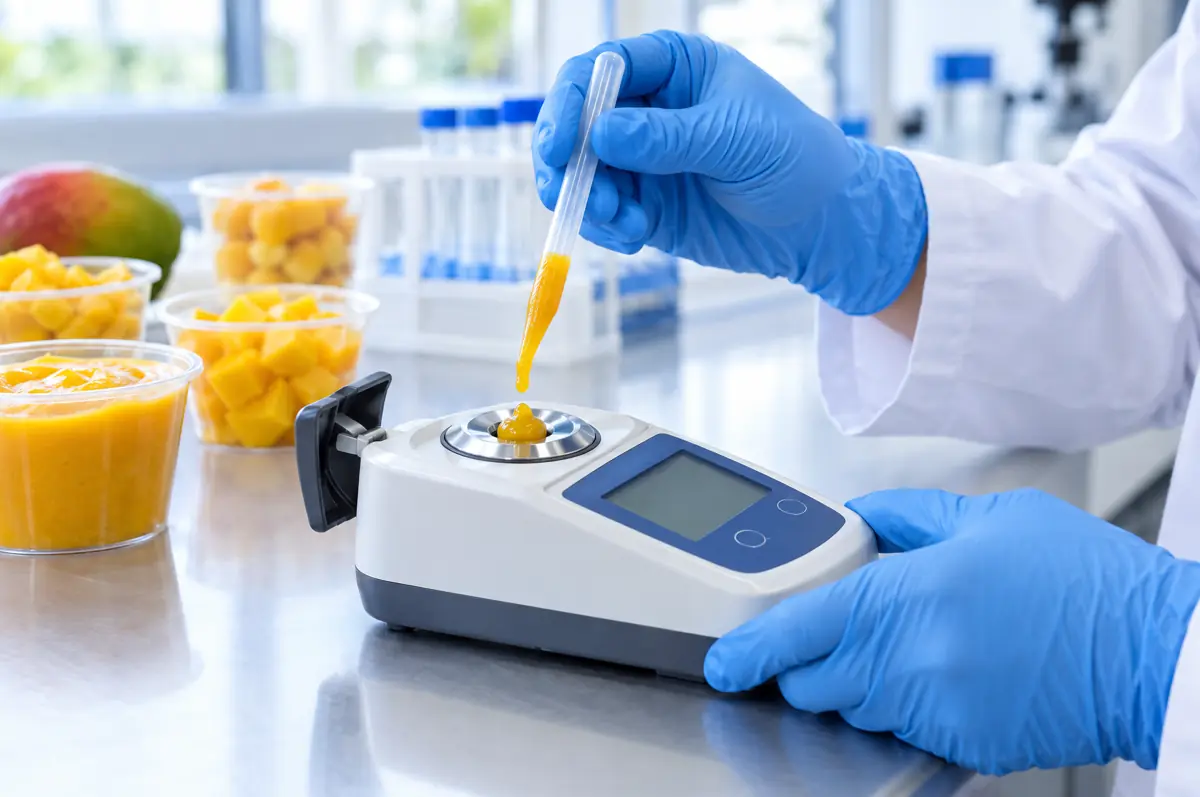
If your shortlist is a frozen banana puree supplier rather than an aseptic one, the difference lands on the freight bill before it lands on the Brix. Nafoods, the clearest Vietnamese banana purée supplier, publishes a frozen specification only: Brix minimum 20°, acid maximum 1%, held at −18 °C or below, 24 months or more. Profoodcorp in the Philippines lists aseptic banana purée at 220 kg; Tradelink in India lists aseptic. There is a process reason the two are not interchangeable. Banana purée has a natural pH of 4.7 to 5.1, above the 4.6 acidified-food boundary, so it is acidified with citric and ascorbic acid before aseptic sterilisation. The reference commercial spec runs Brix 21–25 (IFU No. 8), pH 4.7–5.1 (IFU No. 11) and acid as citric 0.2–0.4% w/w (IFU No. 3). Skip the acidification and the product falls under low-acid processing rules, in the United States under 21 CFR 113 rather than 21 CFR 114, with a scheduled process to file. The buyers, in any case, are intermediaries rather than brands: Döhler GmbH leads, with AGRANA, Symrise, KirilMischeff and Tree Top.
What does IQF banana wholesale cost at the border?
In the US, 14.50% with no preference for Vietnam; in the EU, unknown until your broker looks. HTSUS 0811.90.80, other frozen fruit, carries an MFN rate of 14.50%, and the duty-free list for that line does not include Vietnam. Japan is the more interesting case, because the preference is worse than the ordinary rate: on HS 0811.90 the schedule effective 1 January 2016 records WTO/MFN as Free while the EPA rate for Vietnam is 3.6%, so a Form VJ certificate of origin on that line would cost the importer money. A trade agreement is negotiated line by line, not agreement by agreement. That schedule is a decade old and staged reductions may since have moved it, so it must be pulled fresh before any quotation.
The EU duty applicable to frozen banana under CN 0811 90 is not something a supplier should quote from memory, and this article does not hold it. Ask your broker to pull the current TARIC line and the EVFTA elimination schedule for that code before you cost the container. Do not infer it from the fresh banana line, which sits under a different heading and whose own published readings do not agree with each other.
| Origin | Price (USD/kg) | Customs line | Source and data date |
|---|---|---|---|
| Costa Rica | 0.97 | HS 0811.90 | Tridge, March 2026 data |
| Philippines | 1.15 | HS 0811.90 | Tridge, March 2026 data |
| Vietnam | 1.48 | HS 0811.90 | Tridge, March 2026 data |
| Mexico | 1.68 | HS 0811.90 | Tridge, March 2026 data |
| Peru | 2.49 | HS 0811.90 | Tridge, March 2026 data |
| India | 3.32 | HS 0811.90 | Tridge, March 2026 data |
Two warnings on that ladder. HS 0811.90 is a wide basket, other frozen fruit, not banana, so the values include whatever else each origin ships under the heading; and Vietnam sits above the Philippines, which is the reverse of the labour-cost story usually told about this product. The grade-to-grade spread that would explain it is paywalled at Tridge, Mintec and Expana, and is not public. Published wholesale minimums in the category run from 500 to 1,000 kg at Nutrada up to 10 tonnes, one 20-foot reefer, at SAPO Đắk Lắk, which quotes 10 to 15 days to delivery.
What should you ask the plant for before you sign?
Five documents, and all five exist in a plant that is ready for this trade:
- The current GFSI certificate, in scan, with scope and site address legible.
- Per-lot certificate of analysis, with the method named beside each figure.
- Listeria environmental monitoring results for the last three to six months, not a single swab.
- The metal-detector sensitivity validation report, run on IQF banana itself rather than on a generic test piece, because soft frozen slices behave differently in the aperture.
- The anti-browning bath formulation together with the ingredient declaration it produces.
One more check belongs to the same conversation. Residue limits are set on the whole fruit with the skin on: Regulation (EU) No 752/2014 gives banana product code 0163020 with the residue definition whole product after removal of crown, and SANTE/10704/2021 Rev 1, in force since 19 March 2025, recognises peeling as a processing operation, so the finished-product figure is the whole-fruit MRL times a processing factor. That reads like good news for a peeled product, and it usually is. It is not always: 40 CFR 180.507 sets azoxystrobin at 2.0 ppm on whole banana and 0.1 ppm on banana pulp, twenty times stricter. The boundary is per active substance. Peeled means cleaner is true often enough to be dangerous, and the specification should carry the pulp figure where one exists.
Common questions
Is IQF banana a ready-to-eat food under EU rules?
It depends on the intended use you declare. If the product is sold for consumption without cooking, Commission Regulation (EC) No 2073/2005, Annex I, Chapter 1, point 1.19 applies: Salmonella, n = 5, c = 0, not detected in 25 g, throughout shelf life. Declaring the product a raw material to be heated to 75 °C for 30 seconds before consumption removes it from that regime, and from the smoothie channel with it.
Can IQF banana slices be labelled as a single ingredient?
Not if they carry an anti-browning dip, which most commercial IQF banana does. Banana has the strongest enzymatic browning of the common fruits, and the standard remedy is an ascorbic and citric acid dip immediately after cutting. Both acids are declarable ingredients under EU labelling, so the pack cannot say 100% banana. No preservatives and single ingredient are different claims, and only the first survives the dip.
What standard should an IQF banana purchase specification cite?
There is none for the product itself. No Codex standard, no USDA grade for frozen bananas and no EU marketing standard for frozen fruit exists, so every tolerance is contractual. Buyers draft from analogues: Codex CXS 320-2015 for quick frozen product requirements, CXC 8-1976 for cold-chain handling, CXS 233-1969 for sampling at AQL 6.5, and the USDA frozen peach, pineapple and strawberry grades for the defect frame.
Why does aseptic banana purée beat frozen on the route to Europe?
Container class. Aseptic purée travels in bag-in-drum at ambient temperature in an ordinary dry box, at 230 kg in a 55-gallon drum or up to 1,500 kg in a Goodpack. IQF banana and frozen purée need a reefer plugged in for the 28 to 32 days of sea transit. Future Market Insights put aseptic at 48.6% of banana purée volume in July 2025.
What is the EU import duty on frozen banana?
Not something to quote from memory. The duty applicable under CN 0811 90 is not established here, and the fresh banana line cannot be used as a proxy, because adjacent and basket headings carry different rates. Ask your broker to pull the current TARIC line and the EVFTA elimination schedule for that code before you cost a container.