On this page
- Is there a standard for frozen banana slices?
- Which cut formats and size tolerances should the specification name?
- What defect tolerances can a buyer actually write?
- Frozen or thawed: which state does each test use?
- Why does the ripeness clause fail in frozen banana specifications?
- What does the process explain about where the tolerances sit?
- Which microbiological and chemical limits apply by destination?
- How should sampling and inspection be written?
- What should a bulk frozen banana supplier hand over before the first lot?
- Common questions
- Related insights
No international standard covers frozen banana slices. There is no Codex standard, no USDA grade, and no EU marketing standard, which covers fresh fruit only. Every tolerance is therefore a contract term between two companies. Buyers borrow Codex CXS 320-2015 for the −18 °C core temperature and the labelling rules, and must state, defect by defect, whether the sample is measured frozen or thawed.
Is there a standard for frozen banana slices?
No. Codex has no quick-frozen banana standard. USDA publishes no Standard for Grades of Frozen Bananas. The EU marketing standard for bananas applies to fresh fruit only. When a buyer and a bulk frozen banana supplier disagree about a lot, there is no industry standard either side can invoke. The only rules are the ones written into the purchase specification.
The gap is easiest to see at the boundary. The EU marketing standard for fresh bananas fixes a minimum length of 14 cm and a minimum transverse thickness of 27 mm. It allows skin defects of no more than 1 cm² per fruit in Class Extra, 2 cm² of rubbing and scarring in Class I and 4 cm² in Class II. Slice and freeze the same fruit and none of that applies. The word that separates the two regimes is “fresh”.
What a buyer can do is incorporate instruments written for neighbouring products, and name each one as an agreed contract term, not as an applicable standard:
| Instrument | What it covers | What to borrow for banana | Limitation |
|---|---|---|---|
| Codex CXS 320-2015 | Quick frozen vegetables | Core ≤ −18 °C; net weight excluding glaze; “style of cut” on the label; AQL 6.5 sampling | A vegetable standard. Vietnam adopted it as TCVN 11511:2024, also for vegetables |
| Codex CXC 8-1976 | Processing and handling of quick frozen foods | Temperature measurement method; −12 °C warmest-package ceiling in distribution | A code of practice, not a product standard |
| Codex CXS 233-1969 | Sampling plans | n and c tables by lot size | Generic |
| USDA Grades of Frozen Peaches, Pineapple, Strawberries | Named frozen fruits | Defect categories and their tolerance structure | Different fruits, different textures |
| USDA Commodity Specification for Frozen Fruit (June 2017) | Federal purchase of frozen fruit | Micro panel, carton strength, the 60-day inspection clause | Written for US procurement |
| USDA AMS Foreign Material Manual | Foreign material classes | Classes 1–4 and GNC | Applies across commodities |
The term “Grade A” shows the problem in a single phrase. One EU supplier blog, Nutrada, defines Grade A as “under 2% defects” and commercial grade as 2–5%. The USDA frame for other frozen fruits scores colour 20, uniformity of size 20, defects 30 and character 30 points, with Grade A at 90 or above. That is a weighted score, not a defect percentage, and the two cannot be compared. Two offers of “Grade A frozen banana slices” can describe different products, because nobody owns the term. The same applies to “industrial grade” and “broken and fines”. The nearest official equivalents are USDA styles such as “Whole & Broken”. The regulatory questions around ready-to-eat status and additive labelling are covered in why Europe buys so little IQF banana. This article covers the specification itself.
Which cut formats and size tolerances should the specification name?
Name one cut format per SKU, with a nominal dimension and a tolerance band. The commercial slice cut at Vietnamese plants is 1 cm. Chunks or segments run 3–5 cm, and dice is 10 mm or 15 mm. For size, the workable rule comes from CBI’s EU model specification and the GG-2616 mango specification: at least 85% of pieces inside the declared band, and no more than 15% outside it.
For IQF banana slices, a practical clause is “≥85% of slices within 10 ± 2 mm thickness”. For dice, use ±3 mm. These are contract figures with no banana standard behind them, so they need a stated measuring method, such as a digital caliper on 30 pieces, with the sample state written beside it. Slices thinner than 8–10 mm tend not to survive a thaw intact. A buyer who wants a thinner slice for a decoration application should expect high broken counts on the receiving bench.
Fix the format before any commercial conversation. Moving dice from 10 mm to 15 mm requires a different blade setup, so a change of cut is a change of production run, not a line on an email.
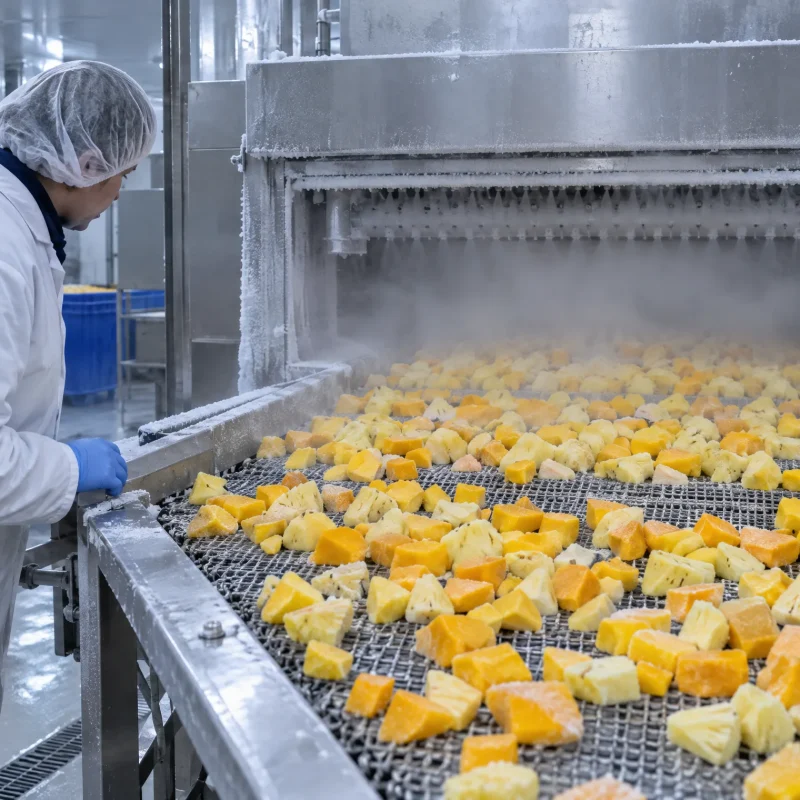
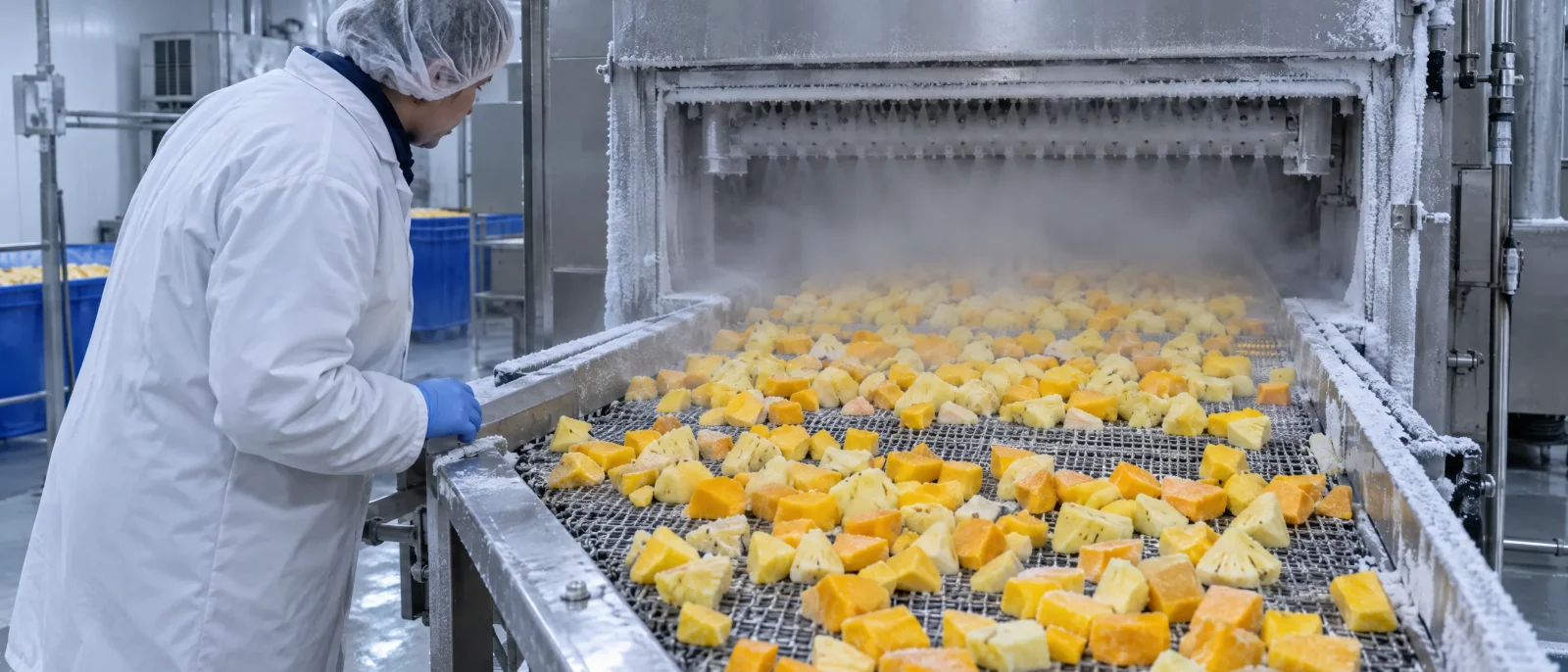
The freezing method also limits which formats are realistic. Banana is soft and sticky and will not fluidise, so fluidised-bed freezers do not work on it. Impingement air lifts and flips soft slices. The correct machine is a straight-belt IQF tunnel with air at −35 to −40 °C for 20–40 minutes, bringing the core to −18 °C or below. The differences in drip loss and clumping between that route and block freezing are set out in IQF vs BQF and what the freezing method changes.
What defect tolerances can a buyer actually write?
Write a number, a unit, a basis (by weight or by count) and a test state against every defect. None of the banana figures below comes from a standard, because none exists. Each is a workable contract starting point placed beside the published analogue it is borrowed from, so you can see what is borrowed and what is chosen. Peel fragments are the defect seen most often in the category, so put them first.
| Defect | Grade A limit (% unless stated) | Industrial limit (% unless stated) | Published analogue | Test state and method |
|---|---|---|---|---|
| Peel fragments | ≤0.5 by weight, none >8 mm | ≤1 by weight, none >10 mm | GG-2616 mango ≤1%, none >8 mm; USDA Frozen Peaches Grade A ≤1 in² per container ≤16 oz | Thawed: 1 kg on a black tray, fragments weighed, largest measured |
| Browned (oxidised) units | ≤1 | ≤3 | GG-2616 “oxidized units ≤1%” | Thawed, unit count |
| Broken; fines <5 mm | ≤10 by count; fines ≤2 by weight | ≤20 by count | USDA Frozen Pineapple broken A ≤10%, B ≤25% by count | Frozen: 1 kg over a 5 mm and a half-nominal screen, fractions weighed |
| Clumps (≤3 pieces) / agglomerates (≥5) | ≤3 / ≤2 by weight | Buyer sets | CBI EU mango model max 2%; GG-2616 <3% / 3%; GG-2615 strawberry 6% | Frozen: 1 kg tipped on a tray, light hand pressure, clustered fraction weighed |
| Mushy or over-ripe units | ≤10 | ≤20 | GG-2616 ≤10%; USDA Frozen Peaches character A ≤10%, B ≤20% | Thawed, unit count |
| Discoloured units | ≤10 | ≤20 | USDA Frozen Peaches Grade B ≤20%; CXS 320 qualitative | Thawed, unit count against a retained sample and the signed defect photo board |
| Blemished or bruised | ≤5 by count | ≤12.5 by count | USDA Frozen Pineapple A ≤5%, B ≤12.5% | Thawed, unit count |
| Freezer burn | 0 | ≤2 of surface area | No published threshold | Frozen, on opening the carton |
Foreign material can follow the USDA AMS Foreign Material Manual directly. The manual defines four classes plus GNC:
- Class 1 covers material that needs magnification, 2 mm or smaller, at ≤25 units per 100 g.
- Class 2 covers 2–7 mm, at 1 deviant per 13 or more sample units.
- Class 3 covers offensive material of 7 mm or more, at 1 per 21 or more.
- Class 4 covers hazardous material such as machine grease, stones, bolts and paint chips, at 1 per 150.
- GNC covers rodent filth, animal parts, sharps and petroleum products. It is not accepted, and the lot is destroyed.
Metal detection needs care. The widely repeated sensitivities of 2.0 mm ferrous, 2.5 mm non-ferrous and 3.0 mm stainless steel are common practice, not a rule. BRCGS requires each site to validate its own sensitivity and sets no figure. Frozen product also reduces the sensitivity a detector can achieve. Ask for the validation report run on IQF banana itself, and write the achieved figures into the contract. How those results reach you on paper is covered in how to read a fruit certificate of analysis.
Two defects have no threshold anywhere. No published ΔE limit exists for IQF banana, and no post-thaw firmness limit exists either. As general guidance, a ΔE of 1 or less is indistinguishable, 2–3 is detectable by a trained eye and above 5 is obvious. The usual approach is to measure three to five commercial samples and set the limit at the mean ±2 standard deviations.
Frozen or thawed: which state does each test use?
In frozen banana, the sample state is half of every tolerance. Broken pieces, fines, clumping, core temperature, freezer burn and odour must be assessed frozen. Drip loss, peel, colour and firmness must be assessed thawed, under a written protocol. Banana has almost no structure after a thaw. Fresh ripe Cavendish needs 22.1–24.8 N to penetrate at ripening day 9–10, according to the Current Agriculture Research Journal, yet thawed slices fall apart under a sieve. None of the banana supplier pages surveyed for this article attaches a state or a method to any number.
The split runs by defect, not by convenience:
| Test | Sample state | Protocol | Instrument or source |
|---|---|---|---|
| Broken and fines | Frozen | 1 kg over 5 mm and half-nominal screens, each fraction weighed | Sieve stack, balance |
| Clumping | Frozen | 1 kg on a tray, light hand pressure, clustered fraction weighed | Balance |
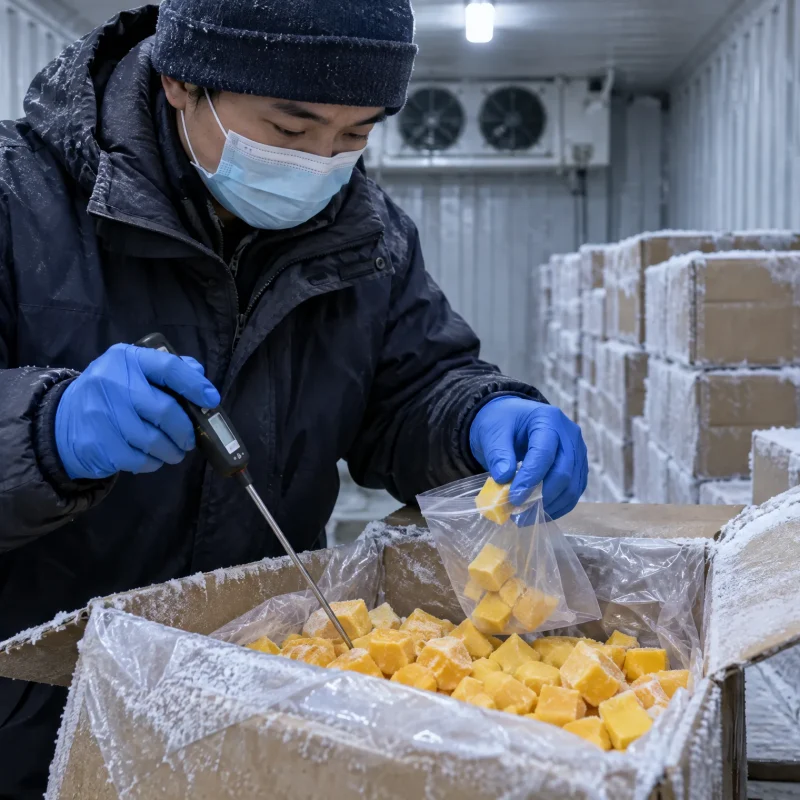
| Core temperature | Frozen | Hole bored ≥2.5 cm with a pre-chilled tool | Codex CXC 8-1976: probe ±0.5 °C, resolution 0.1 °C |
| Drip loss | Thawed | 200 g frozen (m1) on a 2 mm sieve, 4 °C for 18 h, solids weighed (m2); (m1−m2)/m1 × 100 | Balance, chiller |
| Peel fragments | Thawed | 1 kg spread on a black tray, picked, weighed, largest measured | 0.1 g balance, caliper |
| Colour | Thawed | 20 slices on a standard background, ΔE = √(ΔL²+Δa²+Δb²) | Colorimeter, retained sample |
Codex CXC 8-1976 also allows non-destructive measurement between packages, but with a 2.8 °C tolerance, so destructive measurement is the one to name in a rejection clause. Freezer burn and loose ice should be judged the moment the carton opens. Off-odour should be judged then too: banana held in a mixed cold store picks up fish, onion, ammonia and treated-pallet odours, which are obvious on opening and fade once the fruit warms. The control is a clause requiring a dedicated store or a separate chamber. Ice-crystal damage cannot be measured at a plant. It shows up indirectly through drip loss.
Disputes over frozen banana slices usually come down to the thaw regime. Two standardised thaw regimes are in commercial use for texture and shape assessment of frozen banana: 4 °C for 12 hours and 20 °C for 1 hour. No published source shows that the two give the same result. The drip-loss test for frozen banana uses a third regime: 200 g of frozen slices weighed on a 2 mm sieve, held at 4 °C for 18 hours, the solids re-weighed, and the loss taken as (m1−m2)/m1 × 100. A supplier thawing for an hour at room temperature and a buyer thawing for eighteen hours in a chiller can get two different drip-loss figures from the same pallet, and both can be defended. Nutrada’s frequently copied figure of 3–8% drip loss for IQF banana against 10–20% for block-frozen product is published on a supplier blog with no thaw protocol at all, which makes it the figure most likely to reach a specification by copy and paste.
VinFruits Global asks the partner facility for the thaw protocol behind a drip-loss figure before a specification is agreed, because a drip-loss figure without its thaw temperature and duration cannot be checked against the buyer’s own receiving test.
The purchase-order sentence costs nothing to add: “For every tolerance, the test state (frozen or thawed) is as stated in the specification; where thawing is required, the thaw temperature and duration are as stated.”
Why does the ripeness clause fail in frozen banana specifications?
Most specifications name ripeness twice, as a Brix minimum and a colour stage, and treat the two as one clause. They are separate measures with no published link between them. The plant’s yield also improves as the fruit softens, which is the opposite of what the buyer’s texture requirement needs. A clause that does not rank the two measures leaves that conflict to be resolved in the supplier’s favour.
The only published Cavendish ripening dataset available shows Brix and firmness moving in opposite directions:
| Ripening day | Brix (°Bx) | Firmness (N) | pH | Source |
|---|---|---|---|---|
| 1–2 | 4.5–5.0 | 44.8–43.6 | 4.2 | Current Agriculture Research Journal |
| 3–4 | 6.0–6.8 | 41.3–36.8 | 4.5 | same |
| 5–6 | 7.0–8.0 | 35.2–34.2 | 5.0–5.1 | same |
| 7–8 | 12.0–16.7 | 31.9–28.1 | 5.2 | same |
| 9–10 | 19.5–23.7 | 24.8–22.1 | 5.2–5.4 | same |
In this dataset, 18 °Bx is reached only at day 9–10. By then the fruit has lost about a third of its day 1–2 firmness. A “Brix minimum 18” clause therefore specifies fruit at the soft end of the curve. Soft fruit produces mushy units, collapse on thaw and high drip loss, which are the next three lines of the same specification.
The colour half of the clause does not fix this. The commercial scale is Von Loesecke’s seven stages, from 1 (all green) to 7 (yellow with large brown spots). It is a colour chart. No published table maps it to Brix. “Stage 5–6, Brix minimum 18” is therefore two requirements that can disagree on the same pallet.
Yield explains the incentive. BananaTower’s peel-to-pulp ratios are 40:60 at stage 1, 39:61 at stage 3, 38:62 at stage 5 and 33:67 at stage 7. Seven extra points of pulp per kilo of fruit is a large gain when close to 40% of the intake leaves as peel. Each extra day of ripening raises yield, and it also moves the fruit toward the point where it will not hold a 10 mm cut. Stage 5 is a reasonable processing point. Mixing ripeness within a bag is a separate defect, and GG-2616’s mango analogue allows no more than 7% riper units.
A clause you can paste:
- Name both measures, for example Von Loesecke stage 5 and Brix within an agreed band.
- State which measure governs when they conflict.
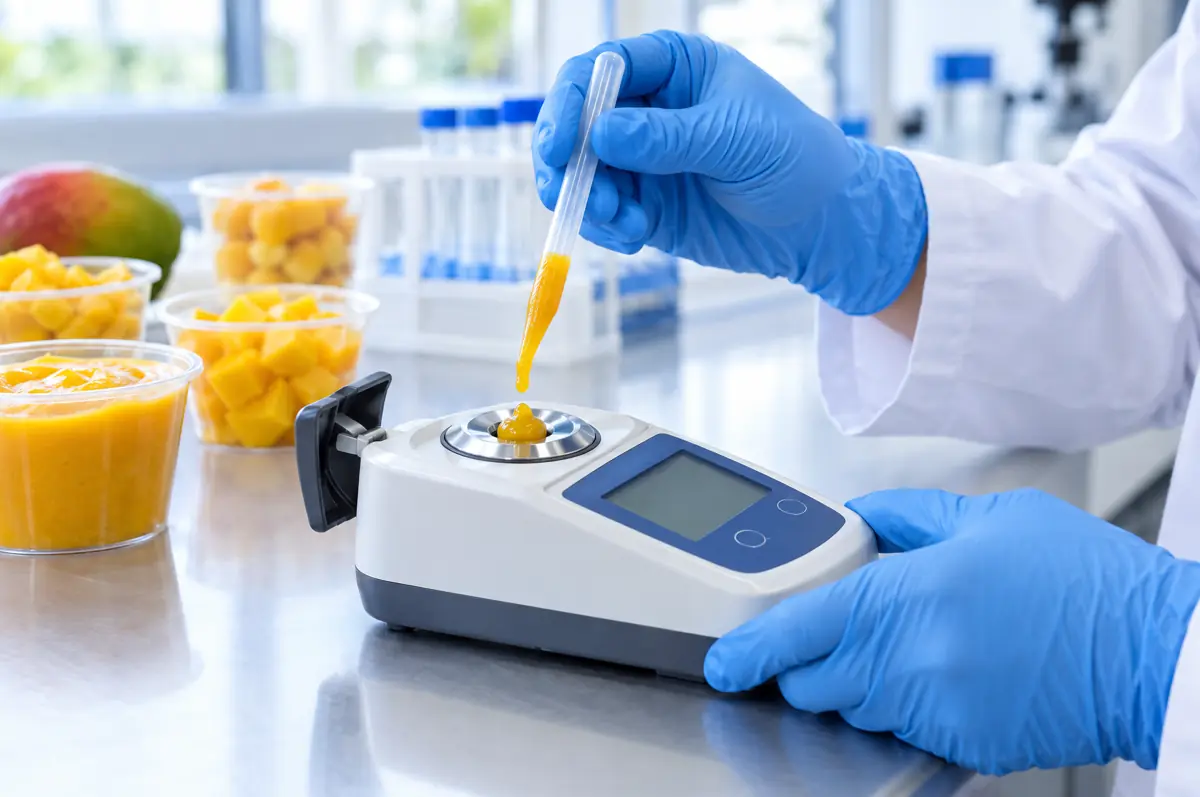
- Measure Brix before freezing, with an ATC refractometer on the pressed juice of 10 fruit, read three times. After freezing, the reading tells you about the thaw, not the fruit.
- Set the intake temperature at 13–15 °C, evidenced by the vehicle temperature record. Below 13 °C, raw fruit suffers chilling injury: grey vascular streaking in the pulp that nothing downstream can remove. Ripening rooms run at 18 °C with ethylene at 100–150 ppm, and never go below 13.3 °C.
What does the process explain about where the tolerances sit?
Three process facts set the tolerances: peeling is manual, cut banana browns within minutes, and an unblanched IQF line has no kill step. Bertuzzi, a banana line builder, specifies manual peeling on a dedicated belt conveyor, and no published success rate exists for machine peelers on curved, short or scarred fruit. That is why peel fragments head the defect list. Ripe banana browns within 2–10 minutes of cutting, so the processing hall is held at or below 15 °C and the time from peel to freezer is kept to at most 15–20 minutes. Browning tolerances depend on that interval.
The anti-browning step is a commercial ascorbic plus citric dip. No free public source gives a validated concentration or immersion time, so buyers specify it in the contract. Steam blanching inactivates banana PPO and POD effectively, and microwave blanching does not, according to European Food Research and Technology. Most commercial IQF banana is not blanched, and thin slices go mushy if it is. An IQF line without blanching has no kill step: freezing stops microorganisms from growing but does not kill them. The microbiological panel in the next section reflects that.
Chlorate comes from the plant, not the field, because it forms in chlorinated wash water. Ask for the wash-water log showing free chlorine, pH and contact time.
Which microbiological and chemical limits apply by destination?
The limits depend on the destination, and frozen banana is consumed both cooked and uncooked. Write the panel against the strictest market on the label. Each line needs its ISO method.
| Parameter | EU, Reg (EC) No 2073/2005 (per g unless stated) | Japan, Food Sanitation Act, not heated before eating (per g) | USDA Frozen Fruit, June 2017 (per g unless stated) | Method |
|---|---|---|---|---|
| Total plate count | No criterion at point 1.19 | ≤100,000 | <50,000 | ISO 4833 |
| Coliforms | No criterion at point 1.19 | Negative (0.01 g × 2, desoxycholate) | <100 | ISO 4832 |
| E. coli | No criterion at point 1.19 | Not specified | <3 | ISO 16649 |
| Yeasts; moulds | No criterion at point 1.19 | Not specified | <10,000 each | ISO 21527 |
| Salmonella | Not detected in 25 g, n=5, c=0, throughout shelf life (point 1.19) | Not specified | Negative in 25 g | ISO 6579-1 |
| L. monocytogenes | Points 1.1–1.3; revised criteria for ready-to-eat foods from 1 July 2026 | Not specified | Not specified | ISO 11290-1/2 |
The EU column covers only the Annex I, Chapter 1 food-safety criteria at the points named. Process-hygiene criteria in Annex I, Chapter 2 of the same Regulation sit outside this column, so a blank entry here does not mean the EU sets no limit for that organism; read Chapter 2 before building a “strictest market” panel.
Published commercial benchmarks are tighter than some legal limits. The GG-2616 mango specification sets TPC <50,000, yeasts and moulds <5,000, coliforms <100, E. coli <10 and S. aureus <10 cfu/g. It requires Listeria negative in 125 g and Salmonella negative in 375 g.
The chemical limits are short. Chlorate for banana is 0.3 mg/kg under Regulation (EU) 2020/749. Lead in fruit is 0.10 mg/kg under Regulation (EU) 2023/915. Patulin does not apply: every published limit for it is an apple limit, so a request for it on a banana CoA is a commercial request, not a legal one. If an acid dip is used, the acids are declarable ingredients and the product cannot be labelled 100% banana. Banana needs no phytosanitary certificate to enter the EU. GFSI certification (BRCGS, IFS, FSSC 22000 or SQF) is not a legal requirement, but EU buyers treat it as mandatory in practice.
How should sampling and inspection be written?
Use Codex CXS 233-1969 at AQL 6.5, Inspection Level I, moving to Level II where a dispute arises. This matches CXS 320. For 10 kg cartons, the plan for units over 4.5 kg applies:
| Lot size (cartons) | Sample size n (cartons) | Acceptance number c (defectives) | Instrument |
|---|---|---|---|
| ≤600 | 6 | 1 | Codex CXS 233-1969 |
| 601–2,000 | 13 | 2 | same |
| 2,001–7,200 | 21 | 3 | same |
| 7,201–15,000 | 29 | 4 | same |
| 15,001–24,000 | 38 | 5 | same |
The table continues at 48/6 for lots of 24,001–42,000 cartons and 60/7 above 42,000. A severity tier sits well on top of it. This is a contract choice, not a standard:
- Critical defects carry zero tolerance and the lot is rejected. These are metal, glass or hard plastic; a positive Salmonella or Listeria result; an untraceable lot code; or a core temperature above −12 °C.
- Major defects are inspected at AQL 2.5. These are peel, clumping or browning over tolerance; short weight; a punctured bag; or a wrong label.
- Minor defects are inspected at AQL 6.5. These are slight colour variation, broken pieces within tolerance, or a dented carton with sound product.
The USDA Commodity Specification for Frozen Fruit (June 2017) requires inspection not more than 60 days before delivery. Put data loggers at the door, middle and end of every reefer, and make an arrival reading above −12 °C grounds for rejection. Keep retained samples of 2 × 500 g per lot until the end of shelf life plus six months. Set a minimum remaining shelf life at arrival of 75%. For the carton, specify 42 ECT or the USDA 225 psi rating, which covers 20–25 lb cartons and so fits a 10 kg carton of about 22 lb; the 275 psi rating applies to 30–40 lb cartons. Add EURO pallets of 80 × 120 cm with ISPM-15 marked timber, and a written pallet pattern. GG-2616’s pattern of 10 cartons per layer, 6 layers, 60 per pallet is a good model of how to write one.
What should a bulk frozen banana supplier hand over before the first lot?
Ask for seven documents, each for a specific reason:
- The current GFSI certificate, in the name of the plant that holds it.
- A CoA for every lot.
- Listeria environmental monitoring results for the last 3–6 months.
- The metal-detector validation report run on IQF banana.
- The anti-browning bath formulation, with the ingredient declaration it produces.
- A signed defect photo board.
- A completed mock recall.
Settle shelf life in writing. Nutrada publishes 12–18 months at −18 °C, while Shimla Hills and Vietnamese suppliers publish up to 24. Nothing reconciles the two. Because the EU Salmonella criterion applies throughout the declared shelf life, a longer declared life means a longer period of liability, not a better product.
Common questions
Is there a Codex or USDA grade standard for frozen banana slices?
No. Codex has no quick-frozen banana standard, USDA publishes no grade standard for frozen bananas, and the EU marketing standard covers fresh bananas only. Every tolerance is a contract term. Buyers incorporate Codex CXS 320-2015, a vegetable standard, and the USDA grade standards for frozen peaches, pineapple and strawberries as agreed reference documents, naming each one in the contract.
Should IQF banana slices be tested frozen or thawed?
It depends on the defect. Broken pieces, fines, clumping, core temperature, freezer burn and odour are assessed frozen, because thawed banana crumbles under a sieve. Drip loss, peel fragments, colour and firmness are assessed thawed. The contract should name the state for every tolerance and, where a thaw is needed, the temperature and the hours.
What drip loss figure should a frozen banana specification set?
No standard sets one. The widely copied figure of 3–8% for IQF against 10–20% for block comes from a supplier blog and has no protocol attached. A workable method is 200 g frozen on a 2 mm sieve, thawed at 4 °C for 18 hours, then the solids weighed. Buyers set the limit against that named protocol.
What Brix should frozen banana slices have?
There is no standard figure, and Brix alone is a weak ripeness clause. In published Cavendish data, 18 °Bx is reached only at ripening day 9–10, when firmness has fallen to 24.8–22.1 N. Name both Brix and Von Loesecke stage, state which governs on conflict, and measure Brix before freezing on pressed juice from 10 fruit.
What microbiological limits apply to frozen banana sold into the EU and Japan?
In the EU, Regulation (EC) No 2073/2005 point 1.19 requires Salmonella not detected in 25 g, n=5, c=0, throughout shelf life, for pre-cut ready-to-eat fruit. Revised Listeria criteria for ready-to-eat foods apply from 1 July 2026. Japan sets total plate count at 100,000 per gram or less and coliforms negative for frozen food not heated before eating.