On this page
- What do moisture and water activity each measure?
- Can you work out water activity from a moisture figure?
- Where does US law draw a water-activity line for fruit?
- Why is Brix the wrong release number on a soft-dried sheet?
- How is each number measured, and what should the COA carry?
- Why is the COA at dispatch not the product at month six?
- What should the purchase order say?
- Common questions
- Related insights
Moisture is the share of a dried piece’s weight that is water. Water activity (aw) is how available that water is to moulds and to chemical change, and neither converts into the other. US federal rules cited here set no limit on water activity: dried fruit sits well below their only aw line, 0.85, under 21 CFR 114.3(b). Specify both per lot, each with its method.
What do moisture and water activity each measure?
Moisture measures quantity: how much of the piece’s weight is water, found by drying a sample to constant mass and weighing the loss. Water activity measures availability: how freely that water can move, which is what a mould or a chemical reaction can use. A specification that gives only the first number tells you how wet the product is. It does not tell you whether it will stay sound.
The difference comes from what else is in the piece. Sugar, a carrier such as maltodextrin, or frying oil binds water or dilutes it. Two products at the same moisture can therefore behave very differently in a warehouse. Moisture is still worth measuring. It drives yield, texture and the price per kilogram of dry matter. It is simply a different question from aw, and a dried-fruit specification needs the answer to both.
For a buyer, the practical test is simple. If the sheet in front of you gives one moisture percentage and a 12-month shelf life, it has made a claim about stability without the number that predicts stability. The certificate side is covered in more depth in how to read a fruit certificate of analysis.
Can you work out water activity from a moisture figure?
No. Published pairs show that aw depends on the product as well as on its water content, and no general conversion exists that a buyer could apply to a Vietnamese dried-fruit sheet. The figures below are the published moisture and aw values available for the products in question. Several sources publish moisture and leave aw out.
| Product | Moisture (%) | Water activity (aw) | Source and method as published |
|---|---|---|---|
| Spray-dried soursop powder, 37% maltodextrin, inlet 156 °C | 2.03 | 0.18 | Chang, Karim, Abdulkarim, Ghazali, Journal of Food Process Engineering 2018; 41(5): e12688 |
| Vacuum-fried okra chips | ≤ 5 | ≤ 0.60 | Published product specification |
| Soft-dried passion-fruit peel, 70 °C × 4 h | 16.10 | not reported | Nguyễn Xuân Hồng et al., Dong Thap University Journal of Science, 2026 |
| Soft-dried passion-fruit peel, 60 °C × 7–8 h | 10–11.5 | not reported | Bùi Thị Hồng Phương et al., Hanoi Open University, 2026 |
| Soft-dried dragon fruit | ≤ 15 | not published | Nafoods, producer’s published sheet |
| Freeze-dried durian, −40 °C pre-freeze | 6–8 | not published | greentropical.vn supplier page, accessed 5 September 2026 |
Read the first two rows together. A powder on a maltodextrin carrier at about 2% moisture measured aw 0.18. A fried chip is held to aw ≤ 0.60 at up to 5% moisture. These are different products made by different processes, which is the point. The carrier, the oil and the sugar decide where aw lands, so a moisture figure on its own cannot tell you. The chip specification itself is covered in dried vegetable chips for industrial buyers.
The two Vietnamese university studies are more telling. Both developed soft-dried passion-fruit peel, both reported finished moisture, and neither reported water activity. When the research literature for a product measures one number and not the other, the supplier sheets built on that research usually do the same. Sugar options for soft-dried mango are set out in soft-dried mango sugar options.
Where does US law draw a water-activity line for fruit?
In the US federal rules covered here, the only fixed aw line for fruit is 0.85. Under 21 CFR 114.3(b), an acidified food is a low-acid food with acid added, an aw above 0.85 and a finished equilibrium pH of 4.6 or below. The rule names among its examples “peppers, tropical fruits, and fish, singly or in any combination”.
That line decides which regime a product falls under, and the regime decides whose paperwork you audit. Above pH 4.6 in a hermetic container, a low-acid product falls under 21 CFR Part 113, thermally processed low-acid foods, and needs a scheduled process. Acidified foods under Part 114 must measure pH potentiometrically above pH 4.0 and keep records for three years. For acidified foods, registration and filing of the scheduled process sit under 21 CFR 108.25.
Dried fruit falls under neither category. It is not a low-acid canned food and not an acidified food, so it needs only the manufacturing facility’s FDA food facility registration, with no FCE or SID filing and no scheduled process (fda.gov, updated 29 May 2025). Canned young jackfruit in brine, by contrast, does need FCE registration and a filed scheduled process. The two products can come from the same fruit and still sit in different regimes, because of where their water activity and pH land.
The consequence for a dried-fruit buyer is direct. No dried-fruit aw limit is set in the US federal rules cited here. Every aw limit between the published 0.18 and 0.60 pairs and the 0.85 regulatory line is a contract number, and you set it. A supplier sheet that prints an aw limit is stating its own target, not a legal requirement. You should know which one you are signing.
Why is Brix the wrong release number on a soft-dried sheet?
Brix measures dissolved solids in a liquid. It is a valid intake measure on fresh fruit and on the infusion syrup, and a weak release measure on a finished soft-dried piece. For soft-dried product, the parameters that control stability and texture are moisture and water activity. A Brix figure such as “≥ 68” belongs to jam and syrup specifications and has no published basis as a limit on a finished soft-dried piece.
The self-correction on record is a useful example. The soft-dried mango sheet published on this site once printed Brix ≥ 70 °Bx. The live page now lists moisture measured per lot and water activity measured per lot, each with its limit agreed in the specification, and a COA carrying moisture, aw, SO₂, residues and microbiology. The two versions describe the same product. Only the second describes it with numbers that predict how it behaves in storage.
On a sugar-infused line, the reason is mechanical. If aw is too high, mould can appear before the stated shelf life. If aw is too low, the piece hardens and stops being soft-dried. Both failures sit inside a range where Brix can read the same. The correct position on the curve is found with an aw meter, not by squeezing a piece between two fingers on the line.
How is each number measured, and what should the COA carry?
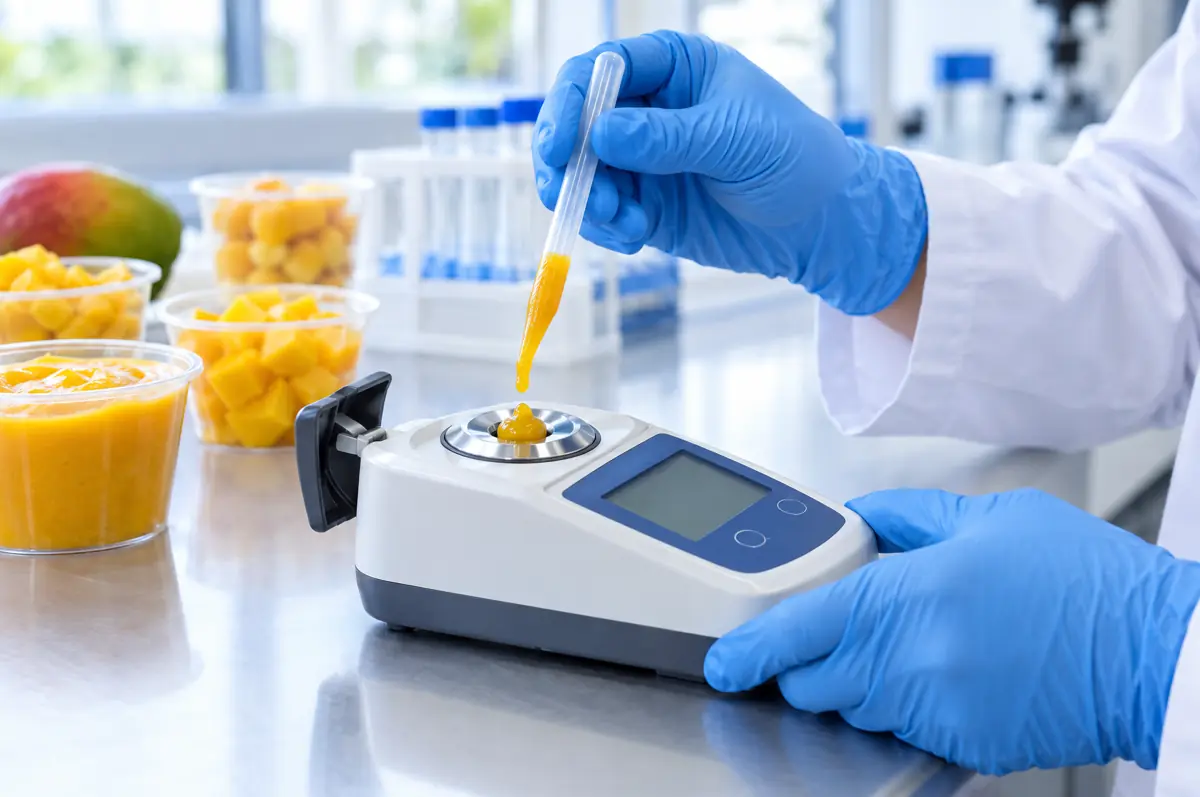
Moisture is measured by drying a lot sample to constant mass in an oven, or with a moisture analyser. Water activity is measured on a lot sample in a calibrated aw meter, with the measurement temperature and sample state stated. A limit that names no method, no sample size, no sample state and no party responsible for measuring it cannot be enforced in a dispute.
That last point is where many dried-fruit sheets fail. “Moisture ≤ 15%” without a method can be argued either way once a lot is rejected at destination. So can a moisture result taken on surface pieces from an opened carton. The COA panel to require on a dried-fruit line is set out below. The limits stay blank because they are yours to write.
| COA line | Unit | How it is measured | Who sets the limit |
|---|---|---|---|
| Moisture | % | Oven to constant mass or moisture analyser; lab names its method; sample from finished packs | Contract |
| Water activity | aw, with measurement temperature in °C | Calibrated aw meter; method and sample state named | Contract |
| SO₂ / additives | mg/kg | Lab method named on the COA | Destination additive rules and contract |
| Microbiology: TPC, yeast and mould, E. coli, Salmonella | cfu/g; Salmonella as detected / not detected in the stated sample size | Lab method named on the COA | Contract and destination rules |
| Pesticide residues | mg/kg | Lab method named on the COA | Destination maximum residue levels |
VinFruits Global reports moisture and water activity as two separate lines on every lot’s certificate of analysis, each with its limit agreed in the specification, because the first number says how much water is in the piece and only the second says whether it will stay sound.
When you review a supplier, ask whether the drying plant holds an aw meter on site and calibrates it, or sends samples out. Ask for three recent lot COAs before agreeing a specification, and check that aw appears on all three with the same method.
Why is the COA at dispatch not the product at month six?
The certificate describes the lot on the day it was sampled. Shelf life describes the lot, the pack and the warehouse together over months. Product with the same moisture at dispatch can reach month six as three different products, depending on the bag it sits in. A Vietnamese study measured exactly that.
In the study by Trương Thị Chiên and colleagues, published in the Vietnam Journal of Science and Technology – B in 2026, spray-dried purple passion-fruit powder started at 3.11% moisture and was stored for six months at room temperature in three pack structures. The powder in a PET/aluminium/PA laminate finished at 3.52% moisture. The same powder in a PA film finished at 4.59%, and in plain single-layer polyethylene at 6.51%. The polyethylene samples also lost about 38% of their polyphenols over the same period. Every sample came from the same product and would have carried the same dispatch certificate. The packaging conclusion that follows for dried-fruit buyers is to specify an aluminium-laminate liner rather than single-layer polyethylene, a vacuum or nitrogen flush, a desiccant sachet, and a moisture limit at dispatch.
Freeze-dried fruit is the extreme case. At 6–8% moisture it takes up water from the air quickly, and in an ordinary bag it will not hold its specification. For that product the liner is part of the specification, not an overhead.
Two further disagreements appear in published documents. First, the soft-dried and chip pages on this site give the same shelf life, 12 months ambient at ≤ 25 °C and RH < 65%, although the products run from chips at up to 5% moisture to soft-dried pieces at several times that. One figure across that range describes the storage promise, not the fruit. Second, for one vacuum-fried chip line, the partner plant’s specification states storage at ≤ 25 °C and RH ≤ 50%, while the website states RH < 65% for the same product. That 15-point humidity gap is the range in which a low-aw product absorbs moisture through an imperfect pack. When two documents for the same lot give different storage conditions, you decide which one goes into the contract.
The test that settles a shelf-life claim is a storage trial on retained samples from the approved lot, kept in the commercial pack at the contract storage condition. Measure aw, moisture and colour at 0, 6 and 12 months. The aw target that belongs in your contract is the one that trial supports.
What should the purchase order say?
The purchase order should carry moisture and water activity as separate limits, each with its method and sample state, plus a shelf life tied to a named liner and a storage condition. The clauses below can be pasted directly. The blanks are deliberate: no published limit exists for these products in the rules cited above, so the values are yours to set.
- Moisture: ≤ ___ %, dried to constant mass; laboratory method named on the COA; one result per lot on a sample drawn from finished packs.
- Water activity: ≤ ___ at 25 °C, measured with a calibrated aw meter; method and sample state named; one result per lot.
- Shelf life of 12 months is valid only in [liner specification], sealed, stored at ≤ ___ °C and ≤ ___ % RH. The supplier retains samples from each lot in the commercial pack for the duration of the shelf life.
- COA per lot: moisture, aw, SO₂, residues, microbiology (TPC, yeast and mould, E. coli, Salmonella).
- Brix may be reported for information and is not a release criterion for finished soft-dried product.
- Where documents for the same lot state different storage conditions, the condition in this contract applies.
Common questions
What is a good water activity for dried fruit?
No dried-fruit water activity limit is set in the US federal rules cited here. The only fixed line is 0.85 under 21 CFR 114.3(b), which defines acidified foods and sits well above any dried fruit. The right limit depends on the product and its texture, so the buyer writes it into the contract and confirms it with a storage trial on retained samples measured at 0, 6 and 12 months.
Can I calculate water activity from a moisture percentage?
No. Water activity depends on what binds the water, such as sugar, carrier or oil, as well as on how much water is present. One published spray-dried soursop powder measured 2.03% moisture and aw 0.18, while a published vacuum-fried chip specification allows up to 5% moisture at aw ≤ 0.60. Ask for both numbers per lot, each measured with a named method.
Does water activity decide how the FDA treats a fruit product?
Only at the 0.85 line in 21 CFR 114.3(b), which separates acidified foods from other products. Dried fruit is neither a low-acid canned food nor an acidified food, so it needs the manufacturing facility’s FDA food facility registration, with no FCE or SID filing and no scheduled process. Canned young jackfruit in brine, by contrast, needs FCE registration and a filed scheduled process.
Why does my soft-dried fruit specification show a Brix figure?
Brix is often carried over from fresh-fruit intake and syrup control, where it is a valid measure. On a finished soft-dried piece it is a weak release measure, and a limit such as Brix 68 or 70 has no published basis for that product. Moisture and water activity are the parameters that control stability and texture. Keep Brix for information only and release lots on moisture and aw.
Does packaging change shelf life if the COA passed at dispatch?
Yes. A 2026 study in the Vietnam Journal of Science and Technology stored passion-fruit powder that started at 3.11% moisture for six months at room temperature. It finished at 3.52% in a PET/aluminium/PA laminate, 4.59% in PA and 6.51% in plain polyethylene. All three samples would have carried the same dispatch certificate. Tie the shelf life to a named liner and a storage condition in the contract.