On this page
- Does an anti-browning dip stop frozen banana slices from browning?
- How do you check which treatment a lot actually received?
- Which browning does no dip fix?
- What slice thickness should you specify for IQF banana?
- IQF or block: which format matches your process?
- Which standards apply to frozen banana slices?
- What clauses belong in the purchase order?
- Common questions
- Related insights
An ascorbic or citric acid dip slows browning on frozen banana slices but does not inactivate the enzyme, so colour must be judged after a defined thaw, not in the frozen bag. Slice thickness, commercially 10 mm, sets the cut surface per kilo and whether the slice survives thawing, and the IQF-or-block choice follows from what your first process step does to the slice.
Does an anti-browning dip stop frozen banana slices from browning?
No. The dip slows the browning reaction on the cut face, and freezing pauses it, but neither inactivates the enzyme. In dip-only product the enzyme is still active when the carton is opened, so a pale frozen slice tells you the dip was applied. It does not tell you that colour will hold at your own process step.
Banana has the strongest enzymatic browning of the common fruits because of high polyphenol oxidase (PPO) and peroxidase (POD) activity. On a fresh cut face, browning appears within 2 to 10 minutes of cutting, yellow-brown turning red-brown, and it shows first at the slice edge. Commercial IQF banana lines answer this with an ascorbic plus citric acid dip immediately after cutting. The dip is not an inactivation step. A study published in European Food Research and Technology found steam blanching the most effective treatment for inactivating banana PPO and POD, and steam-blanched samples showed no appreciable discolouration through a freeze-thaw cycle. Microwave-blanched samples still browned. Most commercial IQF banana is acid-dipped only, not blanched, which means the browning enzyme in a typical carton of frozen banana slices remains capable of working once the fruit thaws.
The colour clause therefore has to name a thaw first, then a reading. A workable form is L*a*b* measured on 20 thawed slices against a standard background, with ΔE = √(ΔL² + Δa² + Δb²) calculated against a retained reference sample. No published ΔE limit exists for IQF banana, so the parties set one. The general colour-science guide is that ΔE of 1 or less cannot be distinguished, 2 to 3 is noticed by a trained eye and above 5 is obvious. A practical way to set the limit is to measure three to five good commercial samples and agree a band around their mean. If your slices sit visible on a product after thawing, such as a bakery topping or a bowl, add a second reading at a fixed time after the thaw ends.
Which thaw to name is already a contested question, and the three regimes in use, together with the tests done frozen and those done thawed, are set out in what a European buyer specifies for frozen banana.
No published dip concentration or immersion time exists for IQF banana. The partner facility’s validated recipe sets it, or the contract does.
How do you check which treatment a lot actually received?
Mostly from records. Vietnamese offers in this category mix four claims: an ascorbic dip, blanching offered as optional, “no preservatives”, and sometimes “100% banana”. Five requests turn those claims into evidence, and a plant that runs its dip properly can answer all five without new testing.
| Request | What it shows | Evidence or method |
|---|---|---|
| Treatment applied to this lot | Dip only, steam blanch plus dip, or none | Batch record for the lot; “optional” blanching means you must ask |
| Bath formulation | What is on the slice surface | Formulation reconciled line by line against the ingredient declaration |
| Bath control log | Whether the dip was held at strength | pH and concentration readings, commonly every 30 to 60 minutes |
| Peel-to-freezer time and hall temperature | Whether browning started before the dip | Shift records; buyers commonly set 15 to 20 minutes maximum and a hall at or below 15 °C |
| Sulphite-free claim | Absence of sulphite | Total SO₂ by the optimised Monier-Williams method; above 10 mg/kg it is a declarable allergen under Regulation (EU) No 1169/2011, Annex II |
The hall temperature matters more on banana than on most produce. Ripe banana at 30 °C browns within minutes, which is why a banana line needs peeling, cutting and dipping in air at or below 15 °C. Browning that begins before the dip is not reversed by it.
pH is weak evidence that a dip happened. Ripe Cavendish already reads pH 5.0 to 5.4 across ripening days 5 to 10, according to data in the Current Agriculture Research Journal. A dipped slice reads lower, but no published figure says by how much, and the acid sits mainly on the surface. A specification band wide enough to include 5.0 to 5.4 cannot separate a dipped slice from an untreated one. Only paired readings on the same lot, before and after the bath, show what the dip did.
Two published texts disagree here. SAPO Đắk Lắk’s published IQF banana specification offers blanching as optional, to kill bacteria and keep colour. Process research records that most commercial IQF banana is dip-only and that steam turns thin slices mushy. The point where they diverge is the cut: blanched 10 mm slices are the format blanching suits least. If blanched slices are offered, ask for the steam time, the temperature and a post-thaw texture result, because the published study gives no parameters. “Kill bacteria” is also a lethality claim, and a short steam blanch is not a validated kill step unless the plant can show the validation.
“No preservatives” can survive an ascorbic dip, since the acids act here as an antioxidant and an acidity regulator. “Single ingredient” and “100% banana” cannot, because the acids must appear in the ingredient list. The labelling consequences are covered in why Europe buys so little IQF banana. VinFruits Global asks the partner facility for the anti-browning bath formulation and the ingredient declaration as one document, because a dip recorded in the plant and missing from the label is a different product from the one in the specification.
“Treated” can also mean wash water. Chlorate comes from chlorinated process water, not from the field, and the EU limit for banana under Regulation (EU) 2020/749 is 0.3 mg/kg.
Which browning does no dip fix?
Two defects look like browning and start before the knife, so no bath removes them. Grey-black streaking comes from chilling injury, when raw fruit is held below 13 °C; the minimum safe ripening temperature for banana is 13.3 °C. Core browning along the slice centre comes from crown rot spreading into the fruit.
The levers for these sit upstream. For chilling injury, ask for the temperature record of the raw fruit through ripening and holding. For core browning, the control is trimming 2 to 3 cm at the crown end before slicing. A QC report that blames all discolouration on the dip is reading the wrong record.
What slice thickness should you specify for IQF banana?
Specify 10 mm unless your process gives a reason not to. That is the slice Vietnamese lines commercially cut, and thickness decides three things beyond appearance: how much cut surface the enzyme can work on, whether the slice survives thawing, and whether blanching is an option.
The geometry is simple. A slice has two cut faces, so cut area per kilo varies inversely with thickness. A 5 mm slice exposes twice the cut surface per kilo of a 10 mm slice, and an 8 mm slice exposes a quarter more. That is arithmetic, not a measured browning rate, but it sets the direction.
Slices thinner than 8 to 10 mm tend not to survive thawing intact: they collapse, bend and lose the round cut face. Thin slices also go mushy under steam, while chunks and half-cuts tolerate blanching. A buyer who wants the most stable colour, steam-blanched, is pushed towards a thicker cut.
The other commercial formats for IQF banana are chunks or segments of 3 to 5 cm, dice of 10 mm or 15 mm, and half-cuts split lengthwise. Changing dice from 10 mm to 15 mm needs a different blade setup, so fix the cut before anything else is negotiated.
For the tolerance, published specifications use the share of pieces inside a declared band. CBI’s EU model specification for mango requires at least 85% of pieces within 12 to 18 mm. For banana slices, a clause buyers can set is at least 85% of slices within ±2 mm of the declared thickness, measured with a digital caliper on 30 slices per sample. Uneven thickness in one bag, 5 mm and 15 mm together, points to a misaligned blade or a worn cutting gap, controlled by resetting the cutter each shift. The risk is highest when the raw material is short, curved second-grade fruit rejected from the fresh export line, because diameters vary; sizing fruit before peeling is the control.
IQF or block: which format matches your process?
The format follows the same question as thickness: what happens to the slice at your first step after thawing. If the slice is seen, its geometry is what you pay for, and IQF protects it. If the slice is blended, geometry is destroyed at step one and a block delivers the same fruit.
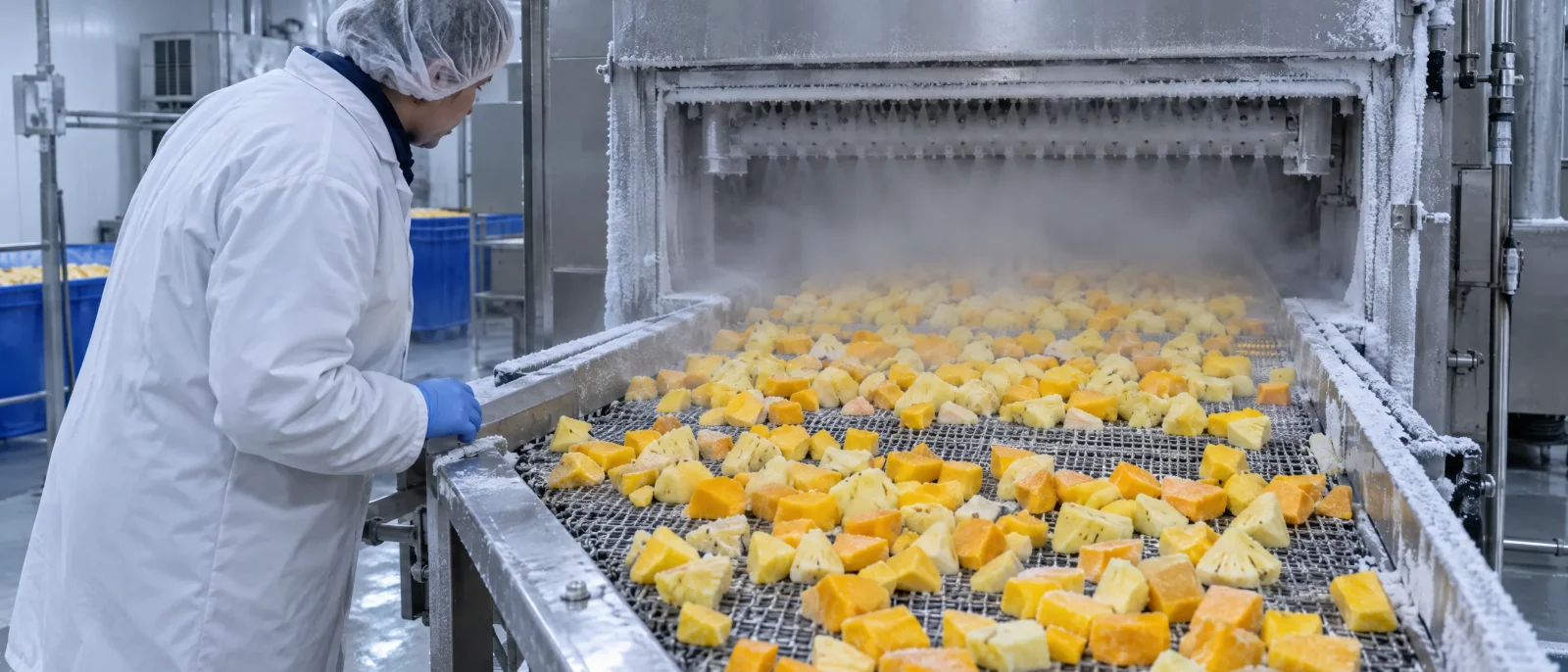
Banana constrains the freezer. Fluidised-bed freezers do not work on it: the slices are soft and sticky and will not fluidise, and impingement air lifts and flips them. A banana IQF line is a straight-belt tunnel with air at −35 to −40 °C for 20 to 40 minutes to a core at or below −18 °C, or a spiral where floor space is short. Equipment vendors supplying Vietnamese plants quote block freezing on contact plates at −35 to −40 °C for 1 to 3 hours per batch, and air blast for 2 to 6 hours; these are vendor parameters, not acceptance criteria. Codex CXC 8-1976 asks for quick-frozen product to pass rapidly through the zone of maximum ice-crystal formation, −1 °C to −5 °C, and slow freezing is the named cause of large ice crystals, high drip loss and mushy slices after thawing.
The most quoted format comparison comes from Nutrada, an EU marketplace selling both: drip loss of 3 to 8% for IQF against 10 to 20% for block. Nutrada publishes no thaw temperature or duration with those figures, so they compare formats on one seller’s terms and are not a specification.
The dip adds surface water. A block freezes it solid; an IQF line has to remove it with vibratory dewatering and air knives before the tunnel, because wet slices clump. CBI puts the IQF requirement plainly: “with IQF, the pieces must not stick together”.
The decision rule:
- Slice is seen (bakery topping, retail bag, bowl topping): buy 10 mm IQF, with the thickness band and the colour-after-thaw clause.
- Slice is blended (smoothie, purée, ice-cream base): a thickness tolerance and a free-flow guarantee buy nothing your process keeps. A block, or a separately specified broken-and-fines grade, matches the use. Frozen strawberry already trades “Whole & Broken” as its own item code with its own specification, GG-2615. Colour still matters in a blend, so the treatment checks still apply.
Broken pieces and fines run at roughly 10 to 20% of slice output and stay with the processor when the contract is silent. If you do not take them, say who does. The price gap between IQF and block banana is not public; it sits behind paid market-data services.
Which standards apply to frozen banana slices?
None directly. There is no Codex standard, no USDA grade standard and no EU marketing standard for quick-frozen banana; EU marketing standards cover fresh fruit only. A banana contract borrows terms from a vegetable standard and says so.
Codex CXS 320-2015, the Standard for Quick Frozen Vegetables, is qualitative on colour, asking for “reasonably uniform colour characteristic of the variety”, and requires the label to carry “quick frozen”, the product name, the style of cut and the size where applicable. Vietnam’s adoption of it, TCVN 11511:2024, likewise covers frozen vegetables, and no Vietnamese national standard for frozen fruit was found. Written into a banana contract, CXS 320 is an incorporated term, not an applicable standard. Suppliers publish shelf life of 12 to 24 months at −18 °C.
What clauses belong in the purchase order?
Five lines turn “anti-browning treated, 10 mm, IQF” into terms you can check on receipt. Each names its evidence, so a dispute is settled by a record or a measurement, not by an adjective.
| Clause | What to write | Method or instrument |
|---|---|---|
| Treatment | Declared treatment per lot: dip only, steam blanch plus dip, or none; bath formulation attached | Batch record; formulation reconciled against ingredient declaration |
| Colour | ΔE against retained sample after a named thaw (temperature, hours), limit agreed by the parties | L*a*b* on 20 thawed slices, standard background |
| Thickness | 10 mm, at least 85% of slices within ±2 mm | Digital caliper, 30 slices per sample |
| Sulphite | Total SO₂ at or below 10 mg/kg if “sulphite free” is claimed | Optimised Monier-Williams; Regulation (EU) No 1169/2011, Annex II |
| Broken and fines | Accepted share, or assigned to the processor | Count by weight on the receiving sample |
Common questions
Does freezing stop banana slices from browning?
No. Freezing pauses the browning enzymes PPO and POD but does not destroy them, and an ascorbic or citric acid dip only slows the reaction. In dip-only slices the enzyme is still active after thawing. Steam blanching inactivated the enzymes in published research, but most commercial IQF banana is not blanched. Judge colour after a defined thaw, not in the frozen bag.
Is no preservatives compatible with an ascorbic acid dip?
Yes, because ascorbic and citric acid act here as an antioxidant and an acidity regulator rather than as preservatives. What a dip rules out is a claim of 100% banana or single ingredient, since the acids must appear in the ingredient list. Ask for the bath formulation and check it against the declaration on the label.
What slice thickness survives thawing?
Slices thinner than about 8 to 10 mm tend to collapse, bend and lose their round cut face after thawing. Vietnamese lines commercially cut 10 mm slices. A thinner slice also exposes more cut surface per kilo, and thin slices go mushy if steam-blanched. A checkable clause is at least 85% of slices within plus or minus 2 mm, measured on 30 slices.
When is block frozen banana the better buy?
When your first step blends the fruit, as in smoothies, purée or ice-cream bases. Blending destroys slice geometry, so paying for a thickness tolerance and free flow buys nothing the process keeps. A block or a broken-and-fines grade matches that use. Block freezing is slower, so drip loss is higher, but colour and treatment checks still apply.
How do I verify a sulphite-free claim on frozen banana?
Ask for a laboratory result for total SO2 measured by the optimised Monier-Williams method on the lot. Under Regulation (EU) No 1169/2011, Annex II, sulphite above 10 mg/kg expressed as SO2 must be declared as an allergen. Many EU and Japanese buyers require frozen fruit to be sulphite free, so put the method and the limit in the purchase order.