On this page
- What does a mango puree specification have to contain?
- What Brix should mango puree be, and against which reference?
- Where does mango puree pH cross the US 4.6 line?
- Which mango variety goes into puree, and why do Vietnamese sheets leave it blank?
- How are consistency, colour and specks measured when no standard method exists?
- Which microbiology regime applies: pasteurised frozen or commercially sterile?
- What packing and shelf-life lines does an aseptic order need?
- What does the full mango puree specification look like?
- Common questions
- Related insights
A mango puree specification means nothing unless each number carries its method: Brix at 20 °C, equilibrium pH with titratable acidity, Bostwick consistency, colour, specks and microbiology. On mango, variety and ripeness move Brix and pH. The published Vietnamese sheet, for frozen puree, gives Brix ≥11.5 against the 13.5 reference and pH to 4.7 against the US 4.6 line, and names no variety.
What does a mango puree specification have to contain?
A workable mango puree specification has seven lines, and each needs a stated test method. They are soluble solids, pH bound to titratable acidity, consistency, colour, defects (specks, lumps and mould count), microbiology, and packing with shelf life. A figure without its method is two different numbers, because two labs can read the same drum differently and both be correct.
Two decisions sit upstream of this article and are covered elsewhere. The first is the format choice, which carries its own storage, freight and Alicyclobacillus consequences. That comparison is set out in aseptic versus frozen fruit puree. The second is customs classification. Frozen uncooked puree can stay in 0811.90, pasteurised puree is commonly entered under 2008.99, and puree obtained by cooking moves to 2007.99. The reasoning is in HS codes for fruit puree, pulp and concentrate, and a broker or binding ruling should confirm it before the first shipment.
On the Vietnamese side, no national standard (TCVN) for mango puree was found. The nearest document is TCVN 7946:2008 for juices and nectars, which is identical to CODEX STAN 247-2005. Every Vietnamese mango puree source found for this article is frozen. No Vietnamese plant’s aseptic filling line for mango puree has been verified. A buyer who needs aseptic drums from Vietnam is therefore writing a specification that the published Vietnamese data does not yet answer.
What Brix should mango puree be, and against which reference?
No legal Brix floor applies to single-strength mango puree. The figures buyers cite are reconstitution references:
- 13.5 °Brix in Directive 2001/112/EC, Annex V, as replaced by Directive 2012/12/EU
- 13.5 °Brix in CODEX STAN 247-2005 and in Vietnam’s own TCVN 7946:2008
- 13.0 °Brix in 21 CFR 101.30
In the EU annex, a double asterisk marks the puree-based entries, which are read without acid correction. The Codex text also defines a concentrate as Brix at least 50% above the reconstituted level.
One Vietnamese processor’s published data sheet sets mango puree at Brix ≥11.5. That floor is 2.0 °Brix below the EU, Codex and TCVN reference and 1.5 below the US figure. A lot at 11.5 carries about 85% of the soluble solids that a nectar or drink formula built on 13.5 assumes (11.5 / 13.5 = 0.85). The shortfall shows up in the buyer’s fruit-content calculation even though no regulation has been breached. A Vietnamese trading company’s listing gives frozen single-strength puree at “≥14–18 °Bx depending on variety”. That listing is the only Vietnamese source that links Brix to variety at all.
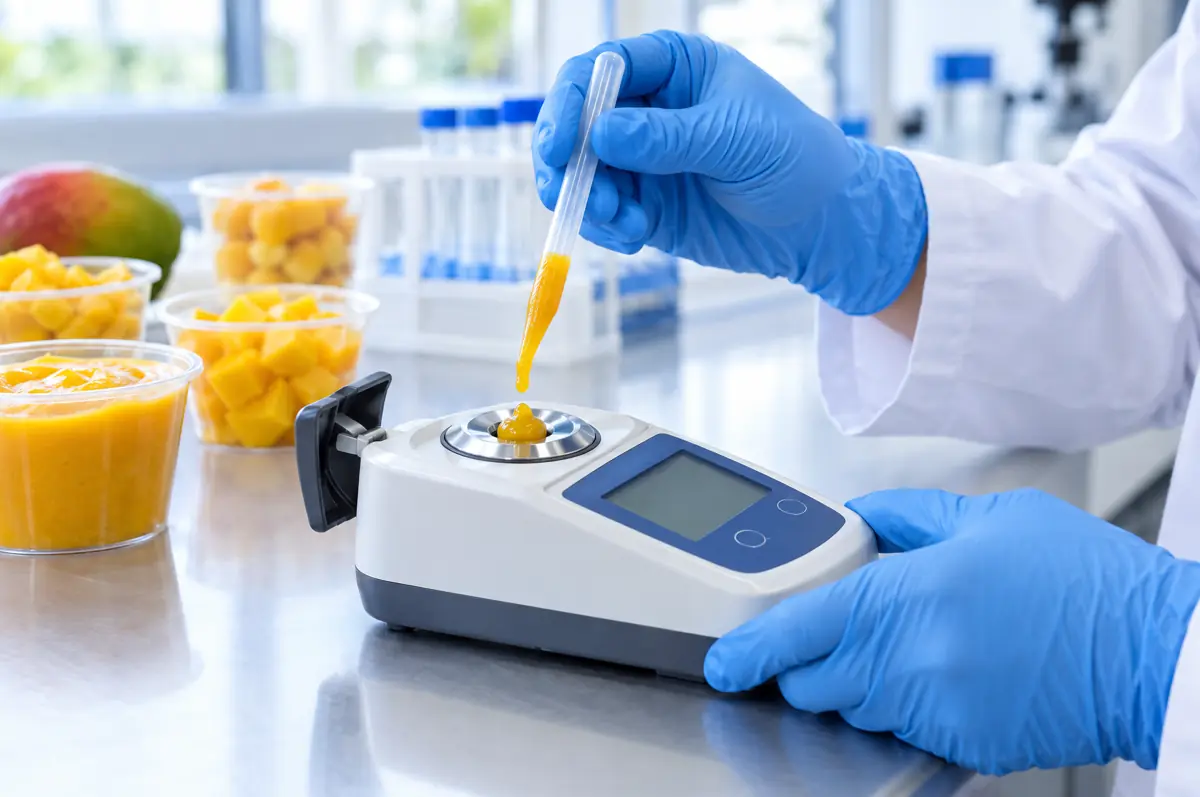
Low Brix has two common causes: fruit picked before it was ripe enough, or wash water carried into the pulper. A specification cannot tell those causes apart, but it can close the gap. Write a Brix range per variety, read by refractometer at 20 °C using IFU No.8 or AOAC 932.12. For frozen lots, write that the reading is taken after complete thaw. Ripeness at intake is variety-specific, as set out in Vietnamese mango varieties for processing. The same Brix target can therefore mean a different harvest point for each cultivar.
Where does mango puree pH cross the US 4.6 line?
Mango puree pH can cross the US low-acid boundary without any processing fault, because ripe mango runs close to it naturally. The figures are:
- FDA’s Approximate pH of Foods lists ripe mango at pH 3.40–4.80.
- 21 CFR 113.3 defines a low-acid food as one above pH 4.6.
- The published Vietnamese frozen sheet gives pH 3.0–4.7. It prints the range with a “%” sign, a presentation error that is a good reason to ask for the method behind it.
Inside a −18 °C cold chain the crossing does no harm; frozen puree is pasteurised, not sterile, so the user plans its own heat step. In a drum held at ambient temperature, the same pH changes which US regulation applies. The lot must either be acidified or receive a low-acid scheduled process.
Three published figures set mango puree pH against the US 4.6 line. FDA’s reference range for ripe mango reaches pH 4.80. 21 CFR 113.3 treats any food above pH 4.6 as low-acid. One published Vietnamese frozen mango puree sheet allows pH up to 4.7. For ambient aseptic mango puree sold into the United States, that overlap is a classification question, not a quality question. The commercial answer is acidification. CBP ruling NY N320885 of 16 December 2021 classified an aseptic organic mango pulp in HTSUS subheading 2008.99.40. That pulp was 99.8% mango and 0.2% citric acid, pasteurised at 90 °C for 20 seconds and 100 °C for 30 seconds, and filled in 55-gallon drums. Commercial aseptic mango pulp is commonly acidified; the pulp ruled in NY N320885 carried 0.2% citric acid. A buyer whose label reads “mango puree, no additives” needs either a frozen supply chain or an acidified lot with a revised ingredient line.
USDA’s commodity description A-A-20252B, Purees, Fruit, Aseptic, makes this a formal contract choice:
“Acidification 1 – Acidified” / “Acidification 2 – Not acidified”
In plain terms, the buyer chooses one option in the purchase order and does not leave it to the plant. The permitted agents are citric acid, ascorbic acid, lemon juice and lemon juice concentrate.
The link to variety is an inference, and it should be written as one. Riper fruit raises Brix toward 13.5, and riper mango also sits at the top of FDA’s pH range. Keo is published as a milder, less acid variety. That makes it the variety whose pH a buyer should check first. No data set of pH by Vietnamese variety exists, so the contract annex has to fix both values per variety.
Under 21 CFR 114, pH above 4.0 must be measured with a potentiometric meter, not paper. The binding value is equilibrium pH. Bind titratable acidity beside it, measured as citric acid and titrated to pH 8.1 by IFU No.3. If pH is bound alone, a plant can pass by adjusting the acid. VinFruits Global holds any puree lot above pH 4.40 for assessment under its specification template, a margin below the 4.6 line in United States rules, because the published Vietnamese mango puree data sheet runs to 4.7.
Which mango variety goes into puree, and why do Vietnamese sheets leave it blank?
No published Vietnamese mango puree data sheet names a variety. The Indian trade, by contrast, sells puree by variety. CBI puts India at about 70% of the EU mango puree market, and Vietnam sits among the “other countries” with Peru, Pakistan and Ecuador. Indian Alphonso fruit runs from mid-May to mid-June and Totapuri from early June to the end of July. Vietnam has no Totapuri, the variety most closely associated with puree.
The Vietnamese varieties differ in ways that matter here. Cát Chu covers about 60% of the mango area in Đồng Tháp, the main delta province, and is published as deep yellow with fine fibre. Two other types, green-skin elephant mango and Taiwanese mango, are very large fruit of 700 g to 1.5 kg. They cover 20–30% of Đồng Tháp’s mango area, and Vietnamese press reports them as unsuitable for processing. Their low Brix and pale colour make them a poor fit for puree.
A sheet that says “Vietnamese mango puree” with no variety line can lawfully be filled from the fruit least suited to it. Harvest maturity is also variety-specific. One Vietnamese IQF processor publishes Keo at 75–80% maturity and Cát Chu at 80–85%. Those are IQF harvest points rather than puree points, but they show that one intake rule cannot serve both varieties.
Season gives the delta a timing argument. The Vietnamese main crop runs March to July and peaks April to June, which is ahead of the Indian Totapuri window. Write the variety, one per lot, on the label and the certificate of analysis (COA), and treat mixed lots as non-conforming.
How are consistency, colour and specks measured when no standard method exists?
Consistency, colour and specks are the lines most likely to cause a dispute, because two of the three have no binding method and the third has no published limit.
Consistency. Consistency is read on a Bostwick consistometer, in centimetres of flow in 30 seconds. IFU publishes no consistency method, and no calibration standard exists for the instrument, so two labs commonly disagree. The contract must therefore fix four things: sample temperature, sample volume, trough levelling, and which party calibrates. For comparison only, one Egyptian aseptic data sheet gives Bostwick 8–12 cm in 30 s. No Vietnamese Bostwick figure has been published.
Colour. Instrument colour is measured by IFU No.80 or a chroma meter at D65/10°. The contract names the colour system, illuminant, observer and cuvette. Without that, the two parties measure in two different systems. A visual check runs alongside it: a three-person panel compares the sample against a signed reference photo set, under D65 light, on a standard white background.
Specks. No published threshold for black specks or fibre in mango puree exists. The count is made visually on a spread sample, and the limit is set in the contract.
Other defects. A-A-20252B states that “Lumps must not exceed 6.35 mm diameter”. The Howard Mould Count (FDA MPM V-9) is the puree test most sensitive to rotten fruit at intake, and IFU No.81 (ergosterol) is the chemical alternative. Low density points to entrained air from poor deaeration and is measured by IFU No.1a. Specify pulp content by centrifuge; the Vietnamese sheet’s ≥20% states no method.
Which microbiology regime applies: pasteurised frozen or commercially sterile?
Frozen and aseptic mango puree are controlled under different microbiological regimes. Their plate counts are not comparable, and a buyer who compares them directly will misjudge both.
| Regime | Total count (CFU/g unless stated) | Yeast and mould (CFU/g unless stated) | Coliform (CFU/g) | Other criteria | Instrument |
|---|---|---|---|---|---|
| Frozen fruit, USDA | <50,000 | yeast <10,000; mould <10,000 | <100 | E. coli <3/g; Salmonella neg/25 g | USDA Commodity Specification, Frozen Fruit (6/2017) |
| Aseptic fruit puree, USDA | <1,000 | <100 | <10 | Commercial sterility required | USDA A-A-20252B |
| Aseptic mango, Egypt | ≤10 per ml | ≤10 per ml | Not stated | Not stated | One Egyptian aseptic data sheet |
Asian aseptic puree data sheets commonly state a total count below 10 CFU/g, the same order as the Egyptian sheet in the table. The roughly 100-fold gap between that figure and USDA’s <1,000 is two regimes, not two quality levels. USDA controls aseptic puree through commercial sterility, and a negative plate count cannot prove sterility. Only an incubation test run under the plant’s scheduled process can do that. Ask for the incubation record and a process-authority letter with the first lot.
Under 21 CFR 120, puree used as a beverage ingredient counts as juice, which requires a 5-log pathogen reduction and records kept by the importer. Large EU and Japanese buyers write Salmonella negative per 375 g and Listeria negative per 125 g into commercial specifications. For Alicyclobacillus, write “not detected in 10 g” using IFU MM12:2019, with a heat shock of 80 °C for 10 minutes. IFU No.12 is the HMF method, a different test, and the two are sometimes confused.
What packing and shelf-life lines does an aseptic order need?
An aseptic order needs four packing lines: net kg per drum, a never-frozen clause, at least 9 months of shelf life remaining at delivery, which USDA requires for puree, and the incubation record described in the microbiology section. Aseptic formats published abroad vary widely:
- 215 ±2 kg drums from India, 80 drums per 20 ft container
- 220 kg drums from the Philippines and Egypt
- 230 kg bag-in-drum in a 55-gallon drum
- 20 kg bag-in-box
- 1,000 kg octabins
“200 kg drum” is a nickname, not a weight, so the contract states net kg per drum. According to WFLO, aseptic bags are not designed for frozen use; the plastics can become brittle or break. Write “never frozen” for aseptic lots.
The published Vietnamese sheet packs frozen mango puree in drums or cartons of 10, 20 or 180 kg in double PE, stored at −18 °C, with 24 months’ shelf life. A Vietnamese trading listing adds 5 and 10 kg PE-lined cartons. Frozen puree has its own risk. Thawing and refreezing darkens the colour and flattens the aroma, which is a reason to record reefer temperatures for the whole voyage.
What does the full mango puree specification look like?
The table below sets each line against the published Vietnamese figure, the reference document and the method. The right-hand column is wording a buyer can paste into a purchase order.
| Parameter | Vietnamese published value | Reference document | Method | What to write |
|---|---|---|---|---|
| Soluble solids | ≥11.5 °Brix | 13.5 (2001/112/EC Annex V as replaced by 2012/12/EU; Codex STAN 247-2005; TCVN 7946:2008); 13.0 (21 CFR 101.30) | IFU No.8 / AOAC 932.12, 20 °C, after thaw | Agreed °Brix range per named variety |
| pH | 3.0–4.7 | 21 CFR 113.3 (>4.6 low-acid); FDA ripe mango 3.40–4.80 | IFU No.11 / AOAC 981.12, pH meter, equilibrium | Ceiling with margin below 4.6 at every sampling point |
| Titratable acidity | ≤1.0% as citric | None (bind to pH) | IFU No.3, to pH 8.1 | Range bound to pH; acidified or not, and agent |
| Consistency | Not published | No standard method | Bostwick, cm in 30 s | Range plus temperature, volume, levelling, calibrating party |
| Colour | “Bright yellow to orange-yellow” | None | IFU No.80 or chroma meter D65/10°; signed photo set | System, illuminant, observer, cuvette, range |
| Defects | Not published | A-A-20252B (lumps ≤6.35 mm) | Spread-sample count; FDA MPM V-9 Howard Mould Count | Lumps ≤6.35 mm; specks and mould-count limits agreed in the contract |
| Microbiology | Not published | A-A-20252B (commercial sterility for aseptic); 21 CFR 120 (5-log reduction) | Incubation test under the scheduled process; IFU MM12:2019 for Alicyclobacillus | Aseptic: incubation record and process-authority letter with first lot; Alicyclobacillus not detected in 10 g |
| Packing and shelf life | 10, 20 or 180 kg in double PE, −18 °C, 24 months | A-A-20252B (≥9 months remaining at delivery) | Net weight check; label and COA | Net kg per drum; aseptic packs never frozen; ≥9 months remaining at delivery |
| Variety | Not named | None | Label and COA | One named variety per lot; mixed lots non-conforming |
Common questions
What Brix should mango puree be?
There is no legal floor for single-strength mango puree. The references are 13.5 °Brix in Directive 2001/112/EC Annex V as replaced by Directive 2012/12/EU, in Codex STAN 247-2005 and in TCVN 7946:2008, and 13.0 °Brix in 21 CFR 101.30, all for reconstituted products. One published Vietnamese frozen sheet gives a floor of 11.5. Write a range by variety, read at 20 °C with IFU No.8, after full thaw for frozen lots.
What pH is aseptic mango puree?
FDA lists ripe mango at pH 3.40 to 4.80, and 21 CFR 113.3 treats food above pH 4.6 as low-acid. Ambient aseptic mango puree is commonly acidified; the pulp ruled in CBP NY N320885 carried 0.2% citric acid. One Egyptian aseptic sheet gives pH 3.5 to 4.5. Specify an equilibrium pH ceiling by pH meter, bind titratable acidity beside it, and state acidified or not acidified.
Which mango variety is used for mango puree?
The Indian trade sells puree by variety, mainly Totapuri and Alphonso, each with its own season. Vietnam has no Totapuri. Cát Chu’s deep yellow flesh makes it the better colour fit among the main Vietnamese varieties, while green-skin elephant and Taiwanese mango are reported unsuitable for processing. No published Vietnamese puree sheet names a variety, so the buyer writes one variety per lot into the contract.
How is mango puree viscosity measured?
Mango puree consistency is read on a Bostwick consistometer as centimetres of flow in 30 seconds. IFU has no consistency method and no calibration standard exists for the instrument, so labs often disagree. The contract fixes sample temperature, sample volume, trough levelling and the calibrating party. One Egyptian aseptic data sheet gives 8 to 12 cm in 30 seconds, useful only as a comparison point.
Is Vietnamese mango puree available aseptic?
Every published Vietnamese mango puree source found is frozen, stored at −18 °C, and no Vietnamese aseptic filling line for mango puree has been verified. Where offered, aseptic supply is arranged by agreement and filler capacity confirmed per order. A buyer taking that route should require the incubation-test record, a process-authority letter, net kg per drum, a never-frozen clause and at least 9 months of shelf life remaining at delivery.