On this page
- Which permissions does a durian shipment to China need, and who holds them?
- Who issues planting-area and packing-facility codes in 2026?
- Why does 24 January 2027 matter for fresh durian contracts?
- Does GACC Decree 280 apply to fresh durian?
- How do the cadmium and auramine O tests shape the harvest schedule?
- What goes in the consignment file for fresh and frozen durian?
- What should a buyer ask the supplier and write into the purchase order?
- Common questions
- Related insights
Every Vietnam durian export to China runs on one of two protocols. Fresh fruit ships under the 11 July 2022 protocol, on planting-area and packing-facility codes that GACC approves. Frozen fruit ships under the 19 August 2024 protocol, on a plant registration governed by GACC Decree No. 280 since 1 June 2026. Every lot also needs a cadmium and auramine O certificate from a GACC-recognised laboratory.
Which permissions does a durian shipment to China need, and who holds them?
A durian lot bound for China rests on up to four separate permissions, and each one sits on a different physical asset: the orchard, the packing house, the processing plant and the testing laboratory. A trading company or an importer cannot hold any of them. The first question to put to a supplier is which code sits on which asset, and who holds it.
| Permission | Sits on | Proposed / granted by | Instrument | Applies to |
|---|---|---|---|---|
| Planting-area code | The orchard (the land) | Vietnam’s Department of Crop Production and Plant Protection proposes; GACC approves | Fresh durian protocol, 11/07/2022; Decree 38/2026/NĐ-CP | Fresh. The frozen protocol also requires fruit from registered planting areas |
| Packing-facility code | The packing house (the building) | Same route as above | Fresh durian protocol, 11/07/2022; Decree 38/2026/NĐ-CP | Fresh |
| Establishment registration | The processing plant | GACC, filed through CIFER | GACC Decree No. 280 (Decree 248 before 01/06/2026); frozen durian protocol, 19/08/2024 | Frozen only |
| Laboratory recognition | The testing laboratory | Recognised by Chinese customs | China’s 100% testing regime for cadmium and auramine O; GB 2762 | Fresh and frozen |
The fresh protocol limits exports to planting areas and packing facilities whose codes GACC has approved. It names the fruit fly Bactrocera correcta and mealybug species as the quarantine pests. Export phytosanitary sampling under the protocol is 2% of the consignment for the first two years, stepping down to 1% if no violations occur. The protocol ran an initial three years to 11 July 2025, and GACC let it roll over automatically without suspension.
The fresh protocol does not require irradiation or vapour-heat treatment. What it requires is cleaning, pest removal and fruit free of soil. Some logistics sources mention fumigation. Confirm that with the regional plant-quarantine sub-department before writing it into a contract.
Frozen durian is a separate regime with its own document set. This site covers it article by article in the HS code and documents for frozen durian. This article centres on fresh fruit and gives frozen one contrast section below.
Who issues planting-area and packing-facility codes in 2026?
Since Resolution 36/2026/NQ-CP of 31 July 2026, commune-level People’s Committees issue planting-area and packing-facility codes. Applications go online through the National Public Service Portal, and the Ministry of Agriculture and Environment holds the data centrally. GACC remains the final approver for China. A code GACC has not approved cannot ship through the official channel.
The resolution sets service times of 3 working days for a code without export registration, 10 working days with it, and 2 working days for reissue. It also replaces prior approval with post-audit. In practice, more codes get issued faster, and more are later found wanting at audit. The national authority is the Department of Crop Production and Plant Protection under the Ministry of Agriculture and Environment, formed from the former Plant Protection Department in the 2025 ministry merger. Its regional sub-departments issue the phytosanitary certificate for each lot. The mechanics of that document are covered in how the phytosanitary certificate for Vietnamese fruit works.
The durian code base is growing. GACC approved 401 more durian planting areas in a round announced on 20 August 2026. In that round, 82.3% of planting-area files and 66.7% of facility files passed, and 86 areas and 83 facilities were told to remediate (Dân trí, 20/08/2026). Trade press gave the durian totals at August 2026 as 1,917 planting-area codes and 249 packing facilities (Agrospectrum Asia, 21/08/2026). Dân trí reported 166 newly approved facilities in the same round. Read 166 as the new approvals and 249 as the running total. Across all products, Vietnam held 9,546 planting-area codes and 1,525 packing-facility codes in May 2026 (Tuổi Trẻ, 15/05/2026, citing the ministry).
A planting-area code attaches to land, and a packing-facility code attaches to a building. A company that owns neither has two legal routes to use one. The first is a written authorisation from the code holder, with liability and indemnity terms. The second is toll packing at a facility that holds a valid code. A written authorisation has no clear legal force if the code is later revoked, so the buyer’s protection has to sit in the purchase order.
Why does 24 January 2027 matter for fresh durian contracts?
Decree 38/2026/NĐ-CP of 24 January 2026 is the first decree-level instrument for Vietnamese planting-area and packing-facility codes. It sets technical conditions, record-keeping, and the grounds for grant, suspension and revocation. Codes issued before it keep their validity for a one-year transition, and that transition ends on 24 January 2027. Any code issued before 24 January 2026 has to be reviewed under the new rules.
A contract signed now for supply after January 2027 should therefore not rely on a code’s past approval. It should rely on re-validation under Decree 38/2026 and on the code appearing on the published list on the shipment date.
Enforcement pressure runs from both directions. Between 2025 and May 2026, China warned 403 Vietnamese planting-area codes and 240 packing-facility codes for non-compliance (Tuổi Trẻ, 15/05/2026, citing the ministry). That figure covers all products, and the source says warned, not suspended. In June 2024 China suspended imports from 33 Vietnamese sources (South China Morning Post, 27/06/2024). On the Vietnamese side, two officials were arrested in March 2026 over a cooperative in Krông Pắc that registered 26 codes and transferred them unlawfully. In late July 2026 a criminal case was opened over falsified test certificates and trafficking in planting-area and packing-facility codes. In August the Deputy Prime Minister directed the Ministry of Public Security to investigate the buying, renting and forging of codes. As of 31 August 2026, no administrative-penalty decree specific to code fraud had been issued, so cases are handled under the Criminal Code. Renting a code is now a criminal exposure, not a commercial shortcut.
Does GACC Decree 280 apply to fresh durian?
No. GACC Decree No. 280 governs the registration of overseas producers of imported food, meaning processing plants. It does not apply to fresh durian. Ngô Xuân Nam, Deputy Director of the Vietnam SPS Office, told Báo Nông nghiệp & Môi trường on 22 October 2025 that the order concerns processed food and processed farm produce, and that it does not change how planting-area codes are managed.
The confusion is understandable. Vietnamese trade press refers to the order as Lệnh, Nghị định or Quy định 280 interchangeably, which makes it read like a Vietnamese decree covering every export. It is a Chinese customs order. It was issued on 14 October 2025, came into force on 1 June 2026, and repeals GACC Decree No. 248 at Article 33. The article-level points below follow the USDA Foreign Agricultural Service GAIN report on the order. The Chinese original has not been read for this article.
- Article 20: moving the production site, changing the domestic registration number, product scope, process, food-safety management system or legal representative requires registration from scratch, not an amendment.
- Articles 21–22: registrations last five years and renew automatically for most product groups.
- Article 27: lending or transferring a registration number is a ground for revocation.
- GACC Announcement No. 27 of 2026: a self-registered facility’s code must be valid at the moment of customs declaration. Codes issued under Decree 248 that are still valid carry over, and renewals or amendments after 1 June 2026 follow Decree 280.
For frozen durian, registration belongs to the physical plant through CIFER, never to a trading company. VinFruits Global asks the partner plant for its GACC registration number, expiry date and registered product list before a frozen durian order is confirmed, because a registration that covers one product does not cover another.
Two points are unsettled, and a buyer should know both readings.
The recommendation route. One reading says frozen durian plant registration goes through CIFER with a recommendation from the Department of Crop Production and Plant Protection, which was the Decree 248-era route. The other reading notes that Announcement 27/2026 lists 17 product groups needing a competent-authority recommendation, and that this list includes dried fruit and dehydrated vegetables but does not clearly include frozen fruit. On that reading, frozen durian plants may self-register. The open question is whether the frozen protocol’s own registration clause overrides Decree 280’s list. Confirm with the Vietnam SPS Office before relying on either.
The label number. The 2024 frozen protocol requires the establishment registration number on the pack. Article 14 of Decree 280 accepts either the Chinese registration number or the number issued by the exporting country’s authority. Decree 248 required the Chinese number on inner and outer packs. It has not been confirmed which number satisfies the protocol now. Specify the Chinese registration number in the purchase order, because it satisfies both texts.
How do the cadmium and auramine O tests shape the harvest schedule?
Since January 2025, Chinese customs has tested 100% of durian consignments for auramine O, a yellow dye, after it was found on Thai fruit, and later added cadmium to the same regime. China’s contaminant standard GB 2762 sets the cadmium limit at 0.05 mg/kg. Auramine O has zero tolerance, so any detection loses the lot. Every Vietnamese durian lot bound for China, fresh or frozen, needs a cadmium and auramine O certificate from a laboratory that Chinese customs recognises, issued before export. Lots that fail at the Chinese border are returned or destroyed. Exporters report booking the laboratory at least 7 days ahead, though some labs accept 3, and a reported sampling practice of 2 fruit taken at random from 5–6 cartons per container. Results take 1–2 days off-peak and 4–8 days at peak. Fresh durian keeps 3–7 days at ambient temperature, so the harvest date follows the laboratory calendar, not the other way round.
The cost of a missing certificate is on record. In early 2025 one exporter had 5 containers returned for lack of an auramine O certificate, and another 5 were turned back.
Laboratory counts move week to week, and the published figures disagree. Tiền Phong reported 50 recognised laboratories across 13 provinces and cities at 7 August 2026: Ho Chi Minh City 19, Cần Thơ 9 and Hà Nội 8, with the Mekong Delta holding 4 cadmium and 6 auramine O labs. Thanh Niên (03/08/2026) counted 48 cadmium and 39 auramine O labs, while Báo Chính phủ (10/08/2026) counted 47 and 39. In May 2026 Tuổi Trẻ reported 16 of 21 cadmium labs operating. Do not rely on any of these counts. Check the issuing laboratory against the published list current on the date of the certificate.
Thailand has more than 300 orchard-level testing points recognised by Chinese customs, which has brought its inspection rate down from 100% to 30%. Vietnam has no equivalent, so every Vietnamese lot still goes through the full test.
What goes in the consignment file for fresh and frozen durian?
A fresh lot to China needs the commercial documents, an export declaration under HS 0810.60.00, the phytosanitary certificate, the cadmium and auramine O certificate, C/O Form E, and the code list with written authority to use each code. Frozen is declared under heading 0811 and adds four documents. The value of the Form E preference over China’s MFN rate has not been checked, so no duty rate is given here.
| Document | Fresh (0810.60.00) | Frozen (heading 0811) | Issuer or instrument |
|---|---|---|---|
| Contract, invoice, packing list, B/L or road document | Yes | Yes | Seller and carrier |
| Phytosanitary certificate | Yes | Yes | Regional plant-quarantine sub-department, via the national single window |
| Cadmium and auramine O certificate | Yes | Yes | GACC-recognised laboratory; GB 2762 for cadmium |
| C/O Form E | Yes | Yes | ASEAN–China FTA issuing body |
| Planting-area and packing-facility code list, with written authorisation | Yes | Planting-area codes | 2022 fresh protocol; Decree 38/2026/NĐ-CP |
| Plant GACC registration, HACCP file, temperature charts, bilingual protocol label | No | Yes | GACC Decree No. 280; 2024 frozen protocol; CAC/RCP 8-1976 |
Three physical checks catch lots that pass on paper. First, the codes printed on the carton must be the codes for this lot, not codes the supplier holds elsewhere. Second, a net weight more than 1 kg off the declared figure is reported as one of the three most common reasons Chinese customs rejects a lot. Third, the fresh reefer is set at 13–15 °C and never below 10 °C, because chilling injury cannot be seen at loading. A data logger is the seller’s only evidence of what happened in transit.
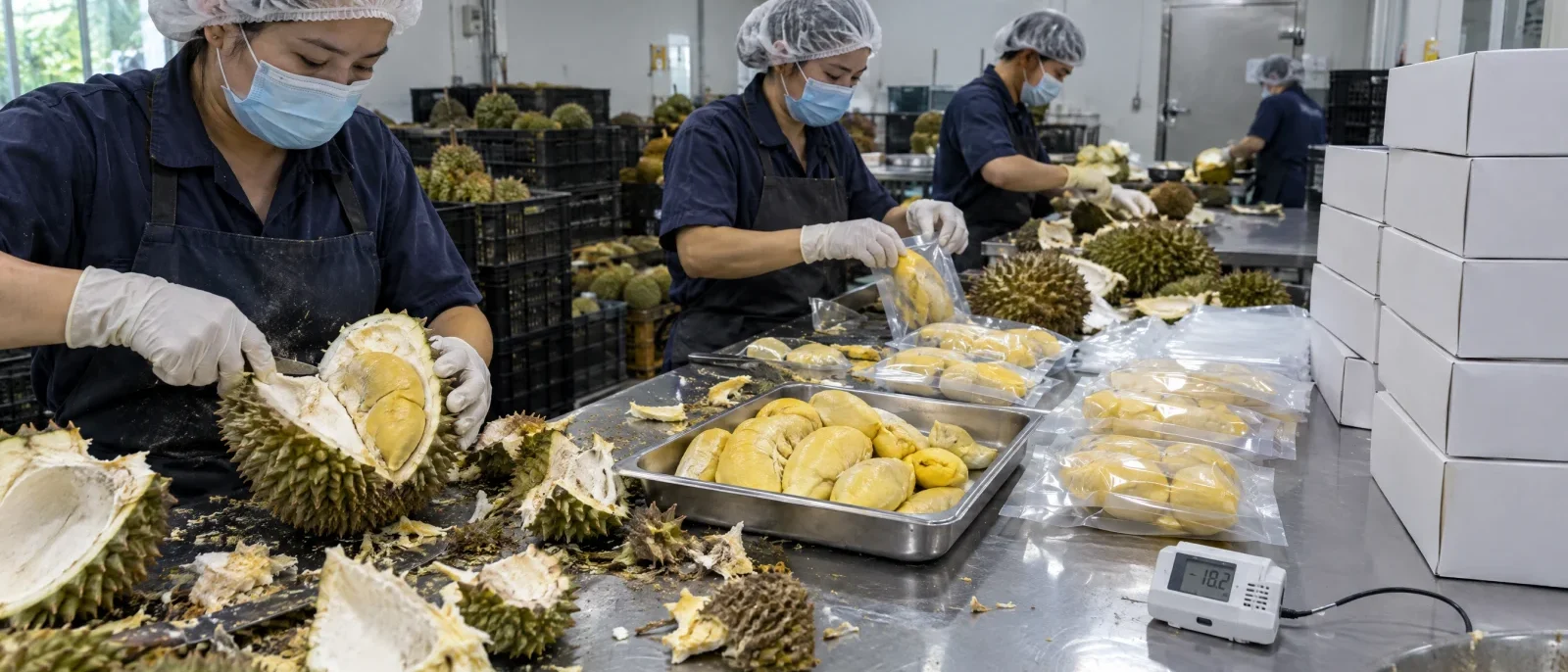
The frozen protocol allows three forms: whole fruit in shell, segments in the pod without seed, and pulp without shell. It requires freezing at or below −35 °C for at least one hour until the core reaches −18 °C or below, then holding at or below −18 °C through storage and transport, following Codex CAC/RCP 8-1976.
What should a buyer ask the supplier and write into the purchase order?
Ask which code sits on which asset, who holds it, under what written authority, and whether it is valid on the shipment date. For frozen, also ask whether the registration has moved to Decree 280, when it expires, whether its registered product list covers this item, and whether anything listed under Article 20 has changed in the past 12 months. A supplier saying it has a code is not evidence.
Get the number in writing. Check it independently where the public system allows, and keep a dated record of what you saw. A dated screenshot from the supplier is weaker than your own lookup.
These clauses are templates to adapt with counsel, not any company’s standard terms:
- The Supplier represents and warrants that all goods originate from planting area code [ ] and are packed or processed at facility code [ ]; that the Supplier is the lawful holder of, or is lawfully authorised in writing to use, those codes; and that those codes are not under suspension or warning at the time of delivery. The Supplier shall provide copies of the code grant documents and any authorisation letter before the first advance payment.
- If a consignment is rejected, detained, ordered destroyed or re-exported for reasons connected to codes (revoked codes, invalid codes, codes used without authority, or misdeclared origin), the Supplier shall indemnify the Buyer for goods value, freight, demurrage and cold-storage charges, destruction or re-export costs, and regulatory penalties.
- Every planting-area and packing-facility code shall have been re-validated under Decree 38/2026/NĐ-CP and shall appear on the published list on the date of shipment.
- For frozen: The plant’s GACC registration shall be valid at the moment of import declaration, its registered product list shall cover the goods, and the Chinese registration number shall appear on the pack.
One security option some buyers use is to retain 10% of each lot’s value for 60 days after clearance. Treat it as an option to negotiate, not a market norm.
Common questions
Does GACC Decree 280 apply to fresh durian from Vietnam?
No. GACC Decree No. 280, in force since 1 June 2026, governs registration of overseas plants producing processed food, which includes frozen durian. Fresh durian ships under the 2022 Vietnam–China protocol on planting-area and packing-facility codes approved by GACC. The Vietnam SPS Office said in October 2025 that the order does not change how planting-area codes are managed.
Can a trading company hold a planting-area or packing-facility code?
No. A planting-area code attaches to the land and a packing-facility code to the building, so only the owner or investor in the asset can hold one. A trading company can use a code under written authorisation from the holder or through toll packing at a coded facility. Buyers should protect themselves with warranty and indemnity clauses, because an authorisation has unclear force if the code is revoked.
What changes on 24 January 2027?
The one-year transition under Decree 38/2026/NĐ-CP ends. Planting-area and packing-facility codes issued before 24 January 2026 must be reviewed under the decree’s conditions for grant, suspension and revocation. A purchase order covering supply after that date should require every code to be re-validated under Decree 38/2026 and to appear on the published list on the shipment date.
What is the cadmium limit for durian exported to China?
China’s contaminant standard GB 2762 sets cadmium at 0.05 mg/kg. Auramine O has zero tolerance. Since January 2025 China has tested every durian consignment, and each lot needs a certificate from a GACC-recognised laboratory before export. Lots failing at the border are returned or destroyed. Check the issuing laboratory against the list current on the certificate date, because published counts change weekly.
Which HS codes are used for fresh and frozen durian?
Fresh durian is declared under HS 0810.60.00. Frozen durian falls under heading 0811 and needs four extra documents: the plant’s GACC registration, the HACCP file, freezing and transport temperature charts, and the bilingual protocol label. Confirm the full national tariff line with your customs broker before declaring.