On this page
- Is “with seeds” a texture choice or a process choice?
- Which HS heading does frozen passion fruit pulp fall under?
- What Brix should frozen passion fruit pulp have?
- How is Brix measured on passion fruit puree with seeds?
- What acidity and pH should the contract bind?
- Why test residues on the pulp rather than the fruit?
- Which microbiology limits apply to frozen pulp?
- How is frozen passion fruit pulp packed and stored?
- Clauses you can adapt into a purchase order
- Common questions
- Related insights
Vietnam’s national standard for frozen passion fruit pulp, TCVN 13941:2023, requires soluble solids of at least 13.5 % after thawing, titratable acidity of 2.5–5.0 % and storage at −18 °C or colder. Published Vietnamese producer sheets print a lower floor of ≥13.0 °Bx. Seeded pulp is usually uncooked and stays in HS 0811.90. Seedless purée is often pasteurised, which can change the heading. The purchase order should name the standard, the methods and the process.
Is “with seeds” a texture choice or a process choice?
In a Vietnamese offer, seeded and seedless pulp are usually made by two different processes, and the process matters more than the texture. It decides the tariff heading, whether US juice HACCP applies and whether the goods can claim preferential origin. The seeds themselves decide none of these.
Seeded pulp is scooped from the halved fruit and frozen uncooked. One Vietnamese producer’s published sheet packs it in two PE bags per 10 kg carton. Seedless purée has been through a pulper and finisher. Producer sheets list it beside NFC juice, and it is often pasteurised. The aseptic alternative, and why an aseptic bag must never be frozen, is covered in aseptic versus frozen fruit purée.
The process choice has three consequences:
- Heading. Uncooked frozen pulp stays in Chapter 8. A pasteurised purée or a juice can move to Chapter 20 (next section).
- Origin. Under EVFTA, RCEP and CPTPP, freezing fruit does not confer origin, because 0811 is still Chapter 8. A Chapter 8 pulp therefore claims preference only if the fruit was grown in Vietnam. Processing into a Chapter 20 product changes the chapter, and that change is what can confer origin. If an offer looks cheap in a short-crop year, ask where the fruit was grown.
- US regime. End use triggers juice HACCP, not seeds. Under 21 CFR 120.1, “juice” includes purée, so a purée used as a beverage ingredient comes under a 5-log pathogen reduction requirement (21 CFR 120.24), with verification records kept by the importer (21 CFR 120.14). The same purée going into a yoghurt base is a different case. Put your application statement on the purchase order.
Which HS heading does frozen passion fruit pulp fall under?
Frozen passion fruit pulp with no added sugar falls under HS 0811.90, frozen fruit that is uncooked or cooked by steaming or boiling. In the EU the line is CN 0811 90 85, which names passion fruit in its list of tropical fruit. The fresh heading, 0810.90, is wrong for frozen goods even when a supplier’s catalogue prints it.
| Product form | Usual process | Heading | EU duty, MFN / EVFTA (%) | Instrument or ruling |
|---|---|---|---|---|
| Seeded pulp, no added sugar | Uncooked, frozen | HS 0811.90; CN 0811 90 85 | 9 / 0 | TARIC (copy dated 08/10/2026) |
| Frozen pulp, sugar added | Uncooked, frozen | CN 0811 90 11 (sugar >13 %) or 0811 90 31 (≤13 %) | 13 plus a specific duty, or 13 / 0 | TARIC (copy dated 08/10/2026) |
| Seedless NFC juice | Pressed, often pasteurised | HS 2009.89; CN 2009 89 97 | Not checked | CBI, uktradeinfo classification |
| Pasteurised single-strength pulp | Heat-treated | HS 2008.99 possible | Not checked | US CBP ruling N320885 (mango precedent) |
The unresolved case is a pulp that is pasteurised and then frozen. CBP ruling N320885 placed an aseptic single-strength mango pulp in 2008.99, but that ruling covers mango, not passion fruit. No published ruling settles whether frozen pasteurised passion fruit purée stays in 0811.90. An EU Binding Tariff Information decision or a CBP ruling on a real lot is the only settlement. Obtain an advance ruling before the first shipment of each new product form.
A certificate of analysis that cites TCVN 13941:2023 tells you nothing about the heading. The standard covers frozen pulp, purée, juice and concentrated forms in one text, while the tariff spreads them across 0811, 2008 and 2009. The wider pattern is set out in HS codes for fruit purée, pulp and concentrate.
What Brix should frozen passion fruit pulp have?
TCVN 13941:2023 sets at least 13.5 % soluble solids after thawing for single-strength forms. Vietnamese producer sheets print ≥13.0 °Bx, and the EU and US texts sit on either side of both figures. Name one document in the contract, because ordinary product falls in the gap between them.
The Brix floor for frozen passion fruit pulp depends on which document the purchase order names. TCVN 13941:2023, the Vietnamese national standard for frozen passion fruit, requires soluble solids of at least 13.5 % after thawing for single-strength pulp, purée and juice. Published Vietnamese producer sheets for both seeded and seedless pulp print at least 13.0 °Bx. The EU minimum for reconstituted passion fruit juice and purée is 12.0 °Brix, set in Annex V of Directive 2001/112/EC as replaced by Directive 2012/12/EU. The US reference Brix for percentage-juice labelling in 21 CFR 101.30(h)(1) is 14.0. A lot reading 13.2 °Bx at 20 °C after thawing therefore passes the producer sheets and the EU minimum, but it fails TCVN 13941:2023 and sits below the US label reference. The divergence band, 13.0 to 13.5 °Bx, lies inside ordinary commercial product, so the contract has to name one text.
| Reference | Brix floor (°Bx) | Applies to | Instrument |
|---|---|---|---|
| Vietnamese national standard | 13.5 | Single-strength frozen forms, after thawing | TCVN 13941:2023 |
| Vietnamese producer sheets | 13.0 | Seeded and seedless pulp | Published product sheets |
| EU reconstitution minimum | 12.0 | Reconstituted juice and purée | Directive 2012/12/EU, Annex V |
| CBI market study | 13.5 | Stated as a European reconstituted minimum | CBI research |
| US label reference | 14.0 | Percentage-juice calculation | 21 CFR 101.30(h)(1) |
CBI’s 13.5 conflicts with the 12.0 in the directive. The legal text governs, and the conflict is recorded here rather than resolved. Neither source says whether the passion fruit entry is acid-corrected, so state in the contract whether your Brix figure is acid-corrected. The concentrated form, where TCVN 13941:2023 sets acidity at 10.0–16.0 %, is covered in passion fruit concentrate at 50 Brix.
The floor is not a ceiling on the fruit. One Vietnamese producer’s agronomy data gives Đài Nông 1, the dominant purple variety, at 16.9 °Brix with 51.6 % juice recovery from an 88 g fruit. Wrinkled, fully ripe fruit that cannot be exported fresh is still good processing material and tends to carry more sugar.
How is Brix measured on passion fruit puree with seeds?
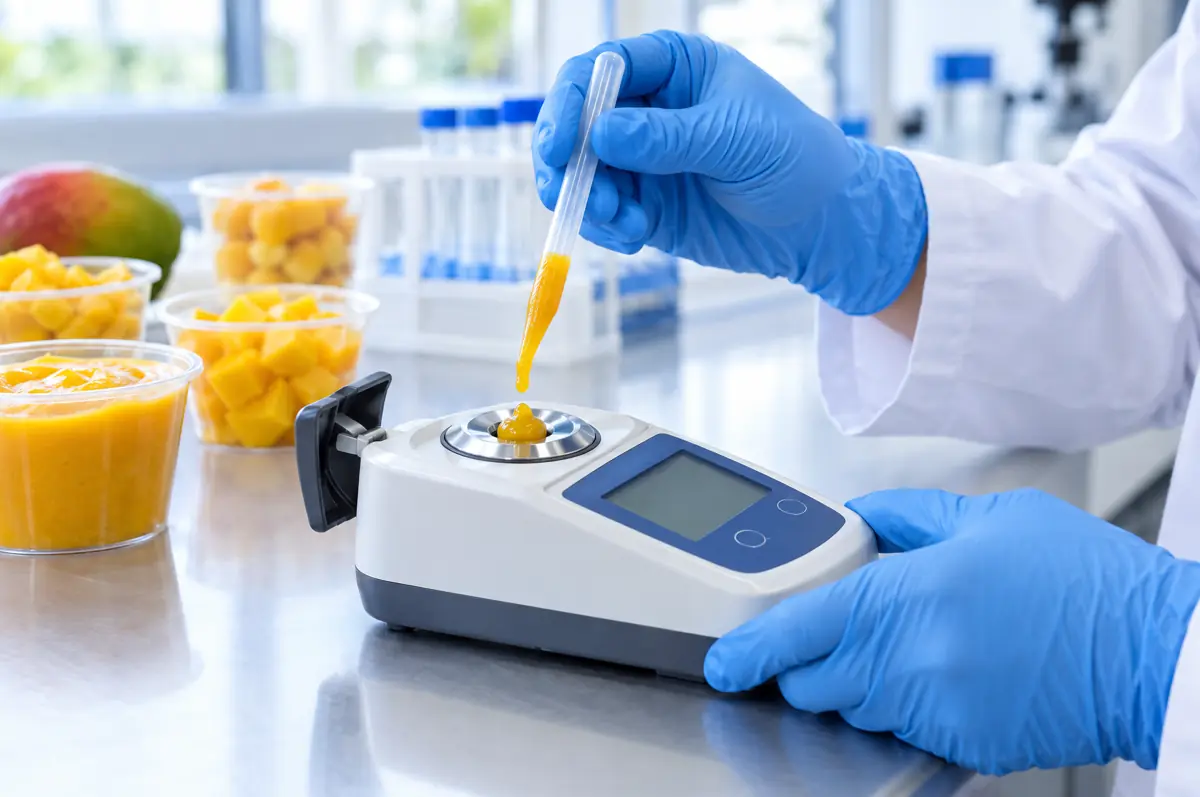
Brix is read on the thawed product at 20 °C by refractometer, under IFU No.8 or AOAC 932.12. On seeded pulp the instrument reads only the liquid phase. No Vietnamese sheet says whether the seeds are sieved out first, at what mesh, or whether seed weight is reported.
The same gap applies to seed content. No published Vietnamese sheet states a seed share for seeded pulp, and TCVN 13941:2023 is not known to set one. You buy seeds by the kilo along with the juice. Two offers at the same Brix floor can carry different amounts of saleable pulp. Compare offers on the same seed basis before comparing price.
A seed limit without its method cannot be proven in a dispute. The contract should define:
- the sample mass taken from the lot
- the thaw method and the temperature at which the sample is weighed
- the sieve aperture that separates seed from pulp
- the result as % seed by weight of the thawed sample, with the largest permitted peel or stem fragment in mm
The figures in that clause are yours to set. No published threshold exists for them.
What acidity and pH should the contract bind?
Bind titratable acidity at 2.5–5.0 % and pH at 2.3–3.5, the TCVN 13941:2023 bands. Measure acidity under IFU No.3, titrated to pH 8.1 and expressed as citric acid. Measure pH under IFU No.11 or AOAC 981.12 with a potentiometric meter, not paper. Bind both values. With pH alone, a plant can pass by changing the acid.
| Document | Product | Titratable acidity (%) | pH | Basis stated |
|---|---|---|---|---|
| TCVN 13941:2023 | Single-strength forms | 2.5–5.0 | 2.3–3.5 | National standard |
| Producer B sheet | Seeded pulp | 2.8–3.8 | Not published | Method not stated |
| Producer A website | Purée | 2.3–6.0 | 2.3–3.5 | Titrated to pH 8.1 |
| Producer A listing | Seedless purée | 2.3–5.0 | Not published | Method not stated |
| Producer A listing | Seedless pulp / NFC | 2.2–4.0 | Not published | Method not stated |
One producer publishes three acidity bands on three pages, and their ends fall outside TCVN on both sides: below 2.5 and above 5.0. The divergence shows up in the Brix/acid ratio, which sets sweetness and your sweetener dose. At the 13.0 °Bx floor, Producer A’s seedless bands give ratios from 13 / 6.0 = 2.2 up to 13 / 2.2 = 5.9. That is a factor of about 2.7 between two lots that both meet a sheet. Producer B’s seeded band gives 3.4 to 4.6. TCVN at its 13.5 floor gives 2.7 to 5.4. This arithmetic assumes acidity is % w/w as citric acid on every sheet, which none of the sheets confirms. The contract should confirm it.
Why test residues on the pulp rather than the fruit?
EU, US and Japanese maximum residue levels are set on the whole fruit with its peel. The residue in a processed product equals the whole-fruit MRL multiplied by a processing factor. For passion fruit that factor can be about 1 or higher, so “peeled” does not mean cleaner.
The legal bases are Regulation (EC) No 396/2005 with product definitions in Regulation (EU) No 752/2014, and 40 CFR 180.1(h) in the US. For processed products, the EU applies Article 20 of Regulation 396/2005, with guidance SANTE/10704/2021 Rev 1 applicable from 19 March 2025. Most peeled fruit leaves systemic actives in the discarded skin. Passion fruit pulp and seed both go into the pack, and water-soluble systemic actives travel with the juice. Concentration raises the factor further. No public study gives a measured factor for omethoate from whole fruit to seeded pulp.
The risk is documented on the fresh side. France’s DGAL reported 15 of 47 Vietnamese fresh passion fruit samples over the MRL in 2024 data published in February 2026, naming omethoate. Japan applies a uniform 0.01 mg/kg to substances without a specific MRL. VinFruits Global specifies the residue screen on the frozen pulp lot itself, omethoate included, rather than accepting a result taken on fresh fruit, because what reaches the carton is pulp and seed, not peel.
Do not copy MRL values into the contract, because they change. Write “complies with the importing country’s MRLs in force at delivery”. Then test against a multi-residue panel your laboratory recommends for Vietnamese passion fruit.
Which microbiology limits apply to frozen pulp?
Freezing stops microorganisms but does not kill them, and an uncooked seeded pulp has no kill step. Whether the pulp counts as ready-to-eat depends on your declared use, not on the product itself. A pulp rippled into ice cream or spooned onto yoghurt without heating leans towards ready-to-eat.
In the EU, an amendment adopted on 20 November 2024 to Regulation (EC) No 2073/2005 applies from 1 July 2026. It covers ready-to-eat foods able to support Listeria monocytogenes growth. The limit is ≤100 cfu/g (EN ISO 11290-2) where the operator can show the level stays below it through shelf life. Otherwise the requirement is not detected in 25 g (EN ISO 11290-1), applied through shelf life. Large EU and Japanese buyers often ask for Salmonella absent in 375 g and Listeria absent in 125 g, larger samples than the legal 25 g. TCVN 13941:2023 Table 3 sets E. coli and Salmonella criteria, but the values were not legible in the copy reviewed, so they are not quoted here. As one benchmark, a US federal purchase specification for frozen fruit (USDA, June 2017) uses APC <50,000/g, yeasts and moulds each <10,000/g, coliforms <100/g, E. coli <3/g and Salmonella negative in 25 g.
Frozen fruit recalls from 2020 to 2026 came from Listeria, hepatitis A and norovirus, not from foreign bodies. No affordable lot test catches the two viruses. They are controlled through worker hygiene at the plant, so ask how that hygiene is audited.
For an acid product, the spoilage organism that matters is Alicyclobacillus. It survives acid-food pasteurisation and spoils juice without swelling the pack or shifting pH. Published growth ranges are pH 2.0–6.5 at 25–70 °C (Pall) or pH 2–6 at 20–70 °C (Merck). Passion fruit’s pH floor of 2.3 sits inside both. It does not grow at −18 °C. The risk lies in the thawed pulp and in your ambient finished product. Suppliers rarely include the test unless asked. Specify “not detected in 10 g” by IFU MM12:2019, which uses a heat shock of 80 °C for 10 minutes.
How is frozen passion fruit pulp packed and stored?
Vietnamese producer sheets pack frozen pulp in double food-grade PE bags. Formats include 10 kg cartons, 10, 20 and 180 kg bulk packs, steel drums and 18 kg plastic pails. Storage is −18 °C or colder, with 24 months from manufacture on the sheets. TCVN 13941:2023 sets the storage line in these words:
“Không lớn hơn −18 °C”
The phrase means “not warmer than −18 °C”. The standard is not known to set a shelf life, so the 24 months is a producer claim, and your contract should state it. Codex CXC 8-1976 adds the distribution rule: hold at −18 °C or colder, and the warmest package must not exceed −12 °C. A core temperature above −12 °C on arrival is a reasonable ground for outright rejection. A warm reefer leg followed by refreezing darkens the colour and flattens the aroma, and a later Brix reading will not show it.
Cartons or drums per 20 ft or 40 ft reefer depend on the plant’s stuffing plan and belong in the quotation. No published standard gives a thaw time for a 180 kg drum or a life after thaw. Set both in your own HACCP plan. For China, frozen pulp must come from a GACC-registered plant under Decree 280, in force from 1 June 2026.
Clauses you can adapt into a purchase order
These clauses come from the instruments above. The values in brackets are yours to set.
- Product: passion fruit pulp, frozen, single-strength, [with seeds / seedless], no added sugar or water. Process: [uncooked / pasteurised at ]. Declared heading: [0811.90 / ], confirmed by advance ruling before first shipment. Reference standard for soluble solids, acidity, pH and storage: TCVN 13941:2023.
- Soluble solids ≥13.5 % after thawing, IFU No.8 at 20 °C, acid-corrected [yes / no]. For seeded pulp, measured on the liquid phase after sieving through [___] mm; seed content reported as % by weight of the thawed sample.
- Titratable acidity [2.5–5.0] % w/w as citric acid, IFU No.3 to pH 8.1; pH [2.3–3.5], IFU No.11. Both reported on every lot COA.
- Intended use: [ingredient for a heat-treated product / used without a kill step]. Per-lot microbiology: TPC, yeasts and moulds, E. coli, Salmonella in [25 / 375] g, L. monocytogenes in [25 / 125] g, Alicyclobacillus not detected in 10 g by IFU MM12:2019.
- Residues: multi-residue screen on the frozen pulp lot, not on fresh fruit, against the importing country’s MRLs in force at delivery as applied under Article 20 of Regulation (EC) No 396/2005.
- Pack and cold chain: double food-grade PE bags in [10 kg carton / 180 kg drum] at −18 °C or colder. Warmest package not above −12 °C in transit. Reefer set at −18 °C or colder with a continuous data logger, and the temperature record travels with the payment documents. More than [4] continuous hours above [−15] °C is grounds for rejection. Remaining shelf life at delivery ≥[75] %. For comparison, USDA requires at least 9 months for purée.
- Origin: fruit grown in Vietnam, declared on the origin statement.
Common questions
What Brix should frozen passion fruit pulp have?
TCVN 13941:2023, the Vietnamese national standard, requires at least 13.5 % soluble solids after thawing for single-strength pulp. Vietnamese producer sheets print at least 13.0 °Bx. The EU reconstitution minimum is 12.0 °Brix and the US label reference is 14.0 °Brix. A lot between 13.0 and 13.5 °Bx passes some of these texts and fails others, so name one in the contract.
Should I buy passion fruit pulp with seeds or seedless?
Decide by application. Seeded pulp is usually uncooked frozen pulp in HS 0811.90, suited to visible-seed uses such as yoghurt and ice-cream ripples. Seedless product is usually finished purée or NFC, often pasteurised, which can change the tariff heading. In the US, a purée used as a beverage ingredient comes under juice HACCP. Compare seeded offers on the same seed basis.
What acidity and pH should I specify for passion fruit pulp?
TCVN 13941:2023 sets titratable acidity at 2.5–5.0 % and pH at 2.3–3.5 for single-strength forms. Specify acidity as citric acid by IFU No.3, titrated to pH 8.1, and pH by IFU No.11 with a meter. Bind both on every lot certificate, because a plant can meet a pH limit alone by changing the acid.
What HS code is frozen passion fruit pulp?
Frozen passion fruit pulp without added sugar falls under HS 0811.90. In the EU the line is CN 0811 90 85, which names passion fruit, with 9 % MFN duty and 0 % under EVFTA with proof of origin. The fresh heading 0810.90 is wrong for frozen goods. A pasteurised purée may classify differently, so get an advance ruling first.
How is frozen passion fruit pulp packed and stored?
Vietnamese producers pack it in double food-grade PE bags inside 10 kg cartons, in 180 kg drums or in 18 kg pails. It is held at −18 °C or colder, and Codex CXC 8-1976 says the warmest package must not exceed −12 °C in distribution. Producer sheets state 24 months from manufacture; TCVN 13941:2023 is not known to set a shelf life.