On this page
- What actually differs between red and white frozen dragon fruit cubes?
- Where does the red colour come from, and when does it fail?
- Is a Brix figure on the spec sheet comparable between suppliers?
- How much do frozen dragon fruit cubes drip on thawing?
- Which applications suit red and which suit white?
- Does the EU’s 30% border check apply to frozen dragon fruit?
- What should the purchase specification say?
- Common questions
- Related insights
Frozen dragon fruit cubes differ by flesh colour in three ways a buyer can test. Red flesh carries betacyanin and published Brix of 13–17 °Bx. White flesh carries no pigment and 11–13 °Bx. Both drip on thawing more than most frozen fruit, and no published drip threshold exists for either, so colour, Brix method and thaw protocol all belong in the contract.
What actually differs between red and white frozen dragon fruit cubes?
Red and white dragon fruit are different species. They differ in pigment, in published sugar range and in what they do to the colour of a finished product. Cut sizes, packing and storage are the same for both. White flesh is Selenicereus undatus (syn. Hylocereus undatus): pink skin, white flesh with black seeds. Red flesh is Hylocereus polyrhizus or H. costaricensis: pink skin, red-to-purple flesh.
The main Vietnamese red-flesh variety is Long Định 1 (LĐ1), bred by the Southern Fruit Research Institute (SOFRI), with deep red-purple flesh. SOFRI also holds plant-variety rights on LĐ5, a purple-pink variety, but supply is narrow and its export volume is not known.
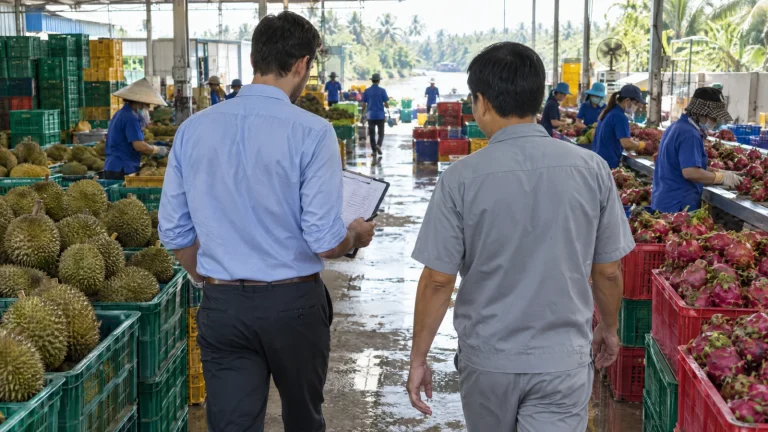
The two colours also come from different places. Lâm Đồng province, which since the 2025 merger includes the former Bình Thuận, holds about 40% of Vietnam’s dragon-fruit area and grows mainly white flesh. That share is reported by the provincial newspaper Báo Lâm Đồng. Red flesh is concentrated in Tây Ninh, in the former Long An districts of Châu Thành and Tân Trụ, which is the closest growing area to the Ho Chi Minh City ports. The main harvest runs May to September, and that is when most frozen product is made. Off-season fruit, forced by electric lighting, comes in November to March.
| Parameter | Red flesh | White flesh | Test method or basis |
|---|---|---|---|
| Soluble solids, °Bx | 13–17 | 11–13 | Published IQF spec; reading point and method not stated by sellers |
| Colour pigment | Betacyanin (betalain group) | None | Visual against retained sample; L*a*b* by agreement |
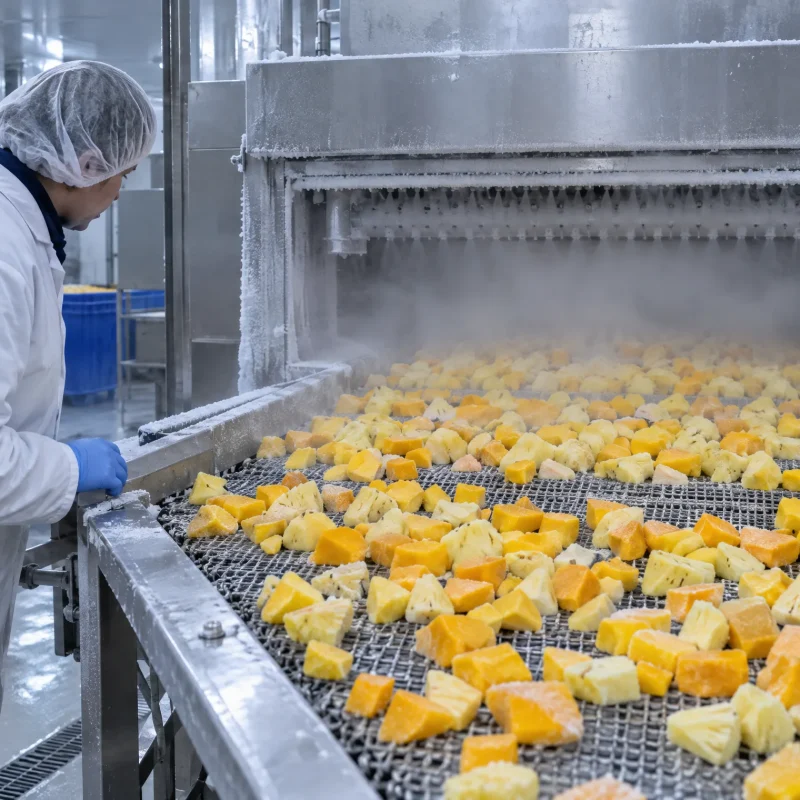
| Dice size, mm | 10×10 or 20×20 | 10×10 or 20×20 | Published IQF spec; caliper check on receipt |
| Storage temperature, °C | ≤ −18 | ≤ −18 | Published spec; 24-month shelf life at −18 °C |
| Drip loss, % | Not published | Not published | 200 g / 2 mm sieve / 4 °C for 18 h (see below) |
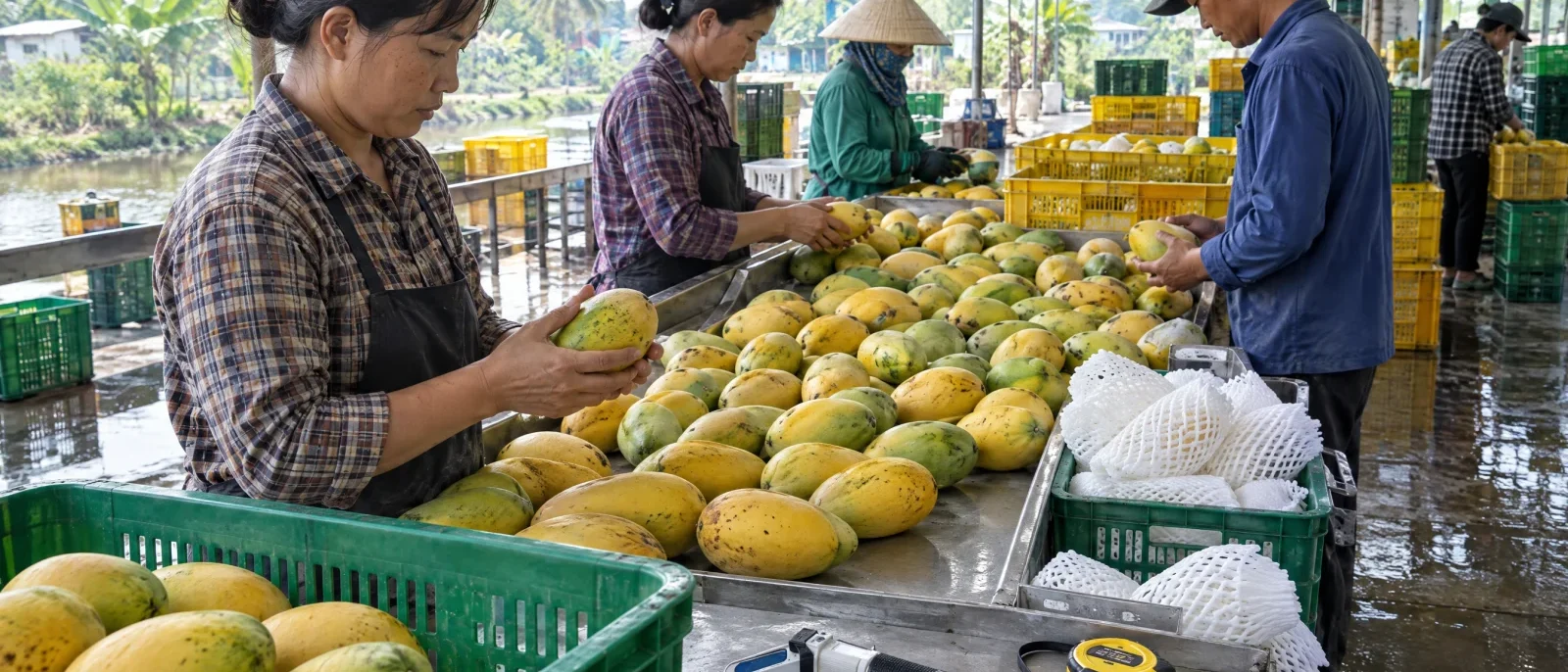
Processing-grade fruit is the smaller end of the harvest: under 300 g, misshapen, or with broken bracts. The defect is cosmetic, not an eating defect. Fruit is peeled by hand with knives, because no industrial dragon-fruit peeler is in wide use. Recovery and contamination risk therefore depend on how well the peeling line is trained and supervised, which is worth asking about at audit and worth covering in pre-shipment sampling of frozen fruit.
Where does the red colour come from, and when does it fail?
Red colour in frozen red dragon fruit comes from a single pigment family, betacyanin. It is a red-violet betalain, the same group as beet betanin (E162). White flesh contains none, so it cannot add colour to anything. Betacyanin is most stable at about pH 4–6 and breaks down under heat, light and oxygen.
The failure conditions decide where red dice work. A cold, acidic product in an opaque pack keeps the magenta. Smoothie bowls, sorbet, frozen yoghurt and blended drinks fit that description. A heated step, a clear retail pack under strong light, or a mix that sits outside pH 4–6 loses it. The same chemistry explains why red dragon fruit cannot replace a synthetic red in a high-heat sterilised product. Commercial colour extracts made from the fruit or its peel need microencapsulation, and pectin-based encapsulation of peel betacyanin is described in published research.
Two things are not available to you. No betacyanin content in mg/100 g has been published for Vietnamese varieties; international studies exist, but none on LĐ1. No reliable pH figure for the flesh is held here either. Measure the pH of your own finished mix and check it against the 4–6 window rather than relying on a value for the fruit alone.
Colour therefore has to be specified against a physical reference. The workable practice, already used for red dragon fruit powder, is a retained approved sample, with L*a*b* readings added only if both sides agree to them.
Is a Brix figure on the spec sheet comparable between suppliers?
Not as published. The 13–17 °Bx (red) and 11–13 °Bx (white) ranges on IQF spec sheets do not say whether they were read on fresh fruit at intake or on thawed finished dice, or at what temperature. Two suppliers quoting the same range may be measuring different things.
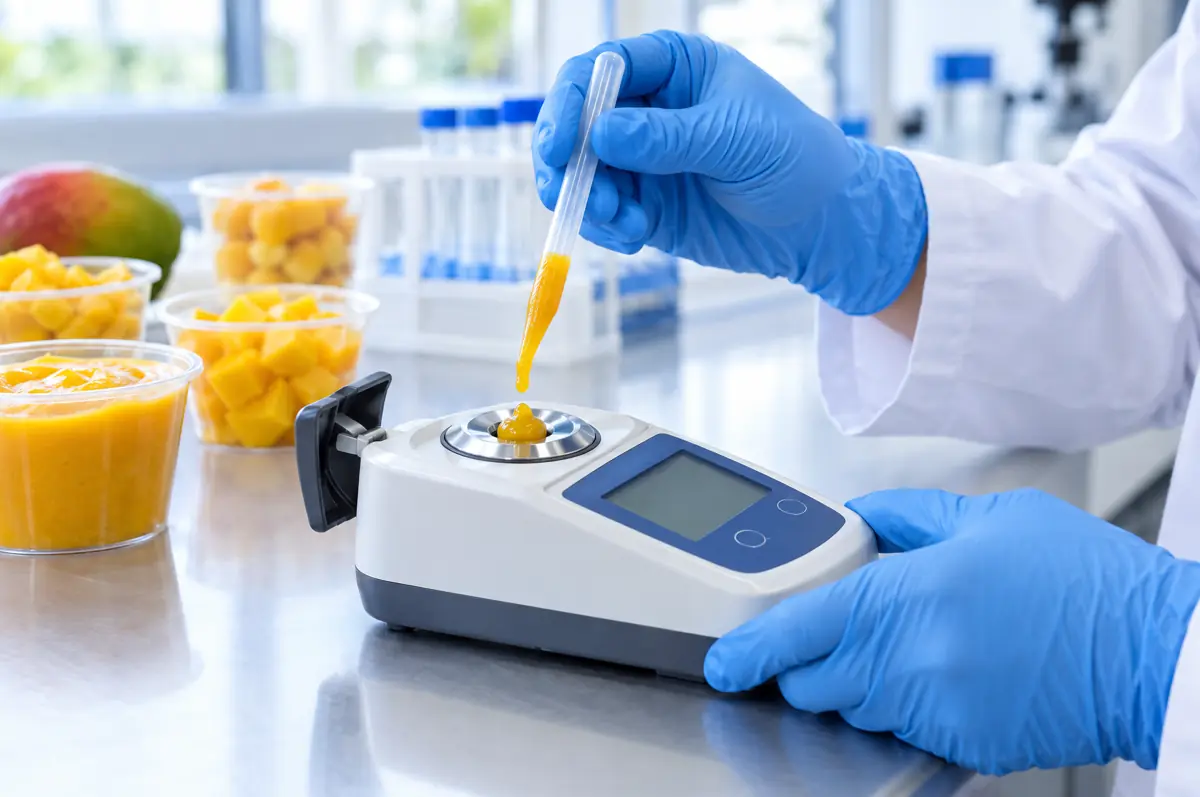
The intake check proposed for processing fruit is a field refractometer reading on 10 fruit per lot, with a floor of 11 °Bx for white and 13 °Bx for red. That is a raw-material control, and it is useful for rejecting watery fruit before it reaches the line. It is not a finished-product figure. Other frozen fruit lines read Brix on juice from thawed product, by refractometer at 20 °C, following IFU Method No. 8 (AOAC 932.12 is the equivalent reference). Use the same convention for dragon fruit.
Without that clause, a red lot reading 12.8 °Bx is in or out of specification depending on which reading the seller chose to report. It also helps to know how to read a fruit certificate of analysis before the first lot arrives. On a certificate, check that the Brix line names its method and temperature, not just a number.
How much do frozen dragon fruit cubes drip on thawing?
Nobody publishes a figure. Dragon fruit has very high water content and weak cell walls, so thawed dice go soft and release liquid more than most fruits do. Live product copy describes the texture after thawing as soft, with some drip. Beyond that qualitative statement, no drip-loss number for Vietnamese IQF dragon fruit of either colour has been published. There is also no evidence that red drips more than white, or the reverse.
The drip-loss test for IQF dragon fruit cubes that makes two results comparable runs as follows. Weigh 200 g of frozen cubes on a balance reading to ±0.1 g; that is m1. Spread them on a 2 mm sieve over a tray and thaw at 4 °C for 18 hours. Weigh the solids retained on the sieve; that is m2. Drip loss in percent is (m1 − m2) / m1 × 100. Two other thaw regimes are in circulation for texture and shape checks, 4 °C for 12 hours and 20 °C for 1 hour, and they produce different numbers from the same lot, so a drip figure quoted without its regime cannot be compared with one that has it. The method was written as a working protocol for IQF banana, not for dragon fruit specifically. No published drip threshold exists for Vietnamese IQF dragon fruit of either flesh colour, so the buyer sets the limit in the contract.
Drip is also the only practical evidence of how the fruit was frozen. Ice-crystal size cannot be measured at a plant. The Codex Code of Practice for the Processing and Handling of Quick Frozen Foods (CXC 8-1976) requires product to pass quickly through the zone of maximum ice-crystal formation, −1 to −5 °C. A slow pass grows larger crystals, which rupture more cells, and that shows up as drip. The difference between freezing methods is covered in IQF vs BQF: what the freezing method changes.
Over-ripe or waterlogged fruit raises drip and should be excluded from dice at intake. That is a reasonable intake rule to write down even before you fix a number.
Which applications suit red and which suit white?
Red suits products where the fruit supplies the colour. White suits products where another fruit should lead. Neither colour sells well into fresh-cut channels once thawed, because the texture does not hold. Both go into smoothies and quick-service drinks, ice cream and sorbet, yoghurt and dairy inclusions, frozen retail and industrial blends.
For red, the deciding conditions are the betacyanin limits above. A smoothie bowl served from frozen in an opaque bowl is close to ideal. The seeds, which cannot be removed from either colour, are part of the look there. Small 10 mm dice suit yoghurt inclusions and 20 mm dice suit bowls and blending. A drink that is pasteurised after the fruit goes in, or a red product sold in a clear cup under shop lighting, will lose colour, and you should plan the process around that before choosing red.
Lot uniformity matters more in red than in any other property, because the eye finds the exception. VinFruits Global writes its red-flesh specification so that pale or mixed red-and-white dice are rejected from a red lot, because a single white piece shows in a magenta bowl. The same logic runs in reverse for white: pink-tinged or red dice do not belong in a white lot.
White flesh is neutral in colour. Its black seeds show as a speckle in clear drinks and in yoghurt, which some brands use as a visual cue and others treat as a defect. Choose white when the dragon fruit is there for body, sweetness or label claim and another ingredient carries the colour. For a smooth purée from either colour, the seeds have to come out by sieving or with a decanter.
Does the EU’s 30% border check apply to frozen dragon fruit?
On the codes as written, no. Commission Implementing Regulation (EU) 2019/1793, as amended by Commission Implementing Regulation (EU) 2026/194 of 28 January 2026, keeps dragon fruit from Viet Nam in Annex II under CN ex 0810 90 20 (TARIC 10). The hazard is pesticide residues, identity and physical checks run at 30%, and each consignment needs an official certificate with sampling and analysis results. CN 0810 is the fresh fruit heading. Frozen pitahaya is classified under CN 0811 90 85, frozen tropical fruit without added sugar, and the subheading text names pitahaya.
Two texts disagree here, and one of them was on this site. Earlier product copy for both IQF dragon fruit lines, dated 17 October 2026, said Vietnamese dragon fruit was listed under 2019/1793 for increased border checks and applied that to frozen dice. The listing is against the fresh code. Later research, and the corrected copy, record that Annex II covers fresh fruit only. The consolidated annexes have not been re-read line by line, so confirm against EUR-Lex before relying on it for a frozen shipment.
A second disagreement concerns the check rate. Some press reports gave 50% for Vietnamese dragon fruit. The regulation’s text says 30%, and the text wins. The 50% figure belongs to Vietnamese chilli and okra in the same annex.
| Instrument | What it covers | Code or limit | Bearing on frozen cubes |
|---|---|---|---|
| Implementing Reg. (EU) 2019/1793 as amended by (EU) 2026/194, Annex II | Fresh dragon fruit from Viet Nam; pesticide residues | CN ex 0810 90 20, TARIC 10; 30% checks | Not the code frozen dice enter under |
| EU Combined Nomenclature 2026 | Frozen tropical fruit, no added sugar, pitahaya named | CN 0811 90 85; MFN 9%, EVFTA 0% | Classification line for frozen dice |
| Regulation (EC) No 396/2005, Article 20 | MRLs for processed products | Processing taken into account | Applies |
| EU default MRL, high-hazard substances | Substances moved to hazard-based assessment, January 2026 | 0.01 mg/kg | Applies |
| Japan positive-list system | Substances with no specific MRL | 0.01 ppm uniform limit | Applies |
Frozen dice are still subject to the general residue law. A per-lot residue report is sound practice for EU product. It is not an Annex II requirement for frozen dice, and a supplier who says otherwise has the code wrong. The EVFTA 0% rate is inferred from the tariff group, not checked line by line in TARIC, so do not write it into a duty clause without a broker’s confirmation. For China, frozen dice must come from a plant registered with GACC under Decree 280, which replaced Decree 248 from 1 June 2026. On the Vietnamese side, declare frozen product under heading 0811.90, not the fresh 0810.90 line.
What should the purchase specification say?
There is no Codex or UNECE standard for frozen dragon fruit. Codex STAN 237-2003 covers fresh pitahayas only, so your purchase specification is the only standard in play. These lines close the gaps the published sheets leave open; fill the brackets to suit your product.
- Identity: Hylocereus polyrhizus/costaricensis (red flesh) or Selenicereus undatus (white flesh), stated per lot. No mixed colours.
- Soluble solids: [13–17] °Bx red / [11–13] °Bx white, by refractometer at 20 °C on juice from thawed dice (IFU No. 8), [n] samples per lot.
- Colour (red): uniform red-magenta matching the retained approved sample; no white or pale pieces; L*a*b* on [20] thawed pieces against the sample if agreed.
- Colour (white): no pink-tinged or red pieces.
- Drip loss: ≤ [__] % by the 200 g / 2 mm sieve / 4 °C for 18 h method, stated with each result.
- Flow: free-flowing on receipt; no clumps larger than [__] mm. Clumping is evidence of thaw and refreeze in the chain, and the liquid lost at your plant is coloured juice leaving the piece.
- Raw material: no dice from over-ripe or waterlogged fruit.
- Cut: [10×10 / 20×20] mm, tolerance [__] mm.
- Net weight: glaze not counted in net weight.
- Pack and storage: 10 kg carton, double food-grade PE liner, ≤ −18 °C throughout.
- Microbiology: the partner plant’s limits for total plate count, yeasts and moulds, E. coli, Salmonella and Listeria monocytogenes, written into the sales specification. Published dragon-fruit sheets carry none. For IQF going to the EU or US, Listeria is the parameter that fails lots and triggers recalls.
- Residues: EU MRLs under Regulation (EC) No 396/2005; per-lot residue report from an accredited laboratory.
FSSC 22000 and HACCP certification is held by the partner plant that produces the dice. Ask for the certificate in the plant’s name and check its scope covers frozen fruit.
Common questions
Is red or white dragon fruit sweeter when frozen?
Published IQF specifications put red flesh at 13–17 °Bx and white flesh at 11–13 °Bx. Neither sheet states whether the reading was taken on fresh fruit at intake or on thawed cubes, or at what temperature. To compare suppliers, specify Brix by refractometer at 20 °C on juice from thawed dice, following IFU No. 8, with the number of samples per lot written into the contract.
Does frozen red dragon fruit keep its colour?
Frozen red dragon fruit gets its colour from betacyanin, a betalain pigment that is most stable at about pH 4 to 6 and breaks down under heat, light and oxygen. It holds in cold, acidic products in opaque packs such as smoothie bowls, sorbet and frozen yoghurt. A heated step, a clear pack under strong light or a mix outside that pH window loses it.
What drip loss should I accept on frozen dragon fruit cubes?
No published drip-loss threshold exists for Vietnamese IQF dragon fruit of either colour, so the buyer sets it in the contract. Tie the limit to a stated method: 200 g frozen, 2 mm sieve, thaw at 4 °C for 18 hours, drip percent equals (m1 minus m2) divided by m1 times 100. A figure without its thaw regime cannot be compared with another supplier’s.
Do EU border checks at 30% apply to frozen dragon fruit from Vietnam?
Implementing Regulation (EU) 2019/1793, as amended by (EU) 2026/194, lists Vietnamese dragon fruit in Annex II under CN ex 0810 90 20, the fresh heading, at 30% identity and physical checks. Frozen cubes enter under CN 0811 90 85. Frozen product still falls under the MRL rules of Regulation (EC) 396/2005, so a per-lot residue report remains sound practice. Confirm against the consolidated text on EUR-Lex.
Can I remove the seeds from frozen dragon fruit cubes?
No. Dragon fruit seeds are small, black and spread through the flesh, so they cannot be taken out of a cube. In red flesh they are part of the look of a smoothie bowl; in white flesh they show as a black speckle in clear drinks and yoghurt. A smooth purée needs sieving or a decanter after the fruit is broken down.