On this page
- Which HS code does dried pineapple take: 0813.40, 0804.30 or 2008.20?
- What does the wrong heading cost beyond the duty rate?
- Can Vietnam supply soft-dried pineapple rings, or only strips?
- Why is ethephon the residue to test on Vietnamese dried pineapple?
- Brix 72 on the offer sheet: what should the specification actually control?
- What does the sugar change besides the tariff line?
- How does pack size change the sampling plan?
- Which specification lines can go straight into the purchase order?
- Common questions
- Related insights
For dried pineapple wholesale, four choices decide more than the photo does. Sugar-infused pieces classify at 2008.20. Pineapple dried with nothing added sits at 0804.30, not the 0813.40 most offers print. The cut decides which Vietnamese variety can supply it, the season decides ethephon exposure under the 1.5 mg/kg EU limit, and pack size resets the Codex sampling plan.
Which HS code does dried pineapple take: 0813.40, 0804.30 or 2008.20?
Neither version of the product belongs in 0813.40. Heading 0813 covers dried fruit other than the fruit of headings 0801 to 0806, and pineapple is in 0804. Pineapple dried with nothing added therefore stays with fresh pineapple at 0804.30. Pineapple soaked in sugar syrup and then dried is a preparation, and it goes to heading 20.08, subheading 2008.20.
The sugar rule is established on mango, not on pineapple. UK Advance Tariff Ruling 600005639 placed diced mango soaked in sugar syrup and dried, in 5 kg bags, in 2008 99. US CBP ruling NY N230016 placed Thai dried mango of roughly 60% fruit and 40% sugar in HTS 2008.99.4000. No ruling on pineapple is cited here. The mechanism carries across, and pineapple has its own subheading, 2008.20, so it does not fall into 2008.99 with the mango.
The 0813.40 code still circulates on offer sheets, and it appeared in earlier product material on this site as well. It is a correction worth making in your own templates before the next order, not a reason to distrust one supplier.
Inside 2008.20 the EU Combined Nomenclature splits again on two things the buyer chooses: whether the immediate pack is over 1 kg, and the sugar content.
| Product as ordered | CN line | Immediate pack | MFN duty (%) | Source |
|---|---|---|---|---|
| Dried, nothing added | 0804 30 00 | any | check in TARIC | EU CN, heading 0804 |
| Sugar-infused, sugar content over 17% | 2008 20 51 | over 1 kg | 19.2 | TARIC data copy, October 2026 |
| Sugar-infused, other sugar content | 2008 20 59 | over 1 kg | 17.6 | TARIC data copy, October 2026 |
| Sugar-infused, sugar content over 19% | 2008 20 71 | 1 kg or less | 20.8 | TARIC data copy, October 2026 |
| Sugar-infused, other sugar content | 2008 20 79 | 1 kg or less | 19.2 | TARIC data copy, October 2026 |
Confirm the ten-digit line in TARIC before the first shipment. The way the CN measures sugar content for these lines is set in the Additional Notes to Chapter 20, and that basis should be checked against the refractometer figure on the certificate of analysis.
What does the wrong heading cost beyond the duty rate?
The wrong heading can cost the EVFTA preference itself. The preference on these Chapter 20 lines is reported as zero with a valid EUR.1 or REX statement of origin; confirm the line rate in TARIC. Origin rules are written by chapter and heading, so a sugared piece declared under a Chapter 8 code is tested against the wrong rule, and the claim can fail at post-clearance audit on goods that really are Vietnamese.
Sugar can also decide origin on its own. The EVFTA product-specific rule for 2008.20 may limit non-originating sugar, so where the cane sugar came from can decide whether the preference holds. Have your broker read that rule in EVFTA Protocol 1 before the contract is signed.
Vietnamese export-procedure guidance reports export duty and VAT on these lines at zero. Nobody on the Vietnamese side therefore pays for a misclassification. The whole exposure sits with the importer.
Can Vietnam supply soft-dried pineapple rings, or only strips?
Vietnam can supply rings, but a ring specification narrows the fruit that qualifies. A whole ring needs fruit wide enough to punch a full ring around a straight, centred core, which in practice means Cayenne or MD2. Strips, chunks and dice can be cut from smaller fruit, which opens the specification to Queen.
That matters because Vietnam’s variety mix is not the world’s. MD2 is roughly 50 to 55% of world pineapple and 70 to 75% of the EU market, but under 5% of Vietnamese pineapple area, according to baochinhphu.vn in August 2025. The northern belt of Thanh Hóa and Đồng Giao in Ninh Bình grows Cayenne alongside Queen. Nghệ An grows Queen and is introducing MD2. The Mekong Delta areas of Tân Phước in Tiền Giang, Kiên Giang and Cầu Đúc in Hậu Giang are mainly Queen.
The Vietnamese trade regards Queen as well suited to soft-drying, because its aroma and high natural sugar mean less added sugar is needed. It is also the variety least suited to rings: the fruit is small, the eyes are deep, and trimming takes a lot of flesh. A buyer who wants both the Queen flavour and a ring shape is asking for two things that pull apart.
Rings also carry a fruit-size premium. The Vietnamese farm newspaper Nông nghiệp & Môi trường recorded in August 2026 fruit of 1 kg and over at roughly 1.3 to 1.4 times the farm-gate price of 300 to 800 g fruit. On the same source, farm-gate pineapple moved by about 3.6 to 3.8 times over 2026 between the April to May main crop and August.
Why is ethephon the residue to test on Vietnamese dried pineapple?
Soft-dried pineapple from Vietnam carries an ethephon question that a buyer cannot answer from the offer sheet. Vietnam supplies pineapple all year because about 30 to 40% of its roughly 52,000 hectares is brought into flower off-season, and the flowering is forced with ethephon or calcium carbide. In an EU reference-laboratory survey by EURL Pesticides, pineapple was the commodity with the most ethephon findings, 47 of 62 samples, or 76%. Regulation (EU) 2026/215 set the EU ethephon maximum residue level for pineapple at 1.5 mg/kg, applying from 19 August 2026. That limit is written for the raw fruit as defined in Annex I to Regulation (EC) No 396/2005, not for the dried piece. The year-round supply and the main residue risk are the same agronomic practice, which is why an off-season lot deserves its own test.
Under Article 20 of Regulation (EC) No 396/2005, a processed food is judged against the raw-commodity limit through a processing factor, with guidance in SANTE/10704/2021 Rev 1, applicable from 19 March 2025. The importing authority decides whether to accept a factor, and the burden of proof rests with the food business. Drying raises a residue concentration, because most of the water leaves and the residue stays. On soft-dried pineapple the added sugar dilutes part of that back. The net factor therefore cannot be calculated from moisture loss. It has to be measured on the actual process, with a paired raw-fruit and finished-piece test from one run.
When VinFruits Global agrees a soft-dried specification with a partner plant, the contract reserves the right to sample raw fruit at the plant’s weighbridge, not only the finished piece, because a dried product’s residue is decided before the fruit reaches the dryer.
Ethephon is not the only candidate. Two analyses rank the risks differently: one puts ethephon first, the other puts cadmium first for pineapple, ahead of any pesticide. Neither ranking rests on measured Vietnamese lots, and no published Vietnamese dataset settles it. Regulation (EU) 2023/915, which replaced Regulation (EC) 1881/2006, sets lead at 0.10 mg/kg and cadmium at 0.020 mg/kg for pineapple, as reported by CBI, and for a dried food the operator must account for the drying factor. Cadmium is not hypothetical here: it has been found in frozen pineapple from Costa Rica. The full set of limits for dried lines is set out in this guide to EU contaminant and residue limits for Vietnamese dried fruit.
Chlorate comes from chlorinated wash water in the plant, not the field; check the pineapple value in the annex to Regulation (EU) 2020/749. Before a first order, filter the RASFF Window by product and origin.
Brix 72 on the offer sheet: what should the specification actually control?
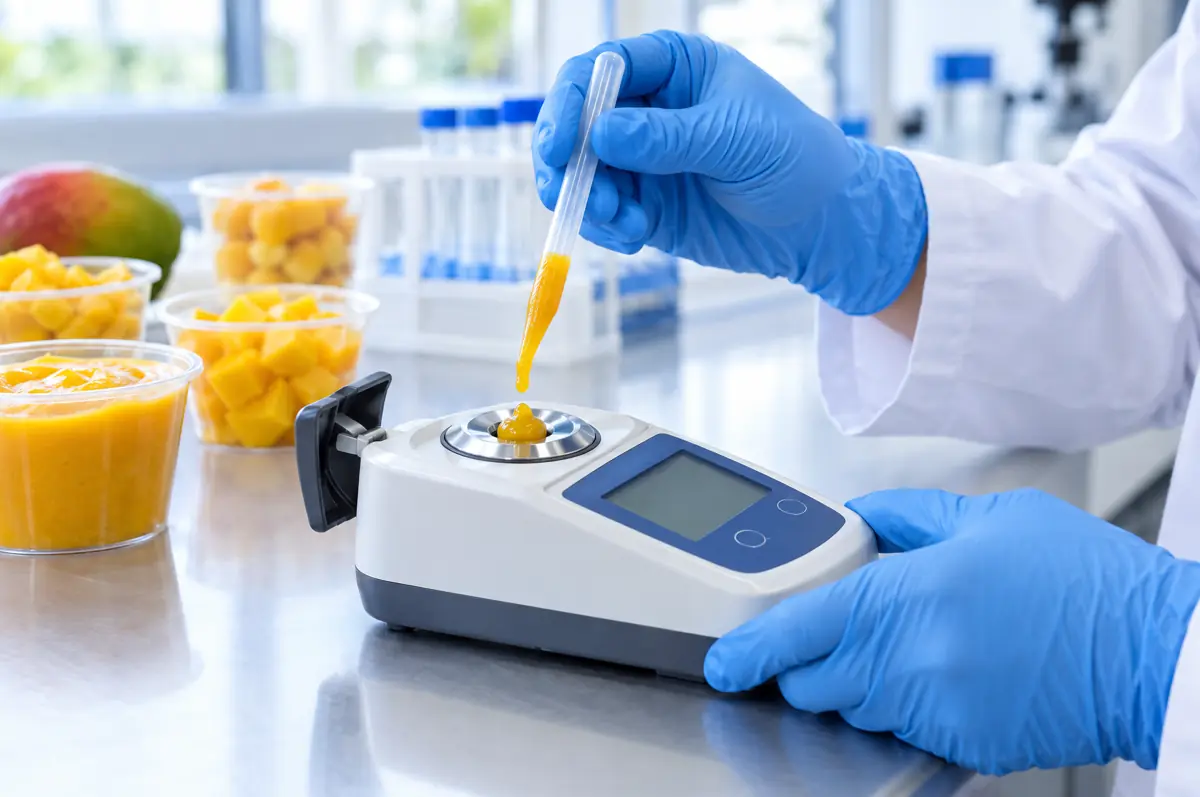
Brix tells you how much sugar went in. Moisture and water activity tell you whether the piece stays soft and free of mould for a year. Vietnamese offer sheets commonly print a Brix of 72 or more because it is easy to read on a refractometer. No published water-activity limit exists for Vietnamese soft-dried pineapple; the buyer sets it in the contract, names the method, and asks for it on every certificate of analysis.
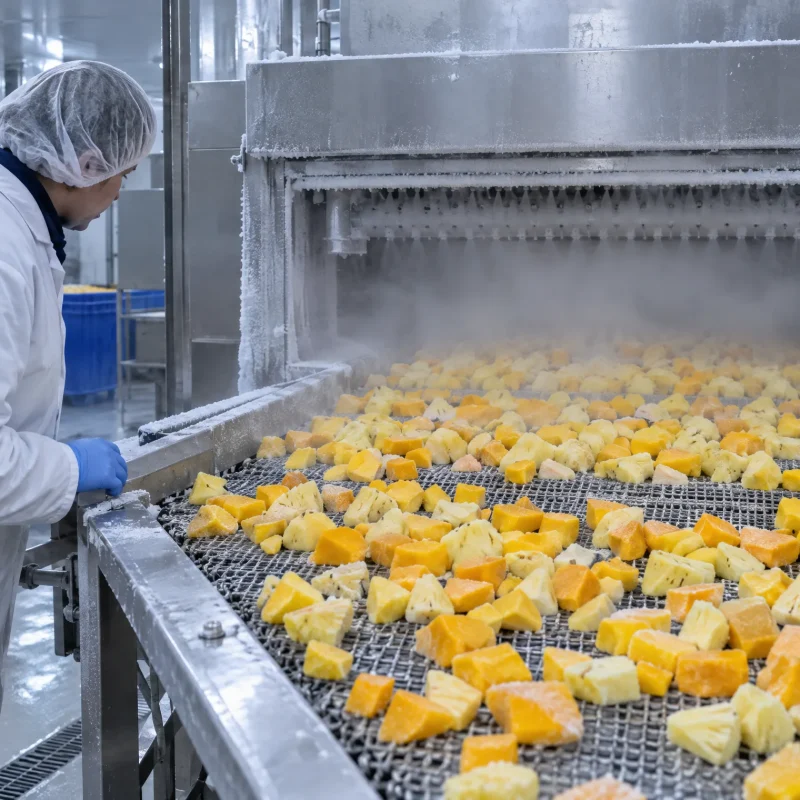
The generic process runs: peel and core, cut to ring or strip, osmotic infusion in sugar, convective or heat-pump drying, moisture equilibration, then vacuum or modified-atmosphere pack. Commercial soft drying in recent research ran at 60 to 70 °C, so “low-temperature dried” on an offer sheet is a claim to ask about, with the dryer setpoint named.
| Parameter | Unit | Limit | Method or instrument |
|---|---|---|---|
| Moisture | % | agreed in contract | method named in contract |
| Water activity (aw) | dimensionless | agreed in contract | method named; calibrated aw meter |
| Ethephon | mg/kg | finished-piece limit agreed in contract; raw fruit at or below the MRL divided by the measured concentration factor | residue method named in contract; raw-fruit MRL 1.5 under Reg (EU) 2026/215; processed basis Reg (EC) 396/2005 Art. 20 |
| Lead / cadmium | mg/kg | 0.10 / 0.020 on fruit, drying factor applied | Reg (EU) 2023/915 |
| Sulphite as SO₂ | mg/kg | declared above 10 | Reg (EU) 1169/2011 Annex II; 21 CFR 101.100 |
| TPC, yeast and mould, E. coli | cfu/g | agreed in contract | method named in contract |
| Salmonella | presence or absence | not detected in the sample mass named in the contract | method named in contract |
For the US, 21 CFR Part 114 treats a food as acidified only at equilibrium pH 4.6 or below and aw above 0.85, and Part 113 applies above pH 4.6 where aw also exceeds 0.85. A shelf-stable soft-dried piece sits outside both, so its US paperwork is the manufacturing plant’s FDA food-facility registration, not a process filing.
What does the sugar change besides the tariff line?
Sugar infusion changes what the label can claim. In the EU, sulphite above 10 mg/kg or 10 mg/L, expressed as SO₂, must be declared as an allergen under Regulation (EU) No 1169/2011, Annex II. In the US, 21 CFR 101.100 requires declaration above 10 ppm.
A “no preservatives” claim is a different promise from “under 10 mg/kg”. The 10 mg/kg figure is only the declaration threshold. A no-preservatives claim also needs no sulphite to have been added at all. Some soft-dried fruit sold in Vietnam lists sodium metabisulphite, E223, on its ingredients, so ask for the full ingredient declaration and a lot SO₂ result rather than relying on a claim line.
Permitted sulphite use levels in dried fruit sit in Regulation (EC) No 1333/2008, Annex II, and “no added sugars” claims are governed by Regulation (EC) No 1924/2006. Read the conditions in both before a claim goes on a retail pouch.
How does pack size change the sampling plan?
The same 1 kg boundary that moves the CN line also moves the acceptance plan. Codex CXS 233-1969, at AQL 6.5 and inspection level I, sets sample size by unit size, so a lot of 10 kg cartons and a lot of retail pouches are sampled differently.
| Unit size | Lot size (units) | Sample n (units) | Acceptance c | Instrument |
|---|---|---|---|---|
| over 4.5 kg | up to 600 | 6 | 1 | Codex CXS 233-1969 |
| over 4.5 kg | 601–2,000 | 13 | 2 | Codex CXS 233-1969 |
| over 4.5 kg | 2,001–7,200 | 21 | 3 | Codex CXS 233-1969 |
| over 1 kg to 4.5 kg | up to 2,400 | 6 | 1 | Codex CXS 233-1969 |
| over 1 kg to 4.5 kg | 2,401–15,000 | 13 | 2 | Codex CXS 233-1969 |
| 1 kg or less | up to 4,800 | 6 | 1 | Codex CXS 233-1969 |
| 1 kg or less | 4,801–24,000 | 13 | 2 | Codex CXS 233-1969 |
| 1 kg or less | 24,001–48,000 | 21 | 3 | Codex CXS 233-1969 |
Split defects by consequence. This is contract practice, separate from the Codex plan. Critical defects (metal, glass, hard plastic, a Salmonella positive, an untraceable lot code) take AQL 0 and reject the lot. Major defects (peel or eye fragments over tolerance, short weight, a punctured pouch, a wrong label) take AQL 2.5. Minor defects take AQL 6.5.
No international standard covers dried pineapple. Codex covers fresh pineapple in CODEX STAN 182-1993 and canned pineapple in CXS 319-2015, which replaced CXS 42-1981. “To international standard” in a dried-pineapple contract points at nothing, so every tolerance has to be written into the contract.
Which specification lines can go straight into the purchase order?
The lines below either cite an instrument or say the value is agreed in contract with the method named.
- Product: pineapple, sugar-infused and dried; state the cut (whole ring, strip or dice) and name the variety.
- Classification: state the CN line under 2008 20 that matches the pack size and sugar content (one of 2008 20 51, 59, 71 or 79), confirmed in TARIC before the statement of origin is issued; nothing-added product under 0804 30 00.
- Origin: supplier to identify the origin of the infusion sugar for the EVFTA product-specific rule.
- Ethephon: lot result on the finished piece against a finished-piece limit agreed in contract under Article 20 of Reg (EC) 396/2005; raw fruit at or below the MRL of Reg (EU) 2026/215 divided by the concentration factor measured on a paired raw/finished test from one run; buyer may sample raw fruit at the plant weighbridge.
- Contaminants: Pb and Cd per Reg (EU) 2023/915, drying factor applied.
- Moisture and water activity: limits agreed in contract, method named, reported on every COA.
- Sulphite: SO₂ result per lot; declared above 10 mg/kg; no claim of “no preservatives” if any sulphite was added.
- Sampling: Codex CXS 233-1969, AQL 6.5 level I, by stated unit size; additionally, by contract, critical AQL 0 and major AQL 2.5.
- Metal detection: the producing plant’s detector-sensitivity validation report on this product (no millimetre figure accepted in place of it).
- Documents: specification as a signed, versioned annexe; signed defect photo set; testing no more than 60 days before shipment, following USDA practice; at least 75% of shelf life remaining on arrival.
- Retained samples: held until shelf life plus 6 months, at the storage condition printed on the label.
- Packing and transport: barrier packaging with desiccant; dry 40 ft container, condensation-free. A phytosanitary certificate is normally not required for dried pineapple.
Common questions
What HS code does soft-dried pineapple take: 0813.40, 0804.30 or 2008.20?
Sugar-infused and then dried, it is a preparation under heading 20.08, at subheading 2008.20. Dried with nothing added, it stays with fresh pineapple at 0804.30. Heading 0813 excludes fruit of headings 0801 to 0806, so 0813.40 fits neither. Inside 2008.20 the EU line changes with pack size over or under 1 kg and with sugar content, so confirm the ten-digit line in TARIC.
Can I order soft-dried pineapple rings from Vietnam, or only strips?
Rings are available, but they need fruit wide enough to punch a full ring around a centred core, which means Cayenne or MD2. MD2 is under 5% of Vietnamese pineapple area. Queen, the variety the trade favours for soft-drying, gives small rings with deep eyes and heavy trim. Strips and dice work from smaller fruit, and large fruit costs roughly 1.3 to 1.4 times more at the farm gate.
Why does the ethephon result matter more for dried than fresh pineapple?
The EU limit of 1.5 mg/kg under Regulation (EU) 2026/215 applies to raw fruit. A dried product is judged through a processing factor under Article 20 of Regulation (EC) No 396/2005, and the food business carries the burden of proof. Drying concentrates residue while added sugar dilutes part of it, so the factor must be measured on the actual process.
What moisture and water activity should I specify?
No published moisture or water-activity limit exists for Vietnamese soft-dried pineapple. Set both in the contract, name the test method, and require both on every certificate of analysis. Brix of 72 or more, as offer sheets commonly print, shows how much sugar went in. Moisture and water activity are what predict whether the piece stays soft and free of mould through its shelf life.
Can a sugar-infused dried pineapple claim no preservatives?
Only if no sulphite or other preservative was added at all. The 10 mg/kg threshold in Regulation (EU) No 1169/2011 Annex II, and 10 ppm under 21 CFR 101.100, decides when sulphite must be declared. It does not make a product preservative-free. Ask for the full ingredient declaration and a lot SO₂ result before printing the claim.