On this page
- What temperature must frozen durian pulp hold, and where is it measured?
- What should you check on a durian carton before you thaw it?
- How should frozen durian pulp be thawed on a production line?
- What does a drip-loss figure for frozen durian actually measure?
- What can you still claim after the pulp has been thawed?
- Which clauses belong in the purchase order?
- Common questions
- Related insights
How to thaw frozen durian pulp: keep it in the sealed pack in a chiller, on a regime written into the specification, such as 4 °C for 12 or 18 hours. Store at −18 °C or colder; Codex CXC 8-1976 lets the warmest package reach −12 °C in distribution. A drip-loss figure needs its method. Before loading, agree which defects are judged frozen and which after a named thaw.
What temperature must frozen durian pulp hold, and where is it measured?
Frozen durian pulp must be held at −18 °C or colder, and the contract must say where that reading is taken and for how long. The Vietnam–China protocol on frozen durian, in force since 19 August 2024, requires storage and transport at or below −18 °C continuously, “in accordance with CAC/RCP 8-1976”. That Codex code, now CXC 8-1976, allows the warmest package to reach −12 °C during distribution.
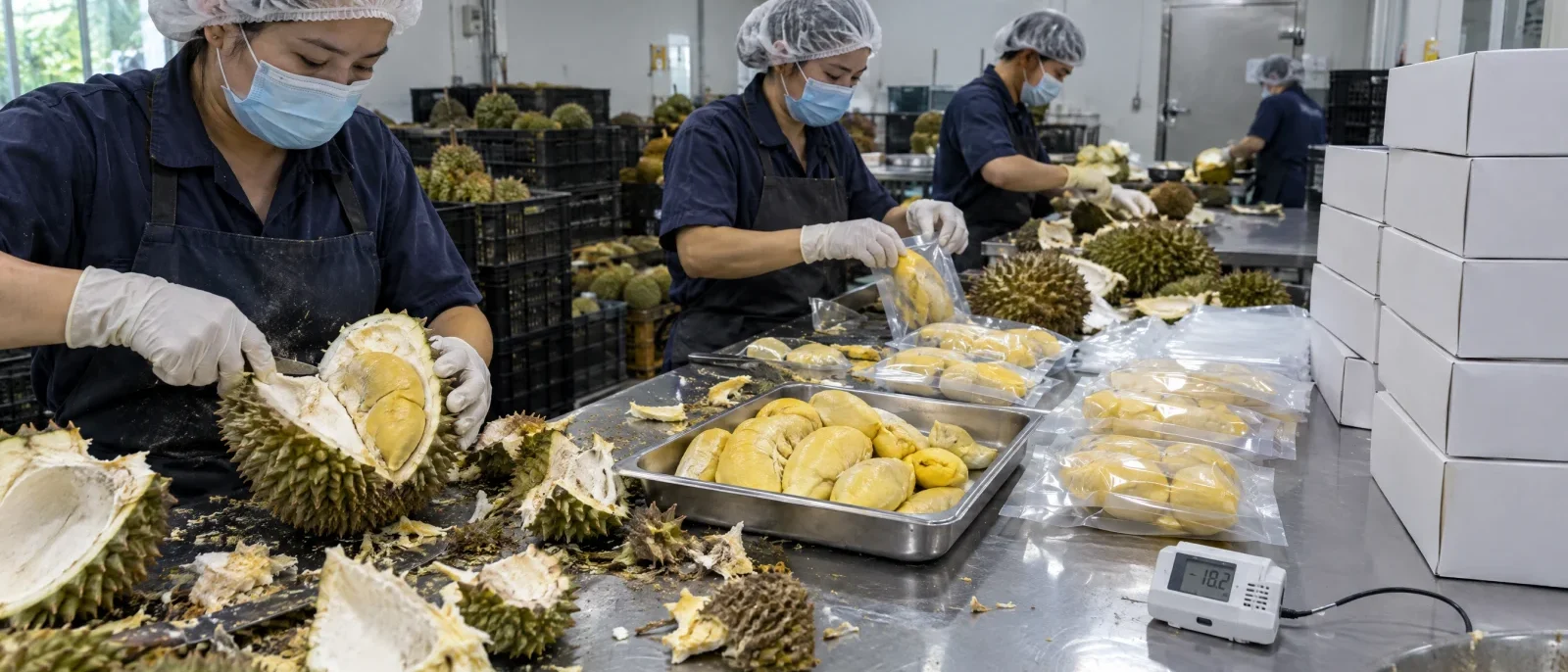
The protocol also sets the freezing step: at or below −35 °C for at least one hour, until the product core reaches −18 °C or colder. It admits three forms: whole fruit in shell, seedless segments with membrane, and seedless pulp. Shelf life is given as up to 24 months at −18 °C.
The two temperature figures are not a conflict of law, because the protocol adopts the Codex code by name. The real gap is the measuring point (product core or air, which carton) and the duration. No published excursion rule that combines a threshold with a time limit was found for frozen fruit. Contracts fill the gap in different ways, and the drafts below disagree with one another:
| Rule | Threshold (°C) | Measuring point | Instrument or basis |
|---|---|---|---|
| Storage and transport | −18 or colder, continuously | Not specified in the protocol | Vietnam–China protocol, in force 19 Aug 2024 |
| Distribution tolerance | −12, warmest package | Product, warmest package | Codex CXC 8-1976 |
| Critical rejection | Warmer than −12 | Product core | Contract construction, built on CXC 8-1976 |
| Recrystallisation limit | Never above −15 | Logger chart | Contract construction, no published basis |
| Duration limit | Above −15 for more than 4 h continuous | Logger chart | Contract construction, no published basis |
None of the last three is a standard. Pick one, write it down, and make sure the seller has signed the same one.
Codex CXC 8-1976 also describes how a core temperature is taken. A pre-chilled tool drills at least 2.5 cm into the product, and a probe accurate to ±0.5 °C reads it. A non-destructive reading between cartons carries a 2.8 °C tolerance, so a between-carton reading of −16 °C does not prove a core of −18 °C.
Logger placement is not standardised either. One specification template asks for three loggers per container, at the door, in the middle and at the back. One sale contract draft asks for two calibrated loggers, at the door and in the centre of the stow, photographed in position before sealing. Reefer set-points and stowage are covered in reefer container settings for frozen fruit. What happens when a logger shows a breach is covered in the frozen fruit quality claims process.
What should you check on a durian carton before you thaw it?
Check odour, freezer burn, ice sheeting, glaze and packaging while the product is still frozen, on opening. These defects either disappear or get confused with thaw damage once the pulp softens, and a claim on any of them needs the frozen-state record.
Odour runs both ways with durian. The fruit is the strongest odour source in a shared cold store, and the pulp also absorbs fish or onion taint from neighbouring goods. A sound cold chain uses a dedicated cold store and container, or produces a cleaning record before loading. Smell is checked as soon as the carton is opened, before thawing. Durian is also rich in fat, and long storage can oxidise that fat and give a rancid note, a defect that starch-rich banana and fibre-rich mango do not develop.
Thaw and refreeze in store or in transit leaves three signs: an ice sheet inside the bag, pieces fused together, and loose white snow. The usual causes are uncontrolled defrost cycles, cold-store doors left open and transloading at ambient temperature.
Freezer burn shows as dry, white, porous patches that are tough and flavourless after thawing. It comes from loose packaging, low store humidity and temperature fluctuation. No published tolerance exists for it, so the contract sets one or it is not claimable.
Glaze matters more for segments than for pulp. Where it is present, the contract must state net weight after glaze removal and the method used to measure it.
Sample to the plan written in the contract. For frozen lots, Codex CXS 233-1969 at AQL 6.5 is the common reference, with Inspection Level I for routine checks and Level II in a dispute, and lot size counted in cartons. The detail is in pre-shipment sampling for frozen fruit.
How should frozen durian pulp be thawed on a production line?
Thaw frozen durian pulp in the sealed pack, in a chiller, on the regime named in your specification. Two chilled regimes are in use for quality scoring: 4 °C for 12 hours, and 4 °C for 18 hours. One specification template also allows 20 °C for 1 hour. The contract has to say which one applies, because each gives a different product.
Durian is harder to thaw than mango or banana for three reasons.
The line has no kill step. There is no blanching and no pasteurisation, so whatever goes into the bag comes out of it. Pulp separation takes place in a room held at 15–18 °C, the one step where the flesh is open at near-ambient temperature.
The fruit keeps ripening after cutting. It is strongly climacteric, and its polyphenol oxidase acts at the cut surface. A slow or warm thaw restarts both mechanisms, which is why a wrong regime produces mushy texture and enzymatic browning on its own.
The thaw is where Listeria monocytogenes becomes a question. At −18 °C the organism survives but does not multiply. Whether EU authorities accept frozen fruit as a food that does not support growth is unsettled, because the product is thawed before use and the thaw stage is the growth stage. Put that question to food counsel in your importing country. The Listeria criterion in Regulation (EC) No 2073/2005, as amended by a Commission Regulation adopted on 20 November 2024 and applying from 1 July 2026, covers ready-to-eat foods able to support growth. The limit is ≤100 cfu/g throughout shelf life if the operator can show the authority this will not be exceeded, tested by EN ISO 11290-2. Otherwise it is not detected in 25 g, tested by EN ISO 11290-1. Frozen durian is eaten thawed and uncooked, so treat it as ready-to-eat unless the specification says otherwise.
That makes intended use a contract term. If the specification does not declare the pulp as ready-to-eat or as an ingredient for a heat-treated process, it defaults to ready-to-eat, and the seller carries the Listeria obligation for the whole shelf life. Evidence of control in the open-product area comes from an environmental monitoring programme, not from a single lot certificate of analysis. BRCGS Food Safety Issue 9, clause 4.11.8, requires a written sampling procedure with action limits and trending.
How long thawed pulp can be held chilled before use has no published figure for durian. Your own HACCP plan and shelf-life validation set it.
What does a drip-loss figure for frozen durian actually measure?
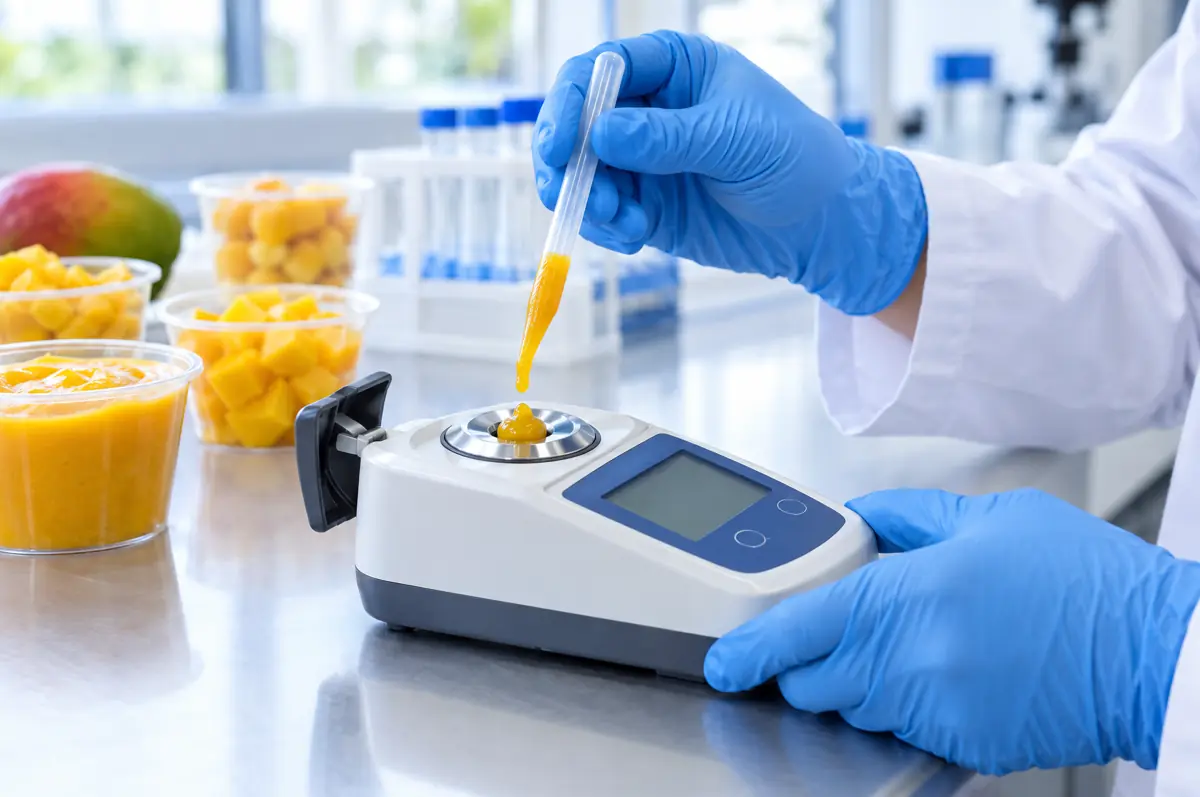
A drip-loss figure for frozen durian measures four choices that the supplier sheet rarely declares: sample mass, sieve aperture, thaw temperature and time, and the basis of the calculation. Change any one of them and the number changes. No Codex standard, USDA grade or published paper sets a drip-loss threshold for frozen durian.
Drip loss on frozen durian pulp is an indirect measure of freezing speed and the cheapest one available. Ice-crystal size cannot practically be measured at a plant or on receipt. Codex CXC 8-1976 asks that product pass quickly through the −1 to −5 °C band, because slow freezing there grows large crystals that rupture cells and release liquid on thawing. Drip loss arises at two stages: slow freezing, and cold-chain breaks in transport. One working method weighs 200 g of frozen product (m1), places it on a 2 mm sieve, thaws it at 4 °C for 18 hours and weighs the retained solids (m2). Drip loss is (m1 − m2) / m1 × 100, by weight, on frozen mass. A durian defect catalogue in use takes a 500 g sample and scores thawed defects after 4 °C for 12 hours. Six hours less at 4 °C drains less exudate, so the two methods give different results on the same lot.
| Method | Sample mass (g) | Sieve (mm) | Thaw regime | Basis | Source |
|---|---|---|---|---|---|
| Specification template | 200, frozen | 2 | 4 °C, 18 h | By weight, on frozen mass | Unpublished working method |
| Durian defect catalogue | 500 | Not stated | 4 °C, 12 h | Not stated | Unpublished scoring rule |
| Vendor statement, whole fruit | Not stated | None | About 6 h, room temperature | Not stated | Equipment supplier claim |
There is a second problem. The 2 mm sieve method was written for IQF pieces such as banana slices and mango dice. Seedless durian pulp is a soft, fat-rich mass. Nobody has recorded whether thawed pulp stays on a 2 mm sieve or smears through it. Require the method to be validated on the contracted form, segment or pulp, before a limit is agreed.
A limit of 5% circulates in the trade for frozen durian. No published standard sets it, and it means nothing without its method. Set the number from a plant’s certificates of analysis or from your own trial lots, after the method is fixed.
VinFruits Global’s specification template records beside every quality result whether the sample was read frozen or after a named thaw, because the same durian segment scored at both points gives two different defect counts.
Two questions get further with a plant than asking which freezing technology it runs. What drip loss did you measure, and by which method? What is the core-temperature chart of the latest lot? A claim that a process keeps colour and aroma “at nearly 100%” is marketing. Convert it into a drip-loss figure plus a colour photo set signed by both parties.
What can you still claim after the pulp has been thawed?
After thawing, a temperature claim rests on the logger record up to the moment the pack was opened. A sensory claim needs the thaw regime written into the contract, and a safety claim needs a sealed counter-sample. A buyer who thaws before agreeing which of these applies has usually given up the claim.
No Codex standard and no USDA grade exists for durian, fresh or frozen. When a seller says “no standard says that”, the statement is literally true. The only substitute is a specification and a reference photo set signed by both parties. Safety parameters do not change with grade: core temperature, foreign matter, microbiology, chemistry and legal labelling are the same for premium, standard and industrial lots. A plant that offers looser microbiology for an industrial grade should be dropped.
Hard flesh, under-ripe segments inside fruit that looked sound, is the defect specific to durian. It cannot be detected before opening, and neither party controls it. One construction agrees in advance that exceeding the hard-flesh limit downgrades the lot instead of returning it, because returning frozen goods to Vietnam almost always costs more than the grade difference.
One sale-side draft makes net weight and organoleptic quality “final and binding” once an independent surveyor, nominated by both parties, has inspected at loading. The buyer then waives weight and sensory claims after the container is sealed. That draft carves out microbiology, pesticide residues, heavy metals including cadmium, and industrial dyes including auramine O. These can be claimed after arrival on the counter-sample sealed at loading, tested at the same laboratory.
One draft makes the seller’s two loggers “the sole admissible evidence” of a temperature breach, and requires the buyer to send the data within 48 hours of opening or lose any temperature claim. That binds buyer and seller only. Britannia P&I’s Refrigerated (reefer) container cargo care & claims (April 2022) notes that a shipper-placed logger may not be accepted against the carrier, where the container’s own record is the primary evidence.
Under CISG Article 36(1), the seller is liable for a non-conformity that existed when risk passed, even if it appears later. Vietnam has been a party since 1 January 2017. Proving that it existed is the hard part. For a suspect lot, the order is: photograph the sealed container, seal number, thermometer and logger before touching anything. Sample to the contract plan. Thaw on the specified regime and log start and end times. Score against the signed photo set with the sample in frame. Keep a sealed counter-sample at −18 °C and notify inside the contract window. Notice after the window loses the claim even when the goods were defective.
Which clauses belong in the purchase order?
Write the measuring point, the thaw regime, the drip-loss method, the intended use and the carve-outs into the purchase order before loading. The wording below is suggested drafting with blanks for you to fill. It is not a set of supplier terms, and it should be reviewed by your own counsel.
- Drip loss. “Drip loss: ≤[__]% by weight. Method: [200 | 500] g taken frozen from [n] cartons per Codex CXS 233-1969; drained on a [2] mm sieve; thawed at 4 °C for [12 | 18] h in the closed pack; result = (frozen mass − drained solids) / frozen mass × 100. Method to be validated on the contracted form (segment / pulp) before the first lot.”
- Temperature. “Product core ≤ −18 °C at loading, measured per Codex CXC 8-1976 (drilled ≥ 2.5 cm, probe ±0.5 °C). Excursion: [no reading above −15 °C | not more than [__] h above −15 °C]; core warmer than −12 °C at any check = rejection.”
- Sample state. “Packaging, clumping, glaze and odour assessed frozen on opening; colour, texture and hard flesh assessed after thawing at 4 °C for [12] h, with start and end times recorded.”
- Intended use. “Intended use: [ready-to-eat | ingredient for a heat-treated process].”
- Carve-outs. “Microbiology, pesticide residues, heavy metals and dyes are excluded from any ‘final at loading’ provision and may be claimed within [__] days of arrival on the counter-sample sealed at loading, tested at the same laboratory.”
- Loggers. If you are offered a “sole admissible evidence, 48 hours” logger clause, sign it knowing that it governs only the sale contract. Against the carrier, the container’s own temperature record is what counts.
Common questions
How do I thaw frozen durian pulp for production?
Thaw it in the sealed pack in a chiller, on the regime your specification names. The chilled regimes in use are 4 °C for 12 hours and 4 °C for 18 hours. Durian has no kill step and keeps ripening after cutting, so a warm or uncontrolled thaw causes browning and mushy texture. No published figure sets a post-thaw holding time; your HACCP plan sets it.
What storage temperature should frozen durian be kept at?
Keep it at −18 °C or colder. The Vietnam–China protocol on frozen durian requires −18 °C or below continuously, in accordance with CAC/RCP 8-1976. That Codex code, now CXC 8-1976, allows the warmest package to reach −12 °C in distribution. Your contract should state where the reading is taken, product core or air, and for how long an excursion is tolerated.
What drip loss is acceptable for frozen durian?
No published standard sets one. A figure of 5% circulates in the trade, but it has no traceable source and means nothing without its method. Fix the sample mass, sieve aperture, thaw temperature and time, and calculation basis first. Then set the limit from a plant’s certificates of analysis or your own trial lots, after validating the method on pulp or segments.
Can I refreeze thawed durian pulp?
Refreezing produces the same damage that thaw and refreeze in transit does: ice sheeting inside the bag, pieces fused together and loose white snow. Thawed pulp is also the stage where Listeria can grow on a product with no kill step. Any decision to refreeze belongs in your own validated HACCP plan.
Can I still claim on a lot after I have thawed it?
Only for what the contract says is judged after thawing. Texture and colour claims are winnable if the contract names the thaw regime and you followed it with start and end times recorded. Safety claims need a counter-sample sealed at loading and tested at the same laboratory. Odour, glaze and packaging must be recorded frozen on opening, before thawing begins.