On this page
- What does individually quick frozen actually mean?
- Which freezers sit behind the word IQF, and why does the fruit choose?
- Why does freezing speed matter for texture and drip loss?
- Why do IQF pieces end up stuck together?
- How do you test for ice crystals you cannot see?
- What should you ask instead of “do you have IQF?”
- Common questions
- Related insights
Individually quick frozen (IQF) fruit is cut fruit frozen piece by piece, so the bag pours freely instead of setting into a block. Codex CXC 8-1976 asks for a rapid passage through −1 to −5 °C without giving a number for “rapid”, and the Codex peaches standard, CXS 75-1981, treats freezing as complete only at a −18 °C core. The word names an outcome. The machine, the dewatering and the test decide its quality.
What does individually quick frozen actually mean?
In trade use, individually quick frozen means frozen fruit pieces that pour freely: each dice, slice or segment froze on its own and stays separate in the carton. That is the whole IQF meaning. It describes a result, not a process. No Codex standard, USDA grade standard or EU marketing standard defines IQF for tropical fruit.
The published instruments stop short of it. Codex has quick-frozen standards for vegetables (CXS 320-2015) and for strawberries, raspberries, peaches and blueberries (CXS 52, 69, 75 and 103, all 1981). EU marketing standards cover fresh fruit only. The label term Codex recognises is “quick frozen” plus the style, meaning the cut form. CBI’s buyer guidance treats pieces sticking to one another as incompatible with IQF, and its sample specification for IQF mango chunks caps clumping at 2%.
Two consequences of that absence, that neither IQF nor BQF is defined anywhere and that block freezing removes the free-flow test altogether, are set out in IQF vs BQF: what the freezing method changes for a frozen fruit buyer. This article covers what the word leaves out: which machine froze the fruit, how fast the fruit itself froze, and where separation is won or lost.
Which freezers sit behind the word IQF, and why does the fruit choose?
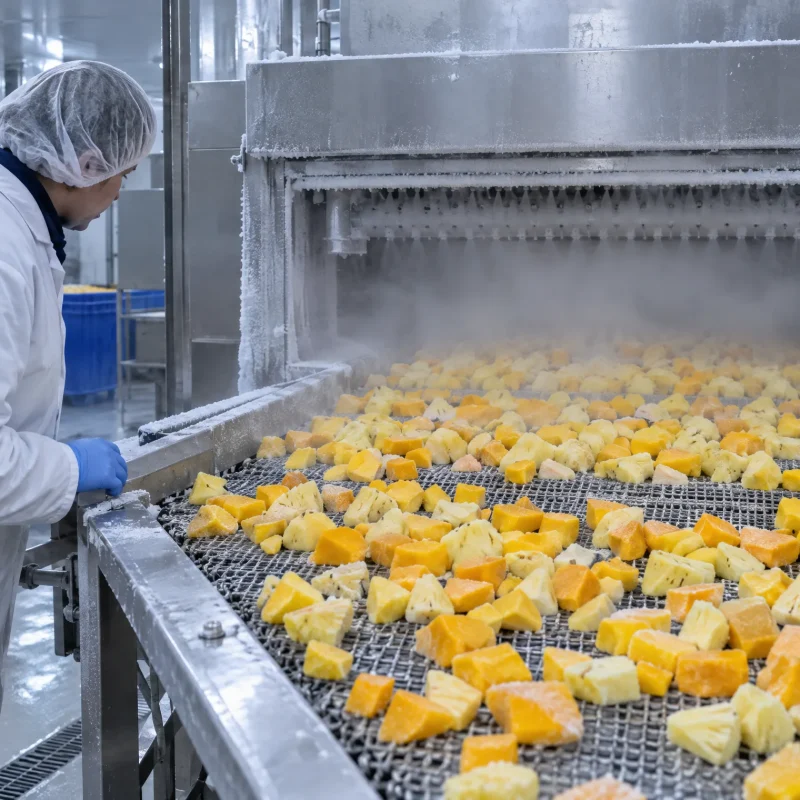
At least five machine types sell under “IQF”, with dwell times from about 3 minutes to 60 minutes at similar air temperatures. That is a factor of twenty between machines carrying the same label. Which one a plant can run is often decided by the fruit, not by the plant’s budget.
| Freezer type | Air temperature (°C) | Dwell time (min) | Behaviour with fruit | Source of figure |
|---|---|---|---|---|
| Straight-belt tunnel | −35 to −40 | 20–40 | Lowest capital cost, easiest to clean | Equipment-supplier parameters (tanlongvn.com, favigas.com.vn), not a standard |
| Spiral | −35 to −40 | 20–60 | Saves floor space, hardest to clean | Equipment-supplier parameters, not a standard |
| Fluidised bed | −35 | 8–20 | Strongest piece separation; needs a firm piece | Equipment-supplier parameters, not a standard |
| Impingement | −35 to −40 | 3–10 | Highest heat transfer; air lifts thin soft slices | Equipment-supplier parameters, unconfirmed |
| Liquid-nitrogen cryogenic | −80 to −100 cabinet | 5–15 (45–60 whole fruit) | Fastest; gas supplied at −196 °C | Equipment-supplier parameters (favigas.com.vn), not a standard |
Batch air blast at 2 to 6 hours and contact plate at 1 to 3 hours sit outside this range and are not IQF methods. The supplier platform Nutrada publishes “−30 to −40 °C in 3–30 minutes” as a general IQF window. That is one company’s description, not a requirement.
Ripe banana shows how the fruit rules machines out. A soft, high-sugar slice will not fluidise; it lies flat and sticks. Impingement air at high velocity flips thin soft slices off the belt. So banana runs on a straight-belt tunnel, or a spiral where floor space is tight, which is why the parameters in an IQF banana slices specification look different from mango. Firm mango dice, by contrast, are typically run on a fluidised bed or spiral at −35 to −40 °C for 8 to 15 minutes. Peeled, de-seeded lychee and longan commonly go through a tunnel or fluidised bed on a similar window.
The plant often matters more than the technology label. DEFRA’s Energy Use in Food Refrigeration puts blast freezing at 70–130 kWh/t, yet its plant survey spans 83 to 2,744 kWh/t, with only about 10% of plants below the Werner (2006) benchmark of 133 kWh/t. Plant-to-plant spread is wider than the gap between methods.
Why does freezing speed matter for texture and drip loss?
Freezing speed matters because it sets the size of ice crystals inside the fruit cells, and large crystals rupture cell walls. On thaw, the ruptured cells release juice (drip loss) and the piece goes soft. Codex CXC 8-1976, also published as CAC/RCP 8-1976, addresses this by requiring a rapid passage through the zone of maximum crystallisation, −1 to −5 °C.
The instrument gives no figure for “rapid”: no minutes, no centimetres per hour, no air temperature. The numbers buyers see are dwell times, and a dwell time measures how long the product sat in the machine. It does not measure how long the core spent between −1 and −5 °C. A 20-minute tunnel loaded at twice its rated capacity can hold product in the crystallisation zone far longer than its brochure suggests.
Speed, ice crystals and drip loss in IQF fruit: Codex CXC 8-1976, the Code of Practice for the Processing and Handling of Quick Frozen Foods, requires quick-frozen product to pass rapidly through −1 to −5 °C, the band in which most water in the fruit turns to ice. It sets no rate. Codex CXS 75-1981, the quick-frozen peaches standard, defines freezing as complete when the core reaches −18 °C after thermal stabilisation. Slow passage through the −1 to −5 °C band grows large ice crystals, which are recorded as the root cause of high drip loss and post-thaw mushiness in frozen banana. Ice-crystal size cannot be checked at a factory or a receiving bay, because cold microscopy is not practical there. The only document that shows whether a lot crossed the band quickly is the plant’s core-temperature trace for that lot; the dwell time on an equipment brochure describes the machine, not the fruit.
Freezing also costs water. Mechanical refrigeration typically takes 1–3% of product moisture; cryogenic freezing with liquid nitrogen takes under 1%, per the equipment maker Advanced Freezer. Treat any cryogenic vendor’s tighter weight-loss figure as a claim until the plant’s own certificate of analysis shows it. What happens to crystals after freezing, in a store or container that swings in temperature, is covered in reefer container settings for frozen fruit. Freezer burn and storage recrystallisation will get their own article.
Why do IQF pieces end up stuck together?
IQF pieces fuse for three reasons, at three stages: the fruit was still wet when it entered the freezer, the freezer was overloaded or its fluidising air too weak, or the product partly thawed and refroze later in the chain. Only the middle cause happens inside the freezer. Separation is mostly won or lost before and after it.
The first stage is dewatering. After cutting and an anti-browning dip of ascorbic and citric acid, the pieces pass a vibratory shaker deck and an air knife immediately before the freezer entrance. Surface water left on a piece freezes into a bridge with its neighbour. This step also decides much of the drip-loss figure, so a plant with an expensive freezer and a poor dewatering deck still ships clumped fruit.
The second is loading. A freezer run above its rated capacity, or a fluidised bed whose air cannot lift the bed, lets pieces sit in contact while they freeze. The third is the cold chain. For lychee and longan, packing in a room above 10 °C, or loading a container that was not pre-cooled to −18 °C, produces fused pulp with large ice crystals. A lot that left the plant free-flowing can arrive clumped.
The free-flow test is simple: pour 1 kg, still frozen, onto a tray, separate it with light hand pressure, and weigh what still adheres. The limits are less simple. The commercial specification GG-2616 (IQF mango chunks, 3/4″) is recorded as allowing clumps of up to three pieces below 3% and agglomerates of five or more pieces at 3%. A cluster of exactly four pieces falls in neither class. GG-2615 (IQF strawberry) allows 6% clumps, and CBI’s 2% defines no cluster size at all. Whatever document you borrow from, write a definition that covers every cluster size, or you import the dispute along with the number.
How do you test for ice crystals you cannot see?
Drip loss is the only practical test a buyer has for ice-crystal damage, and it reports three causes, not one. Frozen-fruit defect catalogues list slow freezing, fluctuating store temperature and overripe raw material as causes of high drip loss, and the same three for mushiness after thaw. A high figure says something went wrong. It does not say where.
Separating the causes takes documents the drip-loss number cannot replace: the raw-material ripeness or Brix record for the orchard, the core-temperature trace for the freezer, and store and container logger data for everything after. Ripeness sets the floor. For banana, stage 5 is the target for IQF, and overripe fruit cuts badly and turns mushy on freezing whatever the freezer does. Steam blanching inactivates the browning enzymes and held colour through a freeze-thaw cycle in published work (European Food Research and Technology), but commercial IQF banana is commonly only acid-dipped, and hard blanching softens ripe slices.
The test itself is written in more than one way. Two specification templates used for Vietnamese frozen fruit disagree:
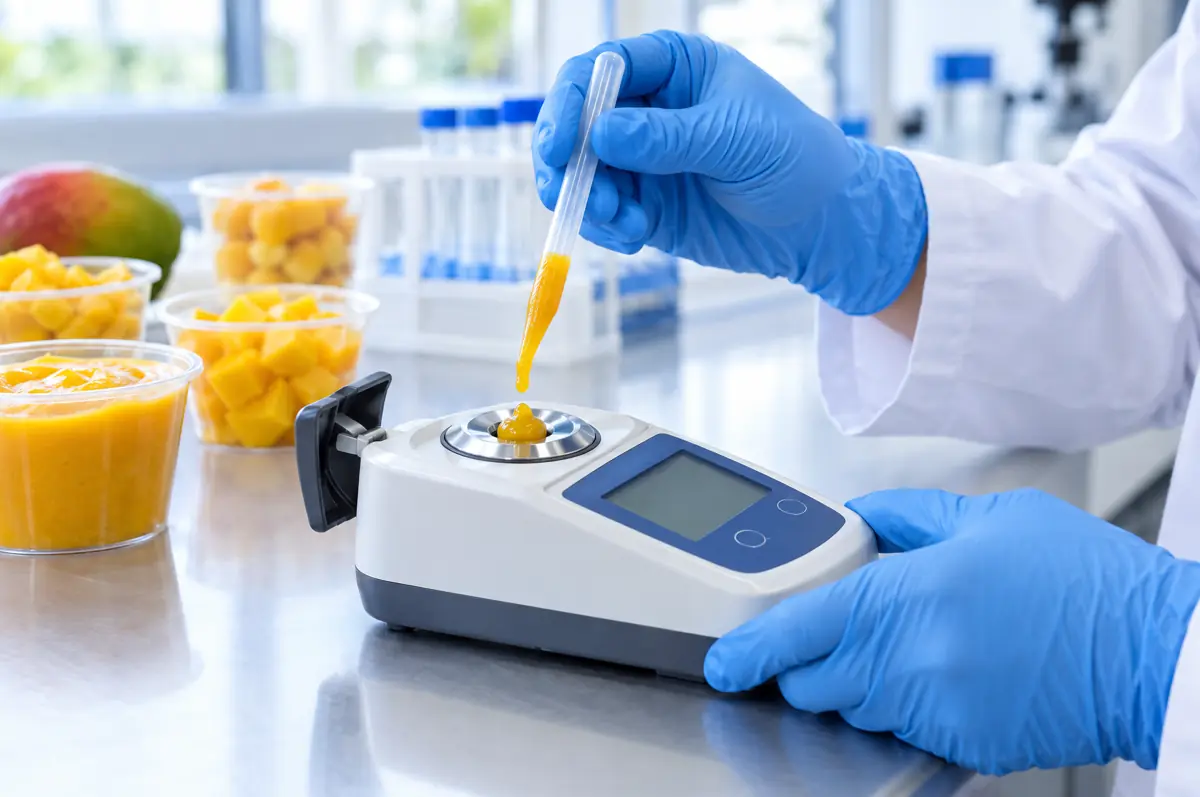
- Regime A: weigh 200 g still frozen onto a 2 mm sieve, thaw at 4 °C for 18 hours, reweigh the solids, and report (m1 − m2) / m1 × 100. The template allows 20 °C for 1 hour instead, provided the report names which.
- Regime B: a 500 g sample, with defects assessed after thawing at 4 °C for 12 hours.
Neither cites a published method, and no standard sets a drip-loss limit for any tropical fruit. Nutrada publishes 3–8% for IQF against 10–20% for block-frozen product, with no thaw regime stated, so the band cannot be reproduced. A percentage without its sample mass, sieve, temperature and hours is not comparable between two suppliers, or between two documents from the same buyer.
VinFruits Global writes the sample mass, sieve size and thaw regime into every drip-loss line of its product specifications, because 200 g thawed for eighteen hours and 500 g thawed for twelve are two different tests.
State matters as much as regime. The same durian segment assessed frozen and assessed after a 12-hour thaw gives clearly different results on browning, softening and drip loss, and a defect catalogue for frozen durian calls that the gap sellers use most. Sieve while frozen, count defects after thawing, and attach to every tolerance whether it is by weight or by count, on what sample, in what state.
What should you ask instead of “do you have IQF?”
Ask four questions that a plant has to answer with a document, then put two clauses in the purchase order. The answer to “do you have IQF?” is always yes. The answers below are not.
- Which freezer do you run for this fruit, and why that one?
- How is the product dewatered before the freezer, and at what loading rate is the freezer run?
- May I see the core-temperature trace for the most recent lot?
- Which drip-loss regime does your laboratory use: sample mass, sieve, thaw temperature and hours?
If a supplier offers a premium freezing technology, ask what the price difference is against its standard product. If there is none, the technology is a cost to the plant, not an advantage to you. On the line, resident QC or a third-party inspector typically checks core temperature, clumping, size, residual peel and a metal-detector test every 2 hours; ask to see those records alongside the pre-shipment sampling plan.
Clause 1, core temperature. Core temperature ≤ −18 °C at freezer exit and at container loading, measured destructively per Codex CXC 8-1976: a hole bored at least 2.5 cm deep with a pre-chilled tool, probe accuracy ±0.5 °C, display resolution 0.1 °C. The core-temperature trace for the lot accompanies the certificate of analysis. Non-destructive readings between cartons carry a 2.8 °C tolerance under the same code and do not replace the destructive reading.
Clause 2, drip loss. Drip loss ≤ [buyer’s figure] %, determined on [200 g] weighed still frozen onto a 2 mm sieve, thawed at [4 °C for 18 h], solids reweighed, calculated as (m1 − m2) / m1 × 100. The supplier’s certificate of analysis reports the same regime.
A third clause for free flow is worth adding if clumping has cost you before: the 1 kg tray test, a limit by weight, and a cluster definition that covers two, three, four and five or more pieces.
Common questions
What does individually quick frozen mean?
Individually quick frozen means each cut piece of fruit freezes separately, so the frozen pieces pour freely from the bag instead of forming a block. It describes the result, not a defined process. No Codex, USDA or EU standard defines IQF for tropical fruit; Codex quick-frozen standards cover vegetables and four temperate fruits, and the label term they recognise is quick frozen plus the cut style.
How fast is quick in quick frozen, and is there a legal number?
There is no general legal number. Codex CXC 8-1976 requires a rapid passage through −1 to −5 °C but sets no rate, and the Codex peaches standard CXS 75-1981 defines completion as a −18 °C core. Equipment dwell times of 3 to 60 minutes describe machines, not the fruit. The plant’s core-temperature trace for the lot is the only document showing how fast the product actually froze.
Why do IQF pieces sometimes arrive stuck together?
Clumping has three causes at three stages. The fruit was still wet entering the freezer because dewatering was poor; the freezer was overloaded or its air too weak; or the product partly thawed and refroze in the store or container. Ask about the dewatering step and loading rate at the plant, and check container logger data on arrival.
Can I check ice-crystal size when frozen fruit arrives?
Not directly. Cold microscopy is not practical at a factory or receiving bay, so crystal damage is assessed indirectly through drip loss. Drip loss also rises with overripe raw material and fluctuating store temperature, so a high figure needs the ripeness record, the freezer core-temperature trace and the logger data before you can say which stage failed.
Is IQF fruit safe to eat without cooking?
Freezing arrests micro-organisms but does not destroy them, and an IQF line has no kill step. Whether a lot can be eaten without cooking depends on the use the product is declared and specified for, and on the microbiological criteria written into the contract, not on the freezing method. Treat IQF as a preservation method, not a safety step.