On this page
- Which microbiological limits on a frozen fruit specification are law?
- Does declaring frozen fruit “ready-to-eat” change the criteria?
- What does Regulation 2073/2005 set for frozen fruit?
- How do Japan, the USDA and published buyer specifications differ?
- Why does the sample mass matter: 25 g, 125 g or 375 g?
- What does a clean COA not show?
- What should the microbiology block of a purchase order say?
- Common questions
- Related insights
Frozen fruit microbiological criteria come from two places. In the EU, Regulation (EC) 2073/2005 sets Salmonella not detected in 25 g for ready-to-eat pre-cut fruit, and its amended Listeria criteria apply to ready-to-eat foods from 1 July 2026. TPC, yeast and mould limits come from buyer and procurement specifications. Whether the lot is declared ready-to-eat decides which legal criteria apply.
Which microbiological limits on a frozen fruit specification are law?
In the EU, the food-safety criteria that Regulation (EC) 2073/2005 applies to ready-to-eat pre-cut fruit cover two pathogens: Salmonella and Listeria monocytogenes. The total plate count (TPC), yeast, mould, coliform and E. coli lines on a typical frozen-fruit specification come mostly from buyers and from procurement documents such as the USDA’s.
The split matters because frozen fruit carries whatever microbial load it went in with. An IQF line has no kill step: no blanching, no sterilisation. Freezing stops micro-organisms multiplying but does not kill them. L. monocytogenes survives at −18 °C, grows at chill temperatures and forms biofilm in wet areas, and the places it settles in a frozen-fruit plant are freezing tunnels, wet conveyors, drains and the bases of evaporator coils.
The incidents bear this out. FDA recall records and EFSA/ECDC reporting for 2020–2026 point to pathogens, not foreign bodies, as the cause of the large events in this category. In June 2023, SunOpta / Sunrise Growers recalled roughly 162,000 cases of frozen fruit over Listeria. An EFSA/ECDC outbreak report linked frozen vegetables from the Greenyard plant at Baja, Hungary, to 53 illnesses and 10 deaths.
For reading the certificate itself, field by field, see how to read a fruit certificate of analysis. For how the analytical sample is drawn from the lot, see pre-shipment sampling for frozen fruit.
Does declaring frozen fruit “ready-to-eat” change the criteria?
Yes. Under EU and Japanese rules, the declared use decides which legal criteria apply. Ready-to-eat is not a physical property of diced mango. It follows from what the producer or seller intends: food meant to be eaten without a cooking or heating step that kills micro-organisms is ready-to-eat. The same IQF bag can sit on either side of that line.
Labelled “ready for smoothies and toppings”, the bag is ready-to-eat. Labelled “ingredient, heat to ≥75 °C for 30 seconds before eating”, it is not. Foodnet, a UK supplier of IQF banana of Ecuadorian and Vietnamese origin, takes the second route on its published specification: the product is an ingredient that must be heated to ≥75 °C for 30 seconds before eating.
The heating route has a commercial cost. Smoothie, ice-cream, yoghurt and topping manufacturers will not buy fruit labelled “must be heated”, and those are the channels that pay best for tropical IQF fruit. If your own use has no kill step, you are buying a ready-to-eat product whatever the supplier’s label says.
Four questions push a frozen product towards ready-to-eat classification:
- Could the end user eat it without heating?
- Does any material, including a website or secondary packaging, suggest using it without heating?
- Does the industrial customer put it into a product with no kill step, such as a smoothie, ice cream, topping or yoghurt?
- Does the label fail to require heating clearly? With no clear instruction, treat the product as ready-to-eat by default.
The third question is the one most often missed in B2B trade, and it applies to the buyer as much as the supplier.
What does Regulation 2073/2005 set for frozen fruit?
Regulation (EC) 2073/2005 sets two pathogen criteria relevant to ready-to-eat frozen fruit. Annex I, item 1.19 covers Salmonella in pre-cut ready-to-eat fruit and vegetables. A Commission Regulation adopted on 20 November 2024, applying from 1 July 2026, amends the Listeria monocytogenes criteria for ready-to-eat foods able to support its growth.
Item 1.19 sets Salmonella at n=5, c=0, not detected in 25 g, for products placed on the market during their shelf life, with ISO 6579-1 as the reference method. Five sample units are tested and none may be positive.
The November 2024 amendment covers ready-to-eat foods able to support growth of L. monocytogenes, except infant foods and foods for special medical purposes. It has two tiers, both applying to product on the market throughout shelf life:
- ≤100 cfu/g by enumeration (EN/ISO 11290-2), where the operator can show the competent authority that the level will not exceed 100 cfu/g throughout shelf life;
- otherwise, not detected in 25 g by detection (EN/ISO 11290-1).
For IQF fruit with an 18–24 month shelf life, a “not detected in 25 g” result has to hold for up to two years, not just on the day of production.
Here the regulation and the physics of frozen storage do not line up, and the question is open. Listeria does not multiply at −18 °C, but smoothie-channel fruit is thawed before use, and growth can resume during thaw. Whether EU authorities accept “frozen, therefore does not support growth” for IQF fruit has not been confirmed. That decides whether the ≤100 cfu/g tier is even available. For lots going to no-kill-step customers, write the stricter tier into the contract until a food lawyer or the competent authority in the importing country has given a view in writing.
VinFruits Global’s product specification template carries a declared-use line, ready-to-eat or ingredient to be heated, because that line decides which Listeria criterion the lot has to meet.
How do Japan, the USDA and published buyer specifications differ?
The same lot can pass one market’s microbiology and fail another’s. Japan’s Food Sanitation Act standard for frozen food eaten without heating requires coliforms negative. The USDA Commodity Specification for Frozen Fruit (June 2017) allows coliforms below 100/g. Neither is EU law, and the USDA document is a federal procurement specification for USDA purchases, not FDA regulation.
| Parameter | ISO method to specify in a contract | USDA Frozen Fruit, June 2017 (per g unless stated) | Published foodservice IQF mango spec (cfu/g unless stated) | Japan, frozen food eaten without heating (per g unless stated) |
|---|---|---|---|---|
| TPC / aerobic plate count | ISO 4833 | <50,000 | <50,000 | ≤100,000 |
| Yeasts | ISO 21527 | <10,000 | <5,000 | — |
| Moulds | ISO 21527 | <10,000 | <5,000 | — |
| Coliforms | ISO 4832 | <100 | <100 | negative, two 0.01 g portions (desoxycholate medium) |
| E. coli | ISO 16649 | <3 | <10 | — |
| Salmonella | ISO 6579-1 | negative in 25 g | negative in 375 g | — |
| L. monocytogenes | ISO 11290-1 | — | negative in 125 g | — |
A dash means the value was not available in the sources used for this article; it is not a statement that the instrument sets no limit for that parameter. The ISO column gives the method to write into a contract, not the method each instrument prescribes. Japan sets its frozen-food standard by category; only the eaten-without-heating values are shown, and its coliform line specifies desoxycholate medium. The USDA E. coli line is printed as written. A value of <3 is typical of a most-probable-number result rather than a colony count, so do not compare it arithmetically with <10 cfu/g. The mango specification also sets S. aureus below 10 cfu/g. A published IQF strawberry specification from the same source sets TPC <50,000, coliform <100 and E. coli <10, and has no yeast or mould line at all.
The numbers also shift sharply by product form. For fruit purée, USDA A-A-20252B sets TPC below 1,000, yeast and mould below 100 and coliform below 10 cfu/g, and requires commercial sterility. A negative TPC does not prove commercial sterility; only an incubation test does. For how cut and grade sit alongside these lines, see the IQF mango specification.
Why does the sample mass matter: 25 g, 125 g or 375 g?
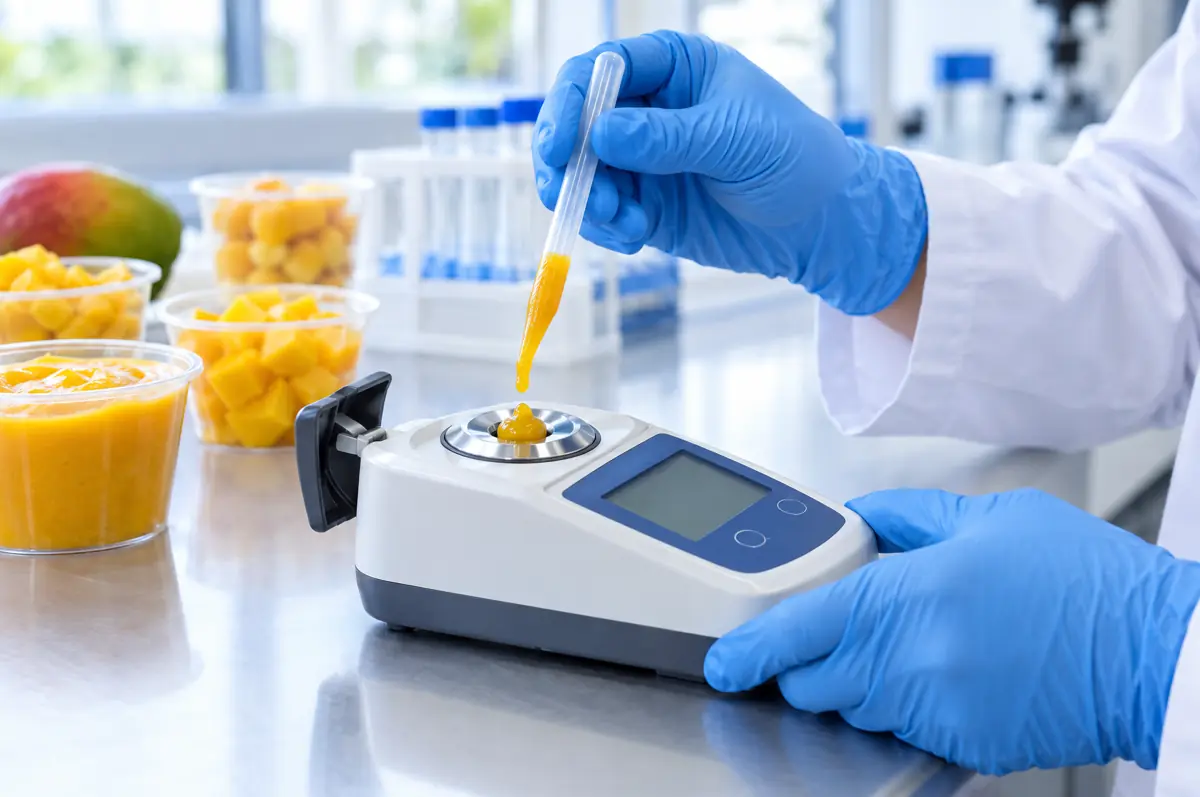
A presence/absence test has no measurement uncertainty in the usual sense, but its probability of detection depends on how much product is analysed. “Salmonella: not detected” without a mass describes no specific test, and it cannot be checked against any specification.
The sample mass on a frozen-fruit COA can differ between law and contract, and the larger contractual masses cost noticeably more than the 25 g legal test. Regulation (EC) 2073/2005, Annex I item 1.19, sets Salmonella not detected in 25 g, n=5, c=0, for ready-to-eat pre-cut fruit, and the November 2024 Listeria amendment uses 25 g for its detection tier. Large EU and Japanese buyers commonly specify Salmonella absent in 375 g (ISO 6579-1) and Listeria monocytogenes absent in 125 g (ISO 11290-1). A published US foodservice IQF mango specification uses exactly those masses, while a strawberry specification from the same source stays at 25 g for both pathogens. The 375 g and 125 g tests have different chances of finding low-level contamination than the 25 g test. The law sets the floor; the contract decides the cost. A frozen-fruit COA line reading “absent” with no analytical mass is incomplete.
Two related points belong in the contract. For a pathogen detected by a presence/absence test, a negative re-test on another portion does not cancel an original positive. For quantitative counts, a difference on the order of one log between two competent labs is normal, which is why legal criteria use n/c sampling plans rather than a single figure. Routine counts (TPC, coliform, E. coli, yeast, mould) are available at low cost in Vietnam. Salmonella and Listeria work needs a lab with ISO 6579-1 and ISO 11290 inside its ISO/IEC 17025 accreditation scope.
What does a clean COA not show?
A clean frozen-fruit COA has two blind spots: enteric viruses, which are not on it, and the plant environment, where Listeria lives. Hepatitis A and norovirus are not part of routine lot testing for frozen fruit and are controlled by prevention. Environmental swabs look for Listeria in drains and on freezer belts, where a lot test does not.
The FDA’s Summary of FDA’s Strategy to Prevent Human Norovirus and Hepatitis A Outbreaks Associated with Fresh and Frozen Berries records no enteric-virus outbreak linked to US-grown berries in 35 years, while the 2022–2023 incidents came from imported product. Both viruses survive freezing. The FDA attributes these outbreaks to poor worker hygiene, inadequate toilet and handwashing facilities, cross-contamination in the field and plant, and infected workers, and it encourages hepatitis A vaccination programmes.
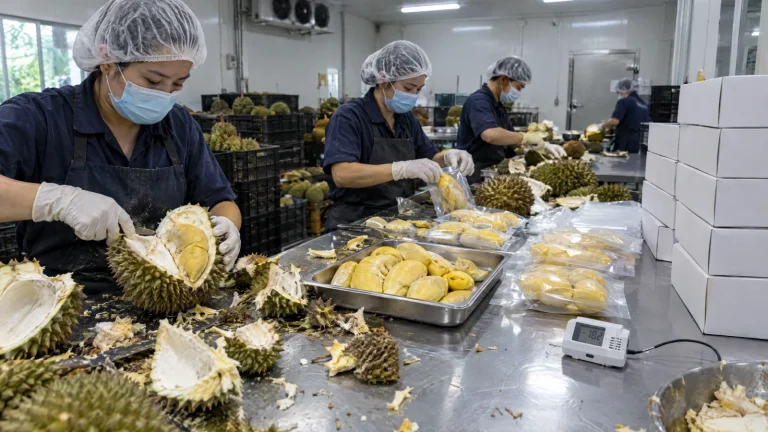
For Vietnamese fruit this lands in an uncomfortable place. The labour advantage of Vietnamese processing is hand peeling and cutting, and workers’ hands are the main route for hepatitis A and norovirus in this industry. The cost advantage and the largest risk sit at the same table. The controls that work are a pre-shift screen for gastrointestinal symptoms, exclusion while symptomatic and, as common practice, for 48 hours after symptoms end, no-touch handwash stations at every clean-zone entry, separation of dirty and clean zones, adequate toilets with water and soap, hepatitis A vaccination for peeling and cutting staff, no reuse of untreated wash water, and recorded training.
For Listeria, BRCGS Food Safety Issue 9, clause 4.11.8, requires a documented environmental monitoring procedure with action limits and trend analysis. Following PROFEL guidance for frozen fruit and vegetables, which is the basis of the zoning below, a four-zone programme typically looks like this:
- Zone 1, product-contact surfaces: post-peel conveyor, knives, freezer belt mesh, packer mouth.
- Zone 2, next to zone 1: frames, machine housings, handles.
- Zone 3, elsewhere in production: floors, drains, forklifts, evaporator bases.
- Zone 4, outside production: corridors, changing rooms, stores.
Ask for the producing plant’s last 3–6 months of results, not only the lot COA. A plant with no environmental monitoring programme does not understand its own risk, and its COA tells you little about it. Certificates such as BRCGS or FSSC 22000 are held by the producing plant, so ask which plant holds them.
What should the microbiology block of a purchase order say?
The microbiology block should state the declared use, then each criterion with its limit, ISO method and sample mass, then the documents that cover what lot testing cannot. Clauses that can go into a purchase order as written, with the bracketed choice made:
- Declared use: [ready-to-eat / ingredient to be heated to ≥75 °C for 30 s before consumption]. The same wording shall appear on the specification, the product label and this contract.
- Salmonella: not detected in [25 / 375] g, ISO 6579-1. L. monocytogenes: not detected in [25 / 125] g, ISO 11290-1 [or ≤100 cfu/g, ISO 11290-2, where the supplier holds a shelf-life study accepted by the importing authority]. Each pathogen result shall state the analytical sample mass.
- TPC [limit] cfu/g, ISO 4833; yeasts and moulds [limit] cfu/g each, ISO 21527; coliforms [limit], ISO 4832; E. coli [limit], ISO 16649. Pathogen testing by a laboratory with the stated methods inside its ISO/IEC 17025 scope.
- A negative re-test on a second portion does not overturn a positive pathogen result on the original.
- With the first lot and quarterly thereafter, the supplier provides the producing plant’s environmental monitoring results for the preceding 3–6 months (zones 1–4, with action limits and trend analysis) and its written worker-health and exclusion policy.
Common questions
Does EU law set a TPC limit for frozen fruit?
The food-safety criteria in Regulation (EC) 2073/2005 for ready-to-eat pre-cut fruit are pathogen criteria: Salmonella not detected in 25 g, and Listeria monocytogenes under the amendment applying from 1 July 2026. The TPC, yeast and mould limits on frozen-fruit specifications come from buyers and procurement documents, such as the USDA Commodity Specification for Frozen Fruit, which sets an aerobic plate count below 50,000/g.
Is IQF mango ready-to-eat under Regulation 2073/2005?
It depends on the declared use, not the product. IQF mango sold for smoothies, toppings or ice cream is ready-to-eat because nobody heats it. The same mango labelled as an ingredient to be heated to at least 75 °C for 30 seconds is not. With no clear heating instruction on the label, treat it as ready-to-eat by default.
Why do buyers ask for Salmonella in 375 g when the law says 25 g?
A presence/absence test analysing 375 g has a higher chance of finding low-level contamination than one analysing 25 g, so they are different tests. Regulation 2073/2005 sets 25 g as the legal floor. Large EU and Japanese buyers commonly specify 375 g for Salmonella and 125 g for Listeria, accepting the higher testing cost in exchange for more assurance.
Does freezing kill Listeria or hepatitis A?
No. An IQF line has no kill step, and freezing only stops micro-organisms multiplying. Listeria monocytogenes survives at minus 18 °C and can grow again during thaw. Hepatitis A and norovirus also survive freezing, which is why the FDA strategy focuses on worker hygiene, sanitation and vaccination.
What should come with a frozen-fruit COA besides the COA?
Ask for the producing plant’s environmental monitoring results for the last three to six months, from a four-zone programme with action limits and trend analysis as BRCGS Issue 9 clause 4.11.8 requires. Ask also for its written worker-health and exclusion policy, with hepatitis A vaccination records where they exist. These cover the hazards a lot COA cannot show.